
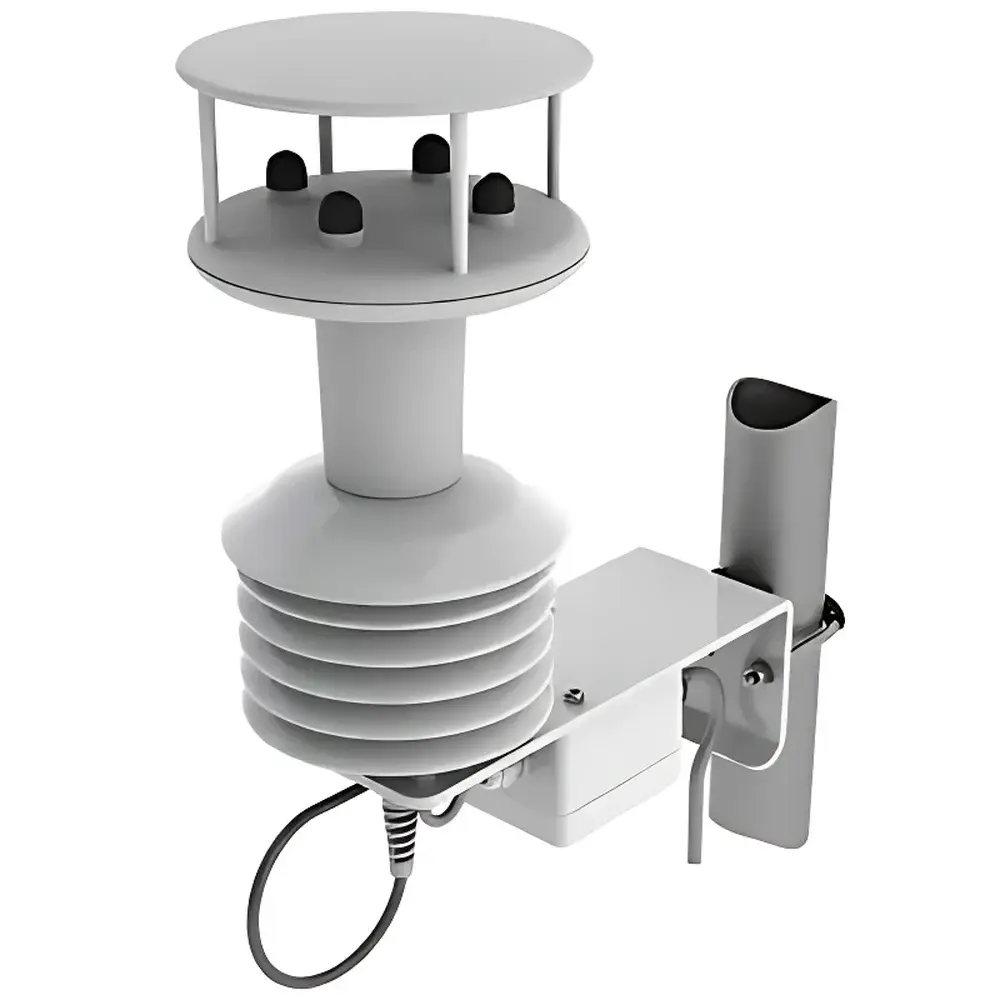
Gill MetPak II Ultrasonic Weather Station
| Brand | Gill |
|---|---|
| Origin | United Kingdom |
| Model | MetPak II |
| Instrument Type | Portable Weather Station |
| Enclosure Rating | IP65 |
| Operating Temperature | −35 °C to +70 °C |
| Power Supply | 5–30 V DC, <16 mA @12 V |
| Output Options | ASCII, NMEA 0183, SDI-12 v1.3, Modbus RTU/ASCII |
| Wind Measurement Principle | Ultrasonic Time-of-Flight (No Moving Parts) |
| Wind Speed Range | 0–60 m/s |
| Wind Direction Range | 0–359° |
| Air Temperature Sensor | Pt100 1/3 Class B (−35 °C to +70 °C, ±0.1 °C accuracy) |
| Relative Humidity Sensor | Rotronic HygroClip HC2-53 (0–100 % RH, ±0.8 % RH @23 °C) |
| Barometric Pressure Sensor | High-stability capacitive sensor (600–1100 hPa, ±0.5 hPa) |
| Dew Point Calculation | Derived from T/RH with ±0.15 °C accuracy @23 °C ambient / 20 °C dew point |
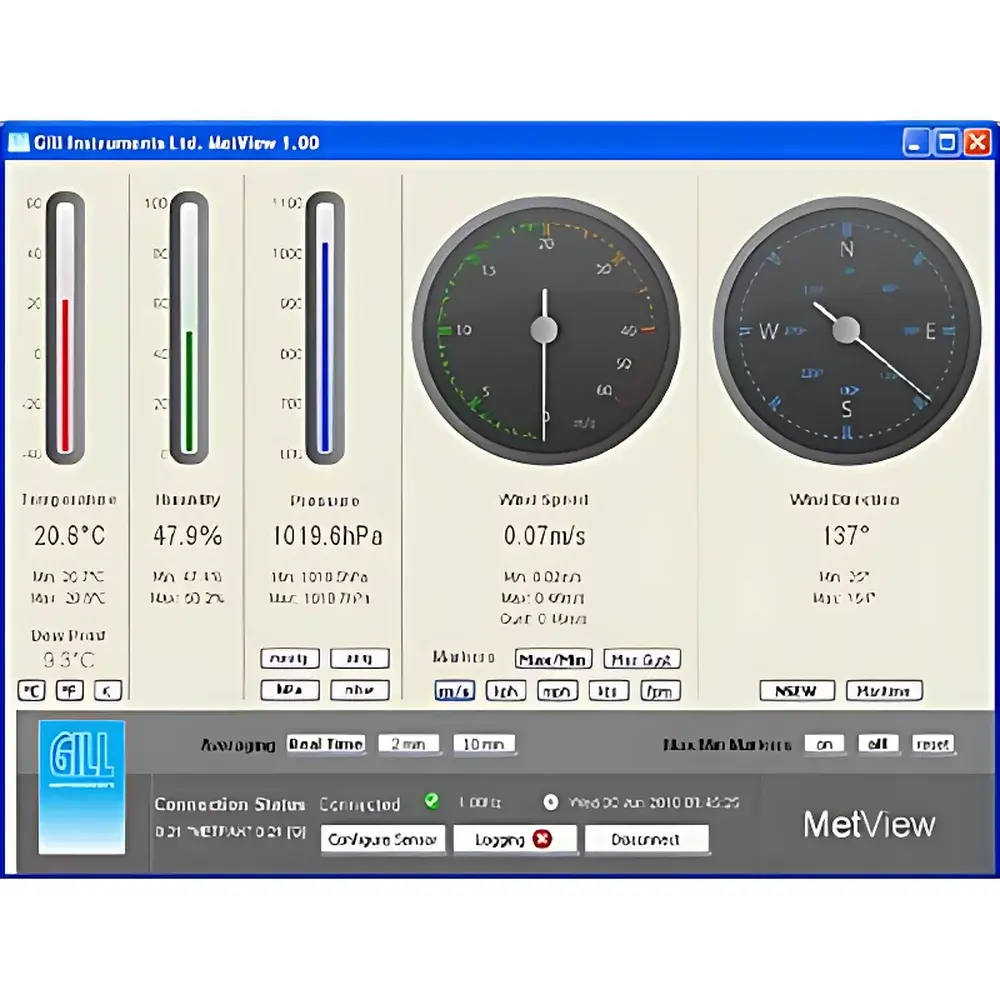
| Data Logging | Via MetView software |
| Configuration | MetSet software |
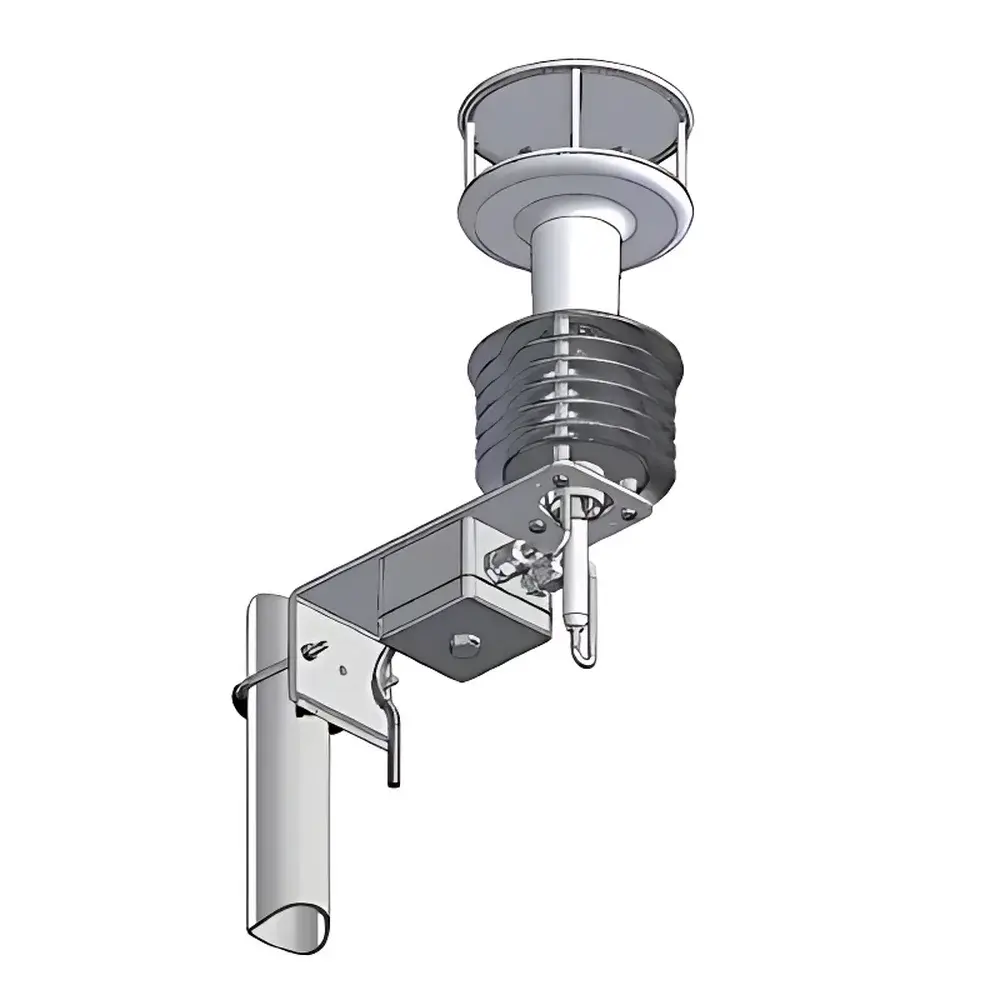
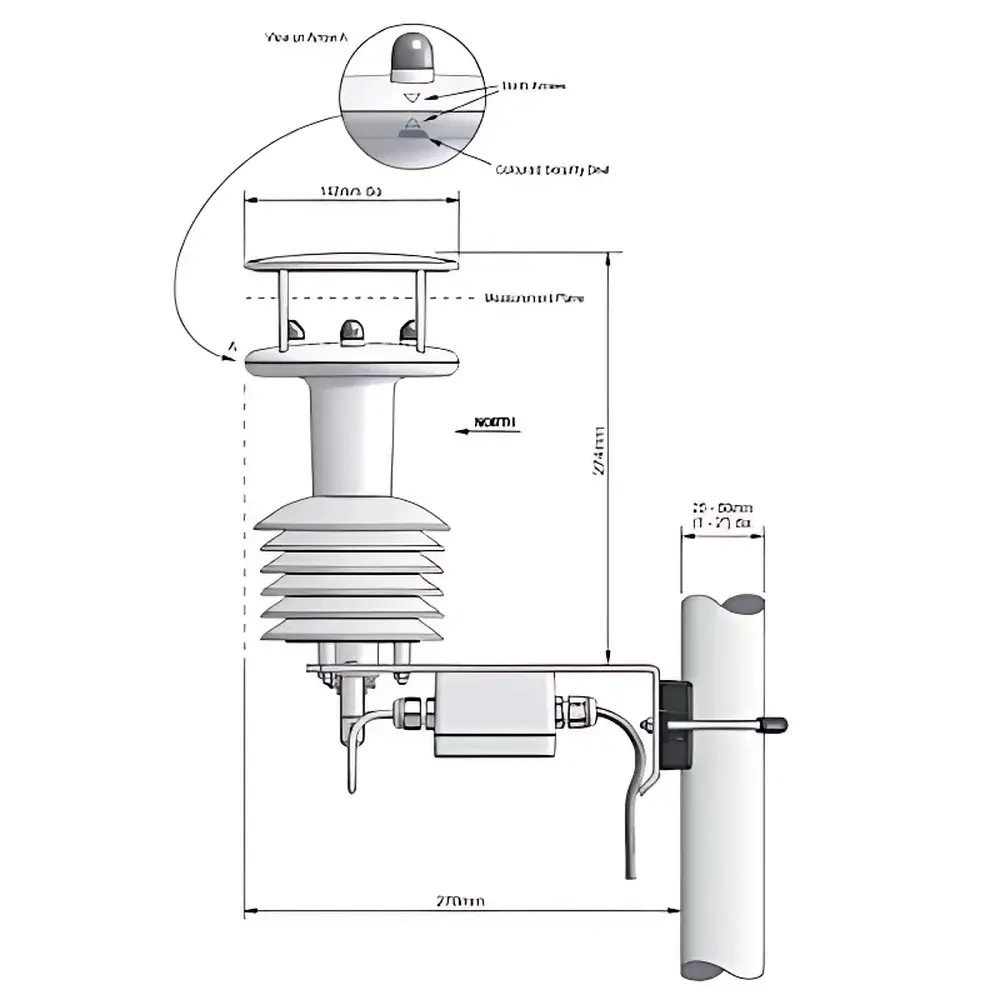
| Mounting | Anodized aluminum U-bracket for vertical masts Ø30–58 mm |
| Weight | 2.1 kg (incl. bracket) |
| Compliance | EN 61326 (EMC), RoHS, CE |
Overview
The Gill MetPak II Ultrasonic Weather Station is a compact, maintenance-free, multi-parameter environmental monitoring system engineered for long-term deployment in remote, harsh, or marine environments. Unlike traditional mechanical anemometers and wind vanes, the MetPak II employs ultrasonic time-of-flight technology—based on Gill’s proprietary WindSonic principle—to measure horizontal wind speed and direction without rotating parts. This solid-state design eliminates mechanical wear, bearing degradation, and icing-related errors, ensuring high reproducibility and operational continuity across extreme temperature gradients (−35 °C to +70 °C) and high-humidity conditions. Integrated sensors include a Pt100 Class B 1/3 temperature probe, a Rotronic HygroClip HC2-53 relative humidity sensor, and a high-stability capacitive barometric pressure transducer. All measurements are synchronized and processed internally, delivering calibrated, time-stamped meteorological data via configurable digital interfaces. The unit’s IP65-rated UV-stabilized housing and anodized aluminum mounting hardware ensure structural integrity under prolonged exposure to salt spray, UV radiation, and mechanical vibration.
Key Features
- Ultrasonic wind sensing with no moving parts—zero mechanical hysteresis, no calibration drift due to bearing wear or ice accumulation
- High-accuracy, traceable metrology: Pt100 temperature sensor (±0.1 °C), Rotronic RH probe (±0.8 % RH @23 °C), and compensated barometric sensor (±0.5 hPa)
- Integrated dew point calculation derived from simultaneous T/RH measurements, compliant with ISO 4677 and WMO Guide to Instruments and Methods of Observation (CIMO Guide)
- Low-power architecture (<16 mA @12 V DC) enabling solar- or battery-powered operation in off-grid locations
- Flexible digital output protocols: ASCII (RS232/RS422/RS485), SDI-12 v1.3, NMEA 0183, and Modbus RTU/ASCII—supporting integration into SCADA, IoT telemetry gateways, and legacy datalogger ecosystems
- Field-configurable sampling intervals (1 s, 2 s, 4 s, or polled mode) and user-selectable units (e.g., m/s, knots, hPa, °F)
- Comprehensive software suite: MetSet (configuration & firmware update) and MetView (real-time visualization, CSV export, and basic trend analysis)—both provided free of charge
Sample Compatibility & Compliance
The MetPak II is designed for unattended outdoor operation in diverse environmental regimes—including coastal zones, alpine stations, offshore platforms, and agricultural research plots. Its sensor fusion architecture ensures minimal cross-sensitivity: thermal mass effects on RH response are mitigated by active thermal shielding; pressure sensor drift is compensated using internal temperature readings; and ultrasonic path geometry minimizes rain-induced attenuation. The instrument complies with EN 61326-1:2013 for electromagnetic compatibility in industrial environments and meets CE marking requirements under the EU Low Voltage and EMC Directives. While not certified for aviation-grade reporting per ICAO Annex 3 or WMO Class I standards, its measurement uncertainty profiles align with WMO Class II specifications for synoptic and climatological applications. Data integrity supports GLP-aligned workflows when used with audit-trail-enabled logging systems.
Software & Data Management
MetView provides real-time display of all six primary parameters (wind speed/direction, temperature, relative humidity, atmospheric pressure, dew point), along with configurable alarm thresholds and on-screen vector wind plots. Data can be logged locally via USB-connected PCs or remotely over RS485 networks. MetSet enables full parameter configuration—including sensor offset correction, output protocol selection, baud rate, and SDI-12 address assignment—without requiring firmware reflash. Both applications run natively on Windows and support export to CSV, MATLAB (.mat), and NetCDF formats. For integration into enterprise environmental monitoring platforms, the MetPak II’s ASCII and Modbus outputs are compatible with common middleware (e.g., Ignition, Node-RED, LabVIEW DAQmx) and cloud ingestion pipelines (e.g., AWS IoT Core, Azure IoT Hub). Optional heating interface kits allow connection to external heated wind sensors for anti-icing in sub-zero maritime deployments.
Applications
- Long-term climate monitoring networks requiring low-maintenance, high-reliability nodes
- Offshore wind farm site assessment and turbine performance validation
- Environmental impact assessments (EIA) for infrastructure projects in sensitive coastal or mountainous terrain
- Research-grade microclimate studies in agriculture, forestry, and glaciology
- Emergency response meteorological support for wildfire management and flood forecasting
- Educational field laboratories where robustness, portability, and pedagogical transparency are essential
FAQ
Is the MetPak II still in production?
No—the MetPak II has been discontinued by Gill Instruments. It remains supported for calibration, repair, and technical documentation access through authorized service partners.
Can the MetPak II operate in freezing conditions with snow or rime ice?
Yes—the ultrasonic wind sensor is inherently immune to ice buildup on transducers. However, for sustained operation below −10 °C in high-humidity or supercooled fog conditions, the optional heating interface kit (for external heated sensors) is recommended.
Does the unit meet FDA 21 CFR Part 11 or EU Annex 11 requirements for electronic records?
The MetPak II itself does not provide electronic signature, audit trail, or role-based access control. Compliance must be implemented at the data acquisition layer (e.g., validated datalogger or LIMS platform) interfacing with its ASCII or Modbus output.
What is the typical calibration interval for field-deployed units?
Gill recommends annual verification against traceable reference standards—particularly for pressure and RH sensors—though many users extend intervals to 24 months in stable, low-contamination environments based on historical drift analysis.
Is third-party software development supported?
Yes—Gill publishes full ASCII and Modbus register maps, SDI-12 command sets, and binary packet structures. All communication protocols are openly documented and do not require licensing for integration.
Related Products







