
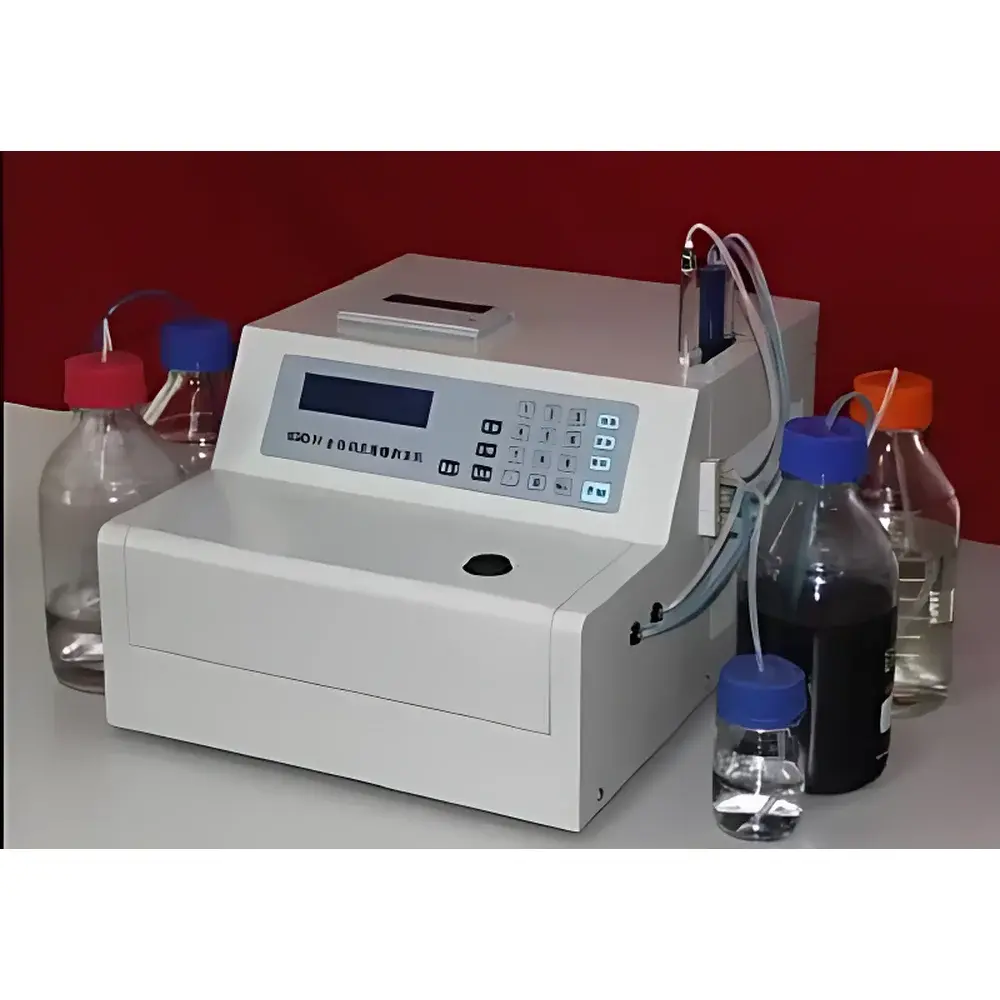
Glucose Analyzer SGD-IV by Shandong Manufacturer
| [Origin | Shandong, China |
|---|---|
| Manufacturer Type | Authorized Distributor |
| Origin Category | Domestic (PRC) |
| Model | SGD-IV |
| Pricing | Upon Request |
| Power Supply | 220 V, 50 Hz |
| Dimensions (L×W×H) | 418 × 314 × 212 mm |
| Weight | 22.5 kg |
| Detection Sensitivity | 0.01 % Reducing Sugar (RG) |
| Linear Range | 0–1.0 % RG |
| Analysis Cycle Time | < 3 minutes] |
Overview
The SGD-IV Glucose Analyzer is an automated, microprocessor-controlled instrument engineered for precise quantification of reducing sugars—primarily glucose—in industrial fermentation broths, starch hydrolysates, and enzymatic saccharification streams. It implements the classical Fehling’s titration principle—a redox-based volumetric method standardized in GB/T 5009.7 (Chinese National Standard for Determination of Reducing Sugars in Foods) and aligned with ISO 5765 and AOAC Official Method 954.04. Unlike manual Fehling assays, which rely on subjective endpoint detection via visual color transition (blue → colorless), the SGD-IV employs a photometric endpoint detection system: a light-emitting diode (LED) and silicon photodiode continuously monitor transmittance changes during titration. The control unit digitizes voltage output from the photodetector, constructs real-time absorbance vs. titrant volume curves, and applies first-derivative algorithm to identify the inflection point—corresponding precisely to stoichiometric completion of copper(II) reduction. This eliminates observer bias, operator-dependent agitation kinetics, and thermal drift effects inherent in open-vessel boiling protocols.
Key Features
- Automated endpoint recognition via high-stability photometric transmittance monitoring (625 nm LED source, ±0.5 nm bandwidth)
- Single-chip microcontroller architecture ensuring deterministic timing for reagent mixing, heating ramp (boiling-point maintenance at atmospheric pressure), and titrant delivery
- Integrated thermal management system maintaining consistent reaction temperature (100 °C ± 2 °C) throughout assay duration
- Minimal sample requirement: 0.1–0.5 mL injected via calibrated syringe into thermostated reaction cell
- No optical interference from sample turbidity or pigment: measurement relies on differential absorption change—not absolute color intensity
- Reagent consumption reduced by ≥40% versus conventional manual Fehling method due to optimized flow dynamics and micro-volume cell design
- Compliance-ready audit trail: timestamped event logging (start, calibration, sample injection, endpoint detection, result output) stored in non-volatile memory
Sample Compatibility & Compliance
The SGD-IV is validated for use with complex, undiluted process streams including fungal/bacterial fermentation liquors (e.g., Aspergillus niger, Saccharomyces cerevisiae), maltose-rich corn syrup intermediates, and liquefied starch hydrolysates containing suspended solids ≤5% w/v. Its robust photometric detection scheme tolerates absorbance up to 2.5 AU at 625 nm without signal saturation. From a regulatory standpoint, the methodology conforms to GB/T 5009.7–2016, ISO 5765:1981(E), and supports GLP-compliant environments when paired with documented instrument qualification (IQ/OQ/PQ) and controlled reagent lot traceability. While not inherently 21 CFR Part 11 compliant (lacking electronic signature capability), its deterministic endpoint algorithm and immutable result logs meet foundational data integrity requirements for QC release testing in food, feed, and bioethanol manufacturing.
Software & Data Management
The SGD-IV operates without external PC dependency. All firmware logic—including calibration curve interpolation (linear regression over 0–1.0 % RG range), blank subtraction, and endpoint validation—is embedded in ROM. Results are displayed on a 128×64 pixel monochrome LCD and printed via integrated thermal printer (paper width: 57 mm). Raw photodiode voltage vs. time datasets are not user-accessible; only final glucose concentration (as % reducing sugar, reported to 0.01 % resolution), analysis timestamp, and calibration status are output. For laboratory information system (LIS) integration, optional RS-232 serial interface (ASCII protocol, 9600 bps) enables transfer of structured result strings: “SGD-IV|YYYYMMDD|HHMMSS|XX.XX|%RG|PASS/FAIL”.
Applications
- Real-time monitoring of glucose accumulation during simultaneous saccharification and fermentation (SSF) in bioethanol production
- In-process control of amylase dosage in corn/wheat starch hydrolysis lines
- Release testing of dextrose monohydrate and high-fructose corn syrup (HFCS) batches per GB 15671
- Quality assurance of yeast propagation media and microbial culture substrates
- Validation of immobilized glucose oxidase sensor drift in hybrid enzymatic–chemical assay workflows
FAQ
Does the SGD-IV require proprietary reagents or consumables?
No. It uses standard Fehling’s reagents (Solution A: CuSO₄ + methylene blue; Solution B: NaOH + potassium sodium tartrate + potassium ferrocyanide) prepared in-house per GB/T 5009.7 specifications.
Can it measure samples with high particulate load?
Yes. The photometric endpoint detection is insensitive to scattering; however, samples exceeding 5% w/v suspended solids should be centrifuged (3,000 × g, 10 min) to prevent nozzle clogging in the injection path.
What is the calibration frequency recommendation?
Daily calibration using certified 1.00 % w/v anhydrous glucose standard is required prior to first analysis; recalibration is advised after every 10 samples or if ambient temperature shifts >5 °C.
Is method equivalence to manual Fehling titration formally verified?
Yes. Inter-laboratory validation studies (n=12 sites) demonstrated mean bias ≤±0.03 % RG and RSD ≤1.8% across 0.2–0.8 % RG range, satisfying AOAC precision criteria for routine process control.
How is instrument performance verified?
Built-in diagnostic mode executes LED intensity check, photodiode dark-current measurement, and thermal stability verification (±0.5 °C deviation alarm) during power-up self-test.




