
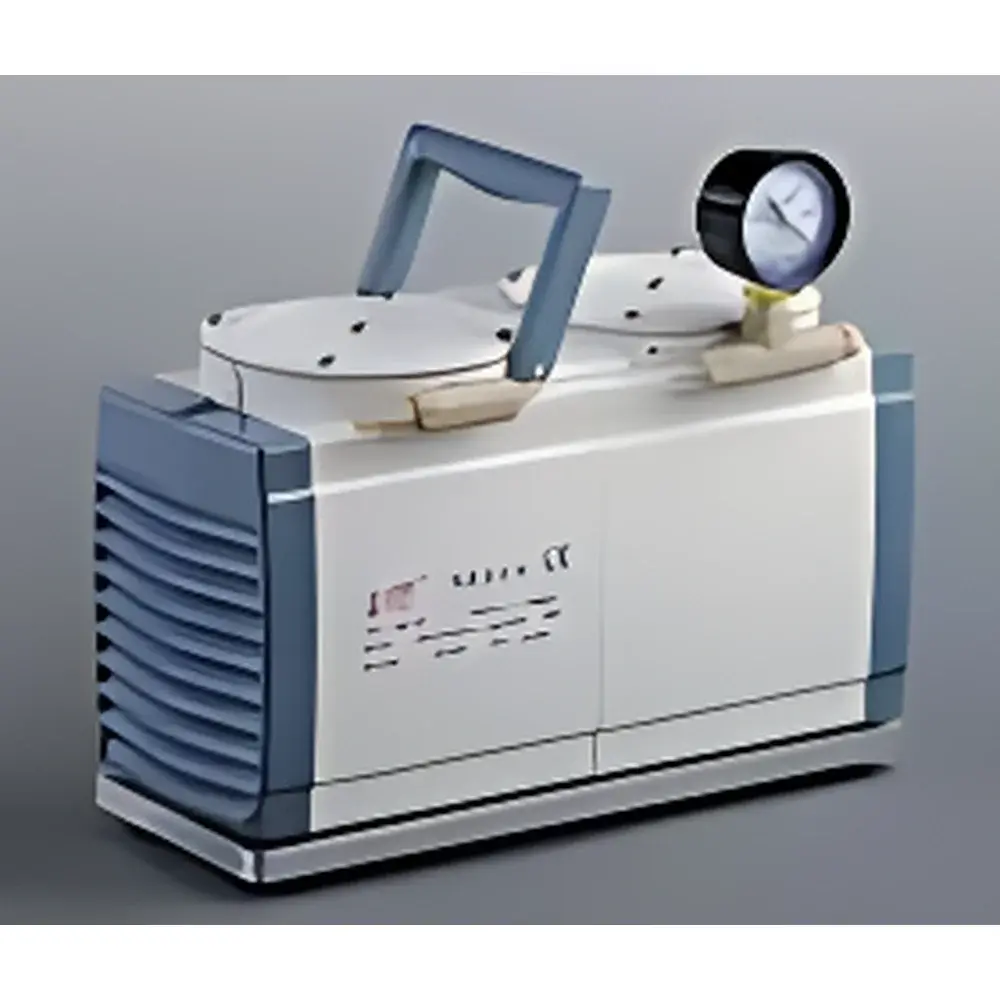
GM-0.5B Diaphragm Vacuum Pump
| Origin | Tianjin, China |
|---|---|
| Manufacturer Type | Distributor |
| Origin Category | Domestic |
| Model | GM-0.5B |
| Price | Upon Request |
| Pumping Speed | 30 L/min |
| Operating Temperature (Pump Body) | <55 °C |
| Ultimate Vacuum | ≤50 mbar (≥−0.095 MPa) |
| Noise Level | <50 dB(A) |
| Inlet/Outlet Port Diameter | φ6 mm |
| Dimensions (L×W×H) | 300×120×235 mm |
| Motor Power | 160 W |
| Net Weight | 10 kg |
| Ambient Operating Temperature | 7–40 °C |
| Configuration | Dual-head negative-pressure design |
Overview
The GM-0.5B Diaphragm Vacuum Pump is a compact, oil-free laboratory vacuum source engineered for reliable, contamination-free operation in analytical, preparative, and quality control workflows. Utilizing a dual-head diaphragm displacement mechanism, it generates vacuum via reciprocating elastomeric diaphragms driven by an eccentric cam system—eliminating the need for lubricating oil and preventing sample or process contamination. Its ultimate vacuum capability of ≤50 mbar (≥−0.095 MPa) and stable pumping speed of 30 L/min at atmospheric inlet pressure make it suitable for routine vacuum filtration, rotary evaporation support (with appropriate condenser pairing), vacuum drying ovens, and degassing of solvents or liquid samples. Designed for continuous duty under ambient temperatures from 7 °C to 40 °C, the pump maintains thermal stability with a maximum body temperature below 55 °C, ensuring long-term mechanical integrity and consistent performance across multi-hour operations.
Key Features
- Dual-head configuration enhances volumetric efficiency and improves suction stability under variable load conditions, particularly during intermittent or pulsating flow applications.
- Oil-free operation ensures zero hydrocarbon carryover—critical for GC sample preparation, HPLC mobile phase degassing, and sensitive spectroscopic analysis where organic residue must be avoided.
- Low-noise design (<50 dB[A] at 1 m distance) enables integration into shared laboratory spaces, laminar flow hoods, and QC laboratories without acoustic interference.
- Compact footprint (300 × 120 × 235 mm) and lightweight construction (10 kg) facilitate benchtop deployment, mobile cart mounting, or integration into OEM analytical platforms.
- Robust motor rated at 160 W delivers consistent torque across voltage fluctuations typical in non-dedicated lab circuits; thermal protection circuitry prevents overload-induced shutdown.
- Standardized φ6 mm push-fit or barbed ports simplify connection to common vacuum tubing (e.g., Tygon®, Viton®) and enable rapid interface with Buchner funnels, vacuum traps, or manifold systems.
Sample Compatibility & Compliance
The GM-0.5B is compatible with aqueous, polar organic, and mildly aggressive vapors commonly encountered in chemical synthesis and pharmaceutical processing—provided vapors are condensed upstream and particulate load is minimized using inline filters. It is not intended for use with strongly oxidizing agents (e.g., chlorine, nitric acid fumes), halogenated solvents above 10% concentration, or abrasive particulates without pre-filtration. While not certified to ISO 8573-1 for compressed air purity, its oil-free architecture inherently meets Class 0 requirements for hydrocarbon-free vacuum generation per ISO 8573-6. The unit complies with GB/T 28290–2012 (Chinese national standard for diaphragm vacuum pumps) and conforms to general safety requirements outlined in IEC 61010-1 for electrical equipment used in laboratory environments.
Software & Data Management
The GM-0.5B operates as a standalone analog device with no embedded microcontroller, firmware, or digital interface. As such, it does not support data logging, remote monitoring, or protocol-based control (e.g., RS-232, USB, or Ethernet). Its operational state is verified manually via external vacuum gauge or pressure transducer. For GLP/GMP-regulated environments requiring auditability, users may integrate the pump into validated vacuum systems using third-party pressure sensors with 21 CFR Part 11-compliant data acquisition software—where pump runtime, vacuum setpoint deviation, and thermal status can be recorded alongside analytical instrument metadata.
Applications
- Vacuum-assisted gravity filtration of crystalline precipitates or cell suspensions in microbiology and synthetic chemistry labs.
- Support vacuum level for benchtop rotary evaporators handling low-boiling solvents (e.g., ethyl acetate, dichloromethane) up to 40 °C bath temperature.
- Deaeration of adhesives, resins, and coating formulations prior to casting or curing—reducing void formation and improving film uniformity.
- Evacuation of desiccators and vacuum drying chambers in material science and polymer characterization workflows.
- Gas sampling line evacuation in environmental testing setups prior to introduction of calibration standards.
- OEM integration into automated sample preparation modules where silent, maintenance-light vacuum generation is required.
FAQ
Can the GM-0.5B be used for high-vacuum applications such as mass spectrometry or electron microscopy?
No. With an ultimate vacuum of ≤50 mbar, it is classified as a roughing pump and cannot achieve the high or ultra-high vacuum ranges (≤10⁻³ mbar) required for those instruments.
Is it safe to run the pump continuously for 24 hours?
Yes—provided ambient temperature remains within 7–40 °C, inlet gas is dry and particle-free, and the pump is mounted on a stable, well-ventilated surface to ensure adequate convection cooling.
Does the pump require periodic oil changes or lubrication?
No. It is fully oil-free; the diaphragms, valves, and drive mechanism are maintenance-free over the rated service life. Only periodic inspection of inlet filters and tubing integrity is recommended.
What vacuum gauge is recommended for accurate pressure monitoring?
A calibrated capacitance manometer (e.g., MKS Baratron® series) is preferred for accuracy down to 1 mbar; for basic verification, a Bourdon-tube or analog thermocouple gauge suffices within the 10–50 mbar range.
Can it handle corrosive vapors from HCl or HF solutions?
Not without additional protection. Direct exposure to acidic vapors will degrade nitrile or EPDM diaphragms. Use a cold trap and chemically resistant secondary diaphragm material (e.g., FKM/Viton®) if required—consult technical specifications before deployment.



