
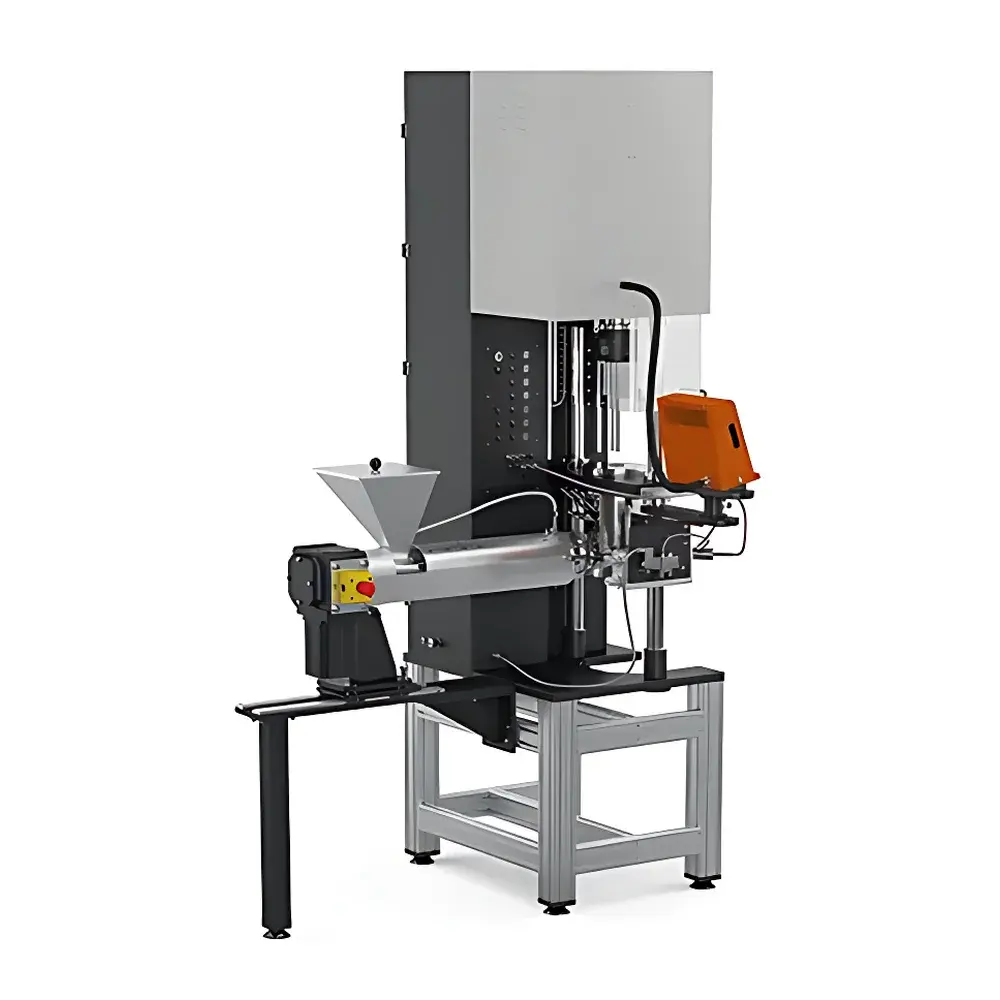
Goettfert CONTIFEED Automated Feeding System
| Brand | Goettfert |
|---|---|
| Origin | Germany |
| Model | CONTIFEED |
| Feed Screw Configuration | D20×10D or D20×25D |
| Mounting Position | Rear-mounted to Goettfert RG50 Capillary Rheometer |
| External Cooling | Optional liquid cooling circuit for rapid thermal stabilization of feed zone |
| Design | Compact, modular, tool-free disassembly for cleaning |
| Compliance | Engineered for ISO 11443, ASTM D3835, and ISO 6721-6 compliant capillary rheometry workflows |
Overview
The Goettfert CONTIFEED Automated Feeding System is an integrated, precision-engineered peripheral designed exclusively for capillary rheometers—particularly the Goettfert RG50 series. It operates on the principle of controlled volumetric extrusion, utilizing a calibrated feed screw (available in D20×10D or D20×25D configurations) to deliver thermoplastic melt directly into the capillary die assembly under defined pressure and temperature conditions. Unlike manual loading or gravity-fed systems, the CONTIFEED eliminates air entrapment at the die entry, ensuring bubble-free material introduction and reproducible flow initiation. Its rear-mount architecture positions the extruder immediately downstream of the RG50’s barrel, minimizing dead volume and thermal lag. This configuration enables true process-simulative testing—where pre-shearing, residence time control, and thermal history are preserved in alignment with industrial extrusion or injection molding conditions.
Key Features
- Direct melt feeding via precision-machined feed screw (D20×10D or D20×25D), eliminating manual plunger insertion and associated variability
- Rear-mounted integration with Goettfert RG50 capillary rheometer, preserving thermal continuity and minimizing axial temperature gradients
- Optional external liquid cooling circuit for rapid thermal stabilization of the feed zone—critical for heat-sensitive polymers and low-viscosity melts
- Compact footprint with modular subassemblies enabling tool-free disassembly; all wetted components are accessible for full cleaning without calibration loss
- Ergonomic operator interface with intuitive mechanical actuation and visual feed status indicators—designed for high-throughput lab environments with minimal training overhead
- Thermally isolated feed chamber to decouple screw heating from barrel temperature control, supporting independent optimization of pre-shearing and capillary flow zones
Sample Compatibility & Compliance
The CONTIFEED accommodates standard thermoplastic pellets, granules, and regrind—compatible with polyolefins, engineering thermoplastics (e.g., PA6, PBT, PC), thermoplastic elastomers, and filled compounds. Its feed geometry and torque-controlled drive ensure consistent feeding of materials exhibiting wide viscosity windows (10²–10⁶ Pa·s at test shear rates). The system complies with core standards governing capillary rheometry: ISO 11443 (determination of apparent viscosity), ASTM D3835 (plastic melt flow rates), and ISO 6721-6 (dynamic mechanical properties). When operated within a validated RG50 platform, it supports GLP-compliant data generation, including audit-trail-enabled temperature/pressure/time stamping per FDA 21 CFR Part 11 requirements when paired with Goettfert’s WinRHEO software.
Software & Data Management
The CONTIFEED functions as a hardware-coupled subsystem within Goettfert’s WinRHEO software environment. WinRHEO provides synchronized control of screw rotation speed, barrel zone temperatures, backpressure monitoring, and capillary pressure transduction—all time-stamped and logged with millisecond resolution. Raw data streams include real-time torque feedback, feed displacement, and melt temperature at the die entrance. Export formats include ASCII (.txt), CSV, and XML, fully compatible with third-party statistical analysis tools (e.g., JMP, MATLAB) and LIMS integration via ODBC drivers. All parameter changes are recorded in an immutable audit trail, fulfilling traceability requirements for ISO/IEC 17025-accredited laboratories.
Applications
- Process-simulative rheological characterization: Pre-shearing and residence time control replicate extruder feed section behavior prior to capillary flow measurement
- PVT (Pressure-Volume-Temperature) analysis under shear, where precise melt density and compressibility must be determined at processing-relevant shear histories
- Thermal stability assessment: Reduced dwell time at elevated temperatures minimizes thermal degradation—enabling reliable measurement of heat-sensitive biopolymers and flame-retardant formulations
- Quality control of compound homogeneity: Dry-blended or masterbatch formulations can be fed without pre-drying, with feed consistency serving as an indirect indicator of blend uniformity
- Development of predictive flow models: High-fidelity input data for computational fluid dynamics (CFD) simulations of extrusion dies and manifold systems
FAQ
Can the CONTIFEED be retrofitted to non-Goettfert capillary rheometers?
No—it is mechanically and electronically engineered for direct integration with the RG50 platform, including proprietary mounting interfaces, signal synchronization protocols, and thermal zoning logic.
Does the system support nitrogen purge or inert atmosphere operation?
Yes—optional gas inlet ports are available on the feed hopper and barrel cover, compatible with standard laboratory nitrogen purging setups to prevent oxidative degradation during high-temperature testing.
What maintenance intervals are recommended for the feed screw and barrel?
Goettfert recommends visual inspection after every 50 test cycles and full disassembly/cleaning every 200 cycles—or more frequently when processing abrasive or carbon-filled compounds.
Is feed rate programmable independently of capillary pressure?
Yes—WinRHEO allows independent definition of screw RPM profiles (ramp, hold, step) while maintaining closed-loop pressure control at the capillary entrance, enabling multi-stage pre-shearing protocols.
How does the CONTIFEED improve repeatability in apparent viscosity measurements?
By eliminating operator-dependent manual loading, reducing entrapped air by >95%, and limiting thermal exposure time to ≤15 seconds before flow initiation, it reduces inter-test standard deviation in ηapp by up to 40% compared to conventional plunger loading methods.



