
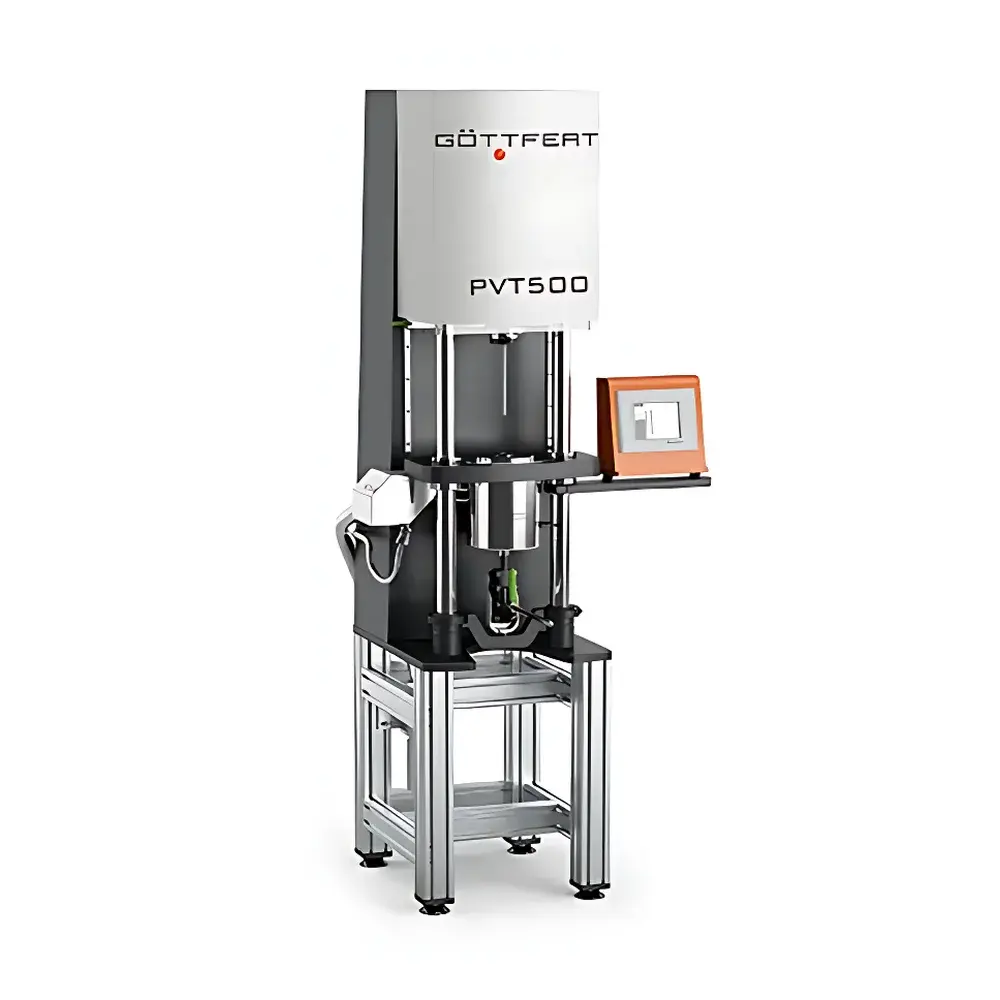
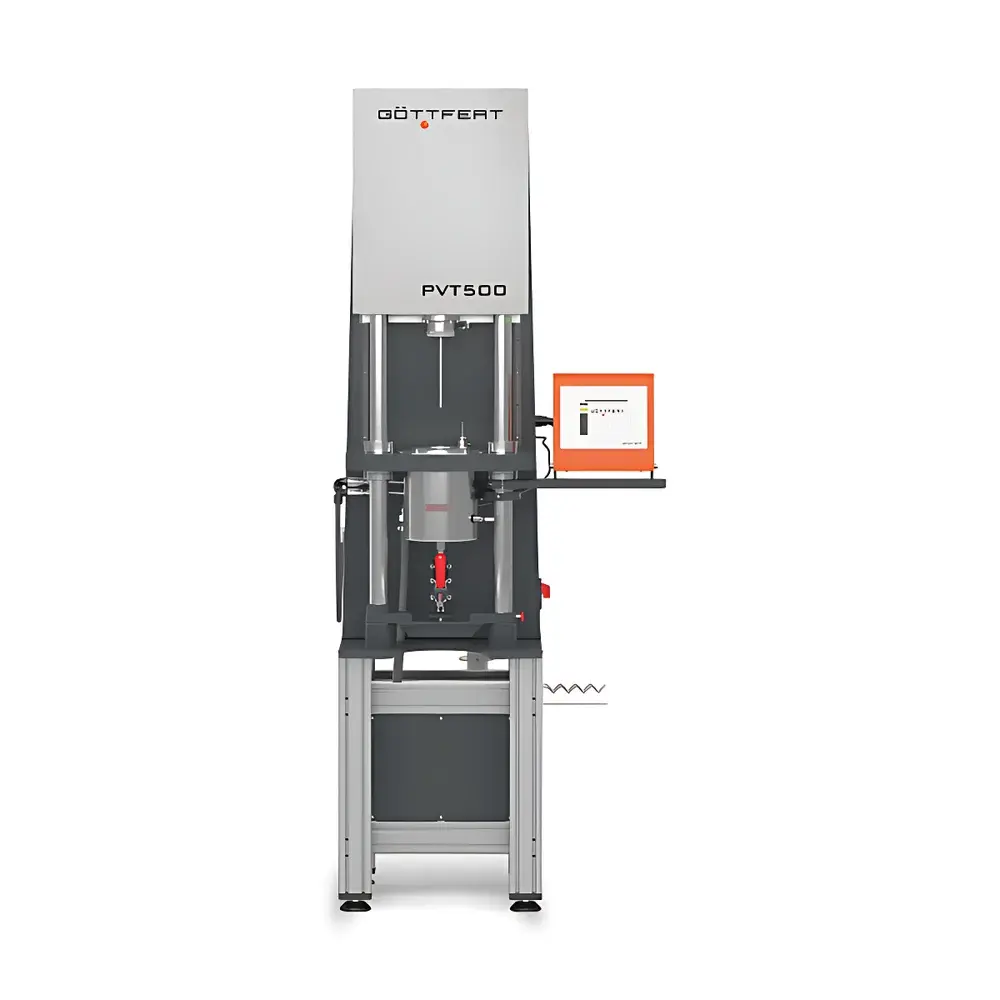
Goettfert PVT500 High-Pressure PVT Analyzer
| Brand | Goettfert |
|---|---|
| Origin | Germany |
| Model | PVT500 |
| Maximum Force | 20 kN |
| Barrel Diameter | 9.55 ± 0.01 mm |
| Effective Barrel Length | 170 mm |
| Piston Diameter | 9.53 ± 0.01 mm |
| Temperature Range | Ambient to 500.00 °C |
| Displacement Resolution | 0.053 µm |
| Minimum Velocity | 0.1 µm/s |
| Frame Stiffness | 130 kN |
| Cooling Rate (Compressed Air) | Up to 30 K/min |
| Dimensions (L×W×H) | 798 × 575 × 1945 mm |
| Weight | ~300 kg |
Overview
The Goettfert PVT500 is a high-precision, high-pressure PVT (Pressure–Volume–Temperature) analyzer engineered for quantitative characterization of thermoplastic and thermosetting polymer melts under controlled thermal and mechanical conditions. It operates on the fundamental principle of volumetric compression measurement: by applying precisely regulated axial force to a confined polymer melt column within a thermostatically stabilized barrel, the instrument records real-time changes in specific volume as functions of temperature and pressure. This enables rigorous derivation of PVT equations of state—critical inputs for injection molding simulation software (e.g., Moldflow, Autodesk Simulation), shrinkage prediction, warpage analysis, and process window optimization. Unlike conventional dilatometers or simple expansion testers, the PVT500 implements true isothermal and isobaric test protocols per ISO 22007-4, ASTM D5930 (Thermal Conductivity), and DIN ISO 48, ensuring metrological traceability and compliance with international material qualification frameworks.
Key Features
- High-force electromechanical actuation system delivering up to 20 kN with closed-loop load control and <1% full-scale accuracy
- Optimized 9.55 mm nominal bore barrel (tolerance ±0.01 mm) and matched 9.53 mm piston (±0.01 mm), minimizing wall slip and shear-induced artifacts during compression
- Sub-micron displacement resolution of 0.053 µm via high-stability linear variable differential transformer (LVDT) sensor, enabling detection of volumetric changes below 0.001% relative to initial melt volume
- Dual-mode thermal management: integrated electric heating jacket with active air-cooling capable of controlled cooling rates up to 30 K/min—essential for replicating realistic mold cooling profiles
- Rigid 130 kN frame architecture with minimized thermal drift and mechanical hysteresis, ensuring long-term repeatability across multi-day PVT cycles
- Dynamic speed range from 0.1 µm/s to 30 mm/s, supporting both quasi-static equilibrium measurements and transient compression/decompression kinetics
Sample Compatibility & Compliance
The PVT500 accommodates standard granular or pelletized thermoplastics (e.g., PP, PE, PC, PA6, PEEK), thermoset prepolymers, and filled compounds (glass-, mineral-, or carbon-reinforced). Sample preparation follows ISO 22007-4 guidelines: pre-drying per material specification, degassing under vacuum prior to loading, and precise mass calibration using certified analytical balances. All measurement protocols are fully compliant with ASTM D5930 (for thermal conductivity add-on), DIN ISO 48 (for rubber compound characterization), and ISO 22007-4 (for plastics—determination of thermal diffusivity and specific heat capacity). Data acquisition and reporting support GLP/GMP audit trails when integrated with validated software environments meeting FDA 21 CFR Part 11 requirements.
Software & Data Management
Control and analysis are performed via Goettfert’s proprietary WinPVT software, which provides real-time visualization of PVT curves, automatic phase transition detection (melting, crystallization, glass transition), and export of ASCII/CSV datasets compatible with CAE preprocessing tools. The software enforces user role-based access control, electronic signatures, and immutable audit logs—including timestamped parameter changes, calibration events, and raw sensor data archives. Raw displacement, force, and temperature time-series are stored at ≥10 Hz sampling rate, permitting post-hoc reprocessing using alternative equation-of-state models (e.g., Tait, Sanchez–Lacombe, or modified Bueche formulations).
Applications
- Generation of high-fidelity PVT databases for injection molding simulation and DOE-driven process optimization
- Root-cause analysis of dimensional instability—e.g., sink marks, void formation, and anisotropic shrinkage—in complex thin-walled parts
- Validation of material supplier datasheets under actual processing-relevant pressure–temperature histories
- Development of custom PVT models for novel bio-based or recycled polymer blends where commercial databases are incomplete
- Supporting regulatory submissions requiring evidence of thermal–mechanical consistency across production lots (e.g., automotive PP composites per VDA 277)
FAQ
What standards does the PVT500 comply with for PVT data generation?
The instrument meets the procedural and metrological requirements of ISO 22007-4, ASTM D5930 (when equipped with thermal conductivity module), and DIN ISO 48 for volumetric behavior characterization.
Can the PVT500 be used for cross-linked polymers or thermosets?
Yes—provided samples are loaded in uncured or partially cured states and tested below gelation temperature; isothermal hold protocols allow monitoring of cure-induced volume changes.
Is external temperature control required for sub-ambient testing?
No—standard operation covers ambient to 500 °C; for sub-ambient studies, optional integration with external cryogenic circulators is available.
How is sample degradation prevented during high-temperature PVT tests?
The system includes programmable nitrogen purge capability and short-cycle thermal profiling to minimize residence time at peak temperatures, reducing oxidative degradation risk.
Does WinPVT support automated report generation for quality documentation?
Yes—templates conform to ISO/IEC 17025 reporting requirements, including uncertainty budgets derived from sensor specifications and environmental monitoring logs.



