
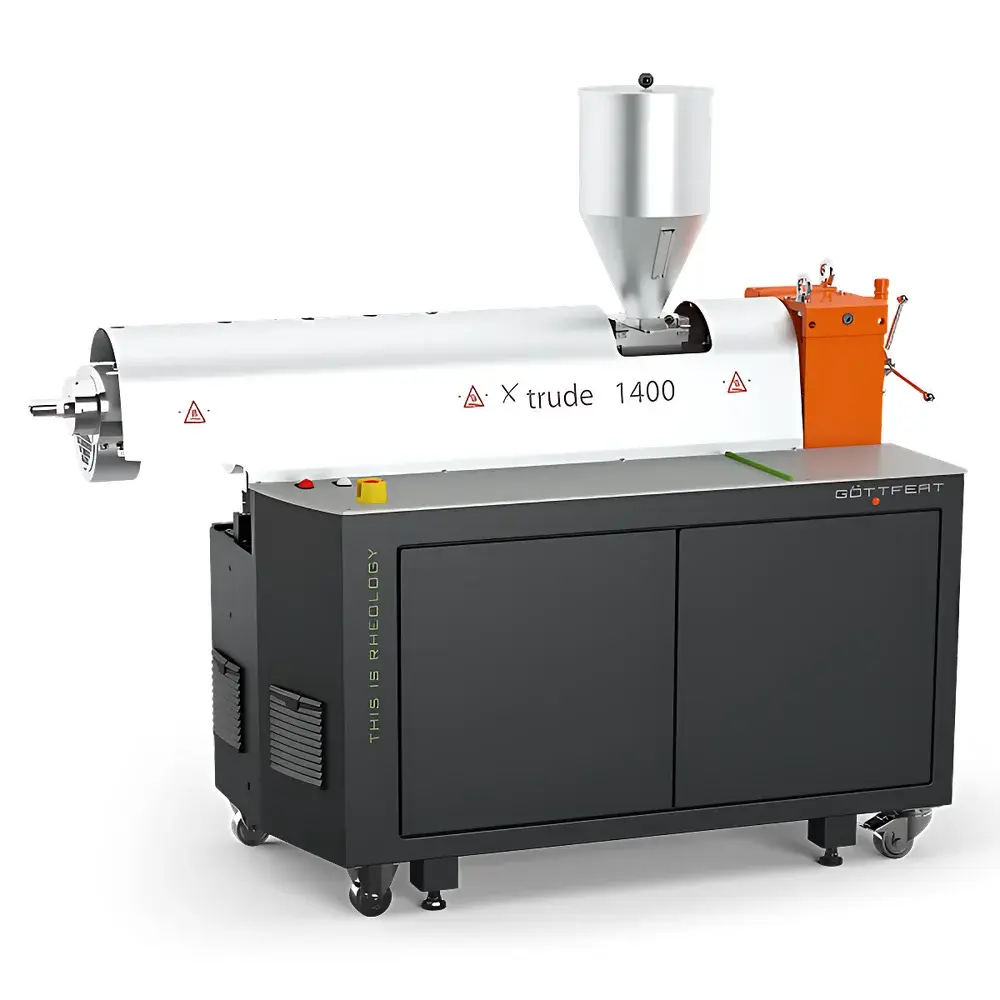
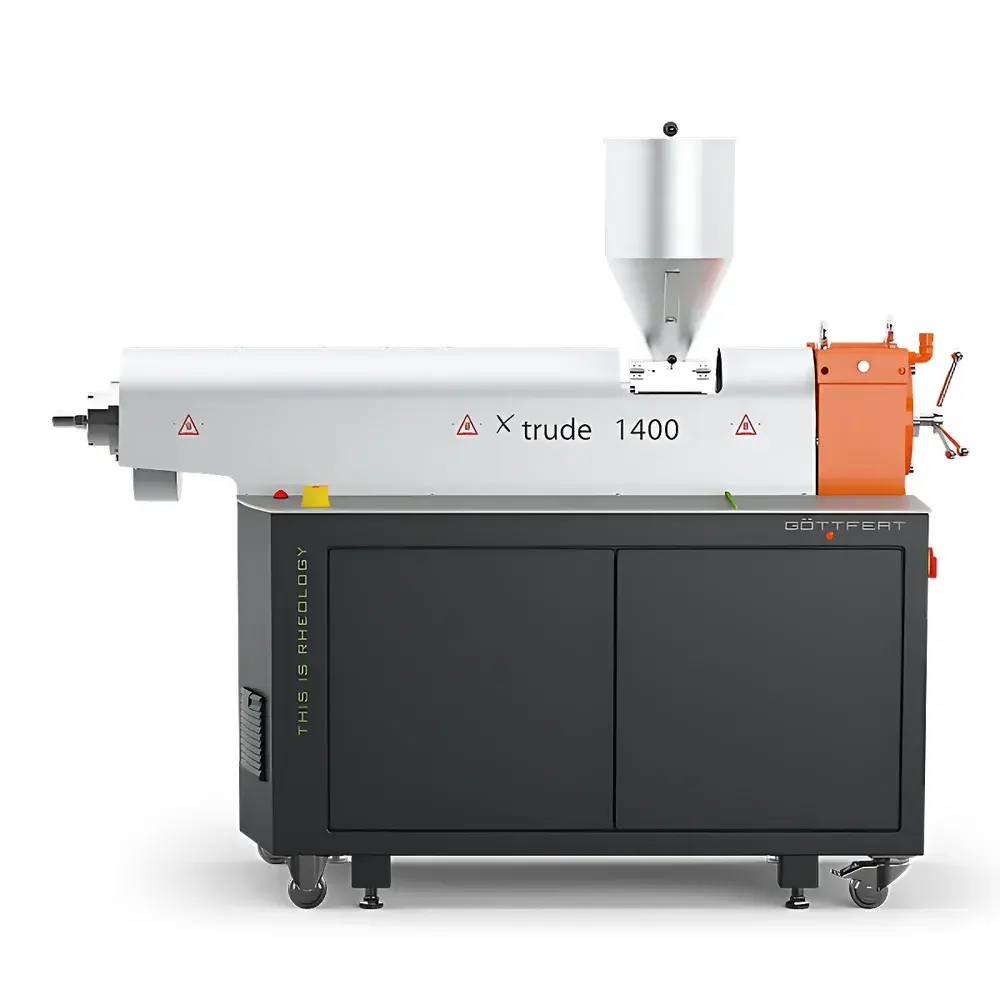
Goettfert X-Trude 1400 Twin-Screw Extruder for Polymer Rheology and Process Simulation
| Brand | Goettfert |
|---|---|
| Origin | Germany |
| Model | X-Trude 1400 |
| Torque | 1400 N·m |
| Max. Screw Speed | 0–120 rpm |
| Power Output | 17 kW |
| Screw Diameter | 45 mm |
| Temperature Range | 60–350 °C (0.1 °C resolution) |
| Heating Zones | 16 independent zones |
| Cooling Zones | 4 liquid-cooled zones |
| Pressure Sensor Options | 0–100 / 0–200 / 0–500 / 0–1000 bar (±0.5% FS accuracy) |
| Dimensions (L×W×H) | 1580 × 600 × 1300 mm |
| Weight | 800 kg |
| Control Interface | Touchscreen + PC via ROSWIN software |
Overview
The Goettfert X-Trude 1400 is a high-torque, precision-engineered twin-screw extruder designed for advanced polymer rheology characterization and laboratory-scale process simulation. Built upon Goettfert’s 50+ years of expertise in rotational and capillary rheometry, the X-Trude platform integrates real-time melt-state monitoring with modular downstream compatibility. Unlike conventional single-screw extruders, the X-Trude 1400 employs a co-rotating twin-screw configuration optimized for homogeneous melting, controlled residence time distribution, and minimal thermal degradation—critical for evaluating shear-thinning behavior, extensional viscosity sensitivity, and melt elasticity of thermoplastics, elastomers, and reactive polymer systems. Its core architecture supports both standalone operation as a feed extruder and seamless integration into hybrid test lines, enabling synchronized data acquisition across coupled instruments such as online capillary rheometers (e.g., RheoScope), melt strength testers, film casting units, and extensional rheometers (e.g., Sentmanat Extensional Rheometer, SER).
Key Features
- 1400 N·m nominal torque output at the drive shaft, enabling stable processing of highly viscous or filled polymer melts—including engineering resins, carbon-black-loaded rubbers, and glass-fiber composites.
- Modular barrel system with interchangeable 45 mm screw configurations (conveying, mixing, kneading, reverse-thread elements) to tailor shear history and dispersive/distributive mixing intensity per application.
- 16 independently controlled heating zones and 4 actively cooled zones using closed-loop liquid cooling, ensuring precise axial temperature profiling from feed throat to die exit (60–350 °C range; ±0.1 °C setpoint stability).
- Integrated pressure transducers mounted at multiple axial positions (die entry, metering zone, vent port) with selectable full-scale ranges (100–1000 bar) and traceable calibration per ISO 17025-accredited procedures.
- Real-time calculation and display of fundamental rheological variables—including apparent shear rate (γ̇), wall shear stress (σ), and apparent viscosity (η)—derived from torque, pressure, and rotational speed inputs using standard capillary flow equations (Bagley, Rabinowitsch, Weissenberg corrections applied).
- ROSIN-compatible control architecture supporting dual-mode operation: local touchscreen HMI for rapid setup and remote PC-based supervision with automated script execution, data logging, and alarm management.
Sample Compatibility & Compliance
The X-Trude 1400 accommodates a broad spectrum of polymeric materials, including but not limited to polyolefins (PP, PE), styrenics (PS, ABS), engineering thermoplastics (PA6/66, PBT, PC), thermoplastic elastomers (TPEs), biopolymers (PLA, PHA), and reactive systems (polyurethane prepolymers, epoxy formulations). Feed forms include pellets, granules, flakes, and powder blends. All wetted components comply with FDA 21 CFR 177.2400 for food-contact polymer processing validation. The system meets CE machinery directive 2006/42/EC and electromagnetic compatibility (EMC) requirements per EN 61000-6-2/-4. Pressure sensor calibrations adhere to ISO 9001:2015 quality management protocols, and ROSWIN software supports audit trails, electronic signatures, and 21 CFR Part 11-compliant data integrity for GLP/GMP-regulated environments.
Software & Data Management
ROS WIN (Rheology Operating System for Windows) serves as the native control and analysis suite. It provides synchronized acquisition of torque, pressure, temperature, screw speed, and motor current at up to 100 Hz sampling frequency. Raw data is stored in vendor-neutral .csv format with embedded metadata (timestamp, operator ID, method name, calibration IDs). Advanced features include automatic start/stop triggers based on melt pressure thresholds, real-time viscosity vs. shear rate curve generation, batch comparison overlays, and export-ready reporting templates aligned with ASTM D3835 (extrusion plastometer), ISO 11443 (injection molding simulation), and ISO 2536 (film extrusion performance). Data archives are structured for long-term retrieval and support third-party integration via OPC UA or TCP/IP socket protocols.
Applications
- Correlation of lab-scale extrusion response with industrial twin-screw processing parameters (e.g., specific mechanical energy, SME; melt temperature profiles).
- Evaluation of thermal stability and degradation onset during extended residence time experiments under nitrogen or vacuum.
- Characterization of filler dispersion quality through pressure fluctuation analysis and torque ripple quantification.
- Calibration and validation of computational fluid dynamics (CFD) models for screw geometry optimization.
- Development of masterbatches and color concentrates requiring precise pigment dispersion and rheological matching.
- Testing of biodegradable polymers under controlled moisture and oxygen conditions using optional purge/vacuum modules.
FAQ
Can the X-Trude 1400 be used with non-Goettfert downstream instruments?
Yes—the extruder features standardized flange interfaces (DIN 28178, ISO 2852) and analog/digital I/O ports (0–10 V, 4–20 mA, RS485 Modbus RTU) for bidirectional communication with third-party rheometers, viscometers, or inline spectroscopy systems.
Is ROSWIN software validated for regulated pharmaceutical or medical device manufacturing?
ROS WIN includes optional IQ/OQ documentation packages and supports 21 CFR Part 11 compliance when deployed on validated Windows OS platforms with domain-controlled user authentication and encrypted database storage.
What maintenance intervals are recommended for the gearmotor and barrel assembly?
Goettfert recommends gear oil replacement every 2,000 operating hours and visual inspection of barrel liner wear every 500 hours; screw element torque checks are advised after each major material changeover.
Does the system support vacuum venting or gas injection capabilities?
Optional vacuum venting (down to 1 mbar absolute) and side-stuffer modules for liquid or powder injection are available as factory-installed accessories with integrated pressure and flow feedback control.
How is temperature uniformity verified across the 16 heating zones?
Each zone undergoes individual PID tuning during factory acceptance testing, and users may perform in-situ verification using calibrated immersion thermocouples per ASTM E220 and ISO/IEC 17025 traceable reference standards.






