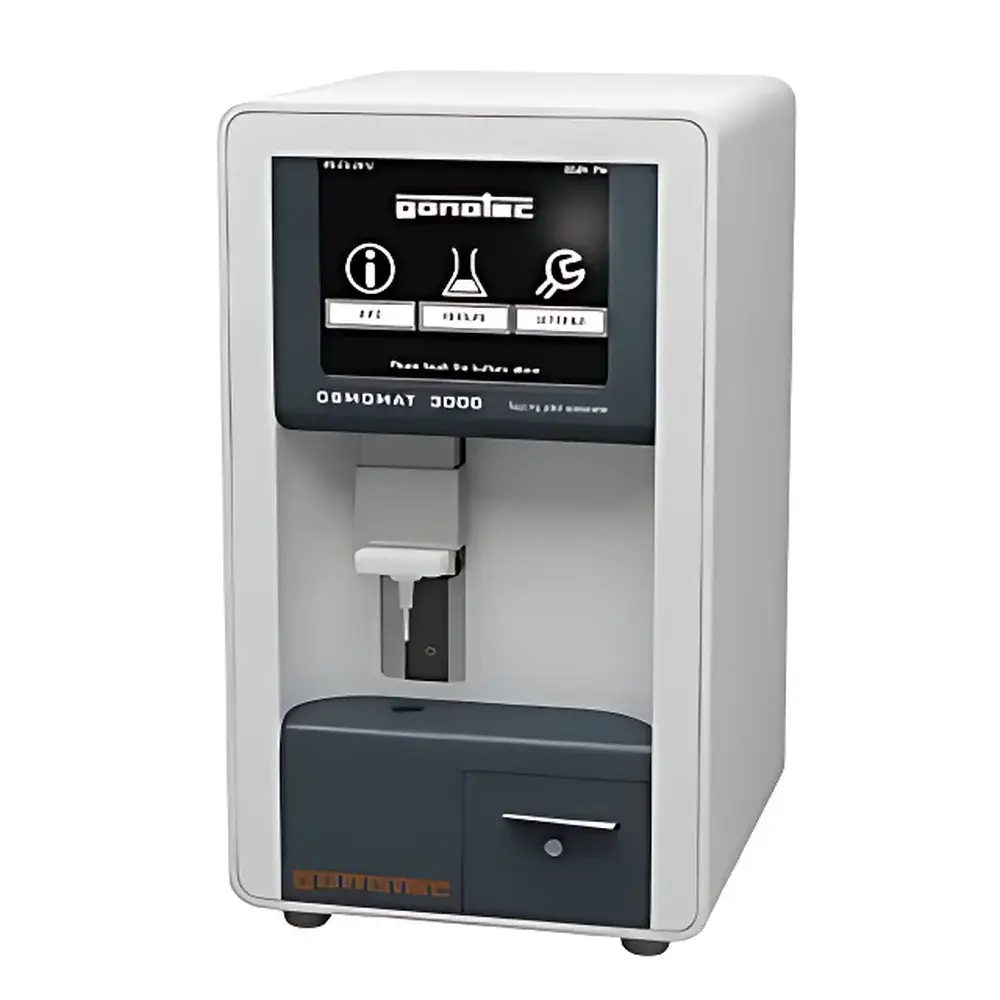
Gonotec OSMOMAT 3000 Freezing Point Osmometer
| Brand | Gonotec |
|---|---|
| Origin | Germany |
| Model | OSMOMAT 3000 |
| Measurement Range | 0–3000 mOsmol/kg |
| Sample Volume | 50 µL (15 µL with optional micro-sampling module) |
| Measurement Time | ~60 s per sample |
| Calibration Options | 10 standard points (100–2500 mOsmol/kg) |
| Display | 5.7" TFT LCD touchscreen |
| Language Support | English, German, Chinese (user-selectable dual-language mode) |
| Compliance | Chinese Pharmacopoeia General Chapter 0632 |
Overview
The Gonotec OSMOMAT 3000 is a precision freezing point depression osmometer engineered for reliable, traceable determination of osmolality in aqueous pharmaceutical and biological solutions. Based on the thermodynamic principle of colligative properties, the instrument measures the depression of the freezing point (ΔTf) induced by solute particles in solution—directly proportional to total osmotic concentration (expressed in mOsmol/kg H2O). This method delivers high reproducibility and minimal matrix interference, making it the reference-standard technique for regulatory-compliant osmolality testing in parenteral drug development, quality control, and stability studies. Designed and manufactured in Berlin, Germany, the OSMOMAT 3000 integrates robust thermal control architecture, automated nucleation initiation, and real-time thermogram analysis to ensure measurement integrity across diverse sample types—from low-viscosity saline infusions to viscous protein formulations.
Key Features
- Automated stainless-steel needle-based ice nucleation: Eliminates manual seeding, reduces operator variability, and ensures consistent supercooling control.
- Dual-mode calibration flexibility: Supports two-point or three-point calibration protocols; single-point calibration allows configurable averaging over 1–3 repeated injections for enhanced baseline accuracy.
- Expanded calibration library: Ten certified reference points (100, 300, 400, 500, 700, 850, 1200, 1800, 2000, and 2500 mOsmol/kg) enable precise range-specific validation aligned with pharmacopeial requirements.
- Optimized thermal management system: Active bottom-cooling design prevents ice accumulation and condensate pooling—enabling continuous operation over extended shifts without drift or recalibration.
- Minimal sample consumption: Standard mode requires only 50 µL; optional micro-sampling module (M-Kit) reduces volume requirement to 15 µL—critical for precious biologics, ocular formulations, and pediatric dosage forms.
- Intuitive 5.7″ resistive touchscreen interface with dual-language support: Users select any two from English, German, or Simplified Chinese—facilitating multilingual lab environments and audit-ready operational continuity.
- Multi-level access control: Password-protected user roles restrict calibration, method editing, and data export functions—supporting ALCOA+ data integrity principles and internal SOP enforcement.
Sample Compatibility & Compliance
The OSMOMAT 3000 is validated for use with sterile, filtered aqueous solutions including intravenous fluids, electrolyte replacements, contrast media, ophthalmic preparations, lyophilized reconstitution solutions, and monoclonal antibody formulations. It meets the analytical performance criteria specified in Chinese Pharmacopoeia General Chapter 0632 (“Osmolality Determination”), and its measurement principle is inherently compatible with ISO 29990, USP , and EP 2.2.35. While not an FDA 21 CFR Part 11–certified system out-of-the-box, its audit trail functionality (via optional Gonotec DataManager software), electronic signature support, and configurable user permissions provide a foundation for GxP-aligned deployment under site-specific validation protocols (IQ/OQ/PQ). Routine verification against NIST-traceable osmolality standards is recommended per laboratory quality management systems (e.g., ISO/IEC 17025).
Software & Data Management
The instrument operates standalone via embedded firmware but integrates seamlessly with Gonotec’s Windows-based DataManager software (v4.x or later) for advanced reporting, trend analysis, and electronic record retention. DataManager supports CSV and PDF export, customizable report templates, statistical process control (SPC) charts, and batch-wise result archiving with time-stamped metadata (operator ID, calibration status, ambient temperature, sample ID). Audit trail logs capture all critical events—including parameter changes, calibration actions, and result deletions—with immutable timestamps and user attribution. When deployed within validated IT infrastructure, the software supports 21 CFR Part 11 compliance through role-based authentication, electronic signatures, and secure database encryption.
Applications
- QC release testing of injectables, dialysis solutions, and nutritional admixtures per pharmacopeial monographs.
- Stability-indicating assay during ICH Q5C long-term and accelerated studies.
- Formulation development support for buffer optimization, excipient screening, and tonicity adjustment.
- Process validation of ultrafiltration/diafiltration steps in bioprocessing.
- Reference-method verification for alternative osmolality techniques (e.g., vapor pressure depression).
- Regulatory submission support—including full traceability documentation for EMA, NMPA, and PMDA dossiers.
FAQ
What regulatory standards does the OSMOMAT 3000 directly comply with?
It fulfills the technical and procedural requirements of Chinese Pharmacopoeia General Chapter 0632 and aligns with USP , EP 2.2.35, and ISO 29990 for freezing point osmometry.
Can the instrument be integrated into a LIMS environment?
Yes—via ASCII text file export (CSV/TXT) or optional OPC UA communication module for real-time data transfer to compliant LIMS platforms.
Is routine maintenance required beyond calibration?
Daily cleaning of the sample chamber and nucleation needle is recommended; annual factory recalibration and thermistor verification are advised for GxP environments.
Does the system support GLP/GMP audit trails?
With DataManager software enabled and properly configured, it provides full electronic audit trails meeting ALCOA+ principles—including attribution, legibility, contemporaneous recording, originality, and accuracy.
How is carryover prevented between samples?
The stainless-steel needle features an integrated wash cycle using deionized water or ethanol between measurements, programmable in the method setup.