
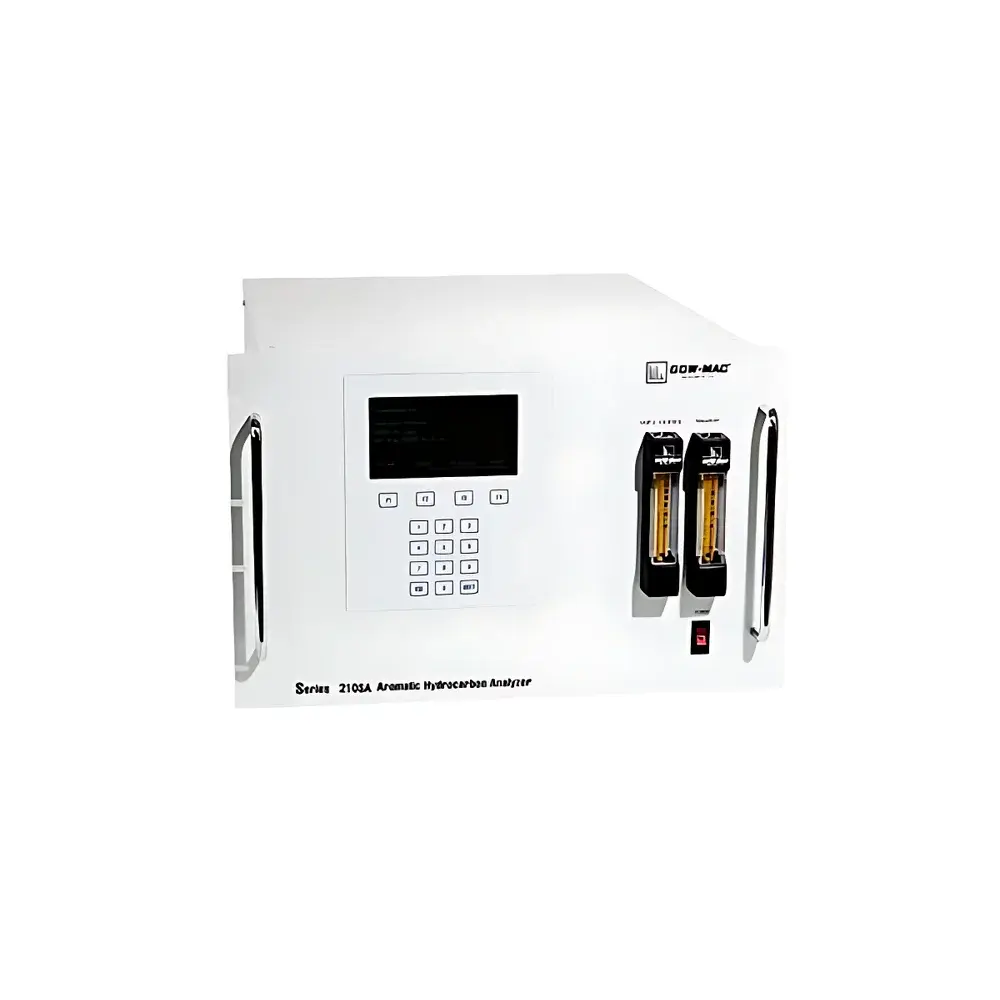
GOW-MAC 210 SA Micro Total Sulfur Analyzer
| Brand | GOW-MAC |
|---|---|
| Origin | USA |
| Model | GOW-MAC 210 SA |
| Detection Principle | Flame Photometric Detection (FPD) |
| Detection Target | Total Sulfur in Gaseous or Liquid CO₂ |
| Detection Limit | <5 ppb for COS |
| Linear Dynamic Range | >3 orders of magnitude |
| Compliance | ISBT Methods 13 & 14 |
| Installation | Benchtop or Rack-Mountable |
| Operating Mode | Continuous or Discrete Flow |
| Calibration | Automated Onboard Calibration |
| Temperature Control | Factory-Set Constant-Temperature Detection Zone |
Overview
The GOW-MAC 210 SA Micro Total Sulfur Analyzer is a dedicated, high-sensitivity analytical instrument engineered for the quantitative determination of total sulfur compounds in food-grade carbon dioxide—both in gaseous and liquid phases. It employs flame photometric detection (FPD), a well-established optical emission technique selective for sulfur-containing species. Upon combustion in a hydrogen-rich flame, sulfur compounds emit characteristic photons at ~394 nm, which are isolated via optical bandpass filtering and measured by a photomultiplier tube. The 210 SA integrates proprietary signal discrimination technology to decouple sulfur-specific emission from background carbon continuum radiation, ensuring robust baseline stability and interference-free quantification—even in high-CO₂ matrices where carbon spectral overlap would otherwise compromise accuracy. Designed for compliance-critical environments, the system operates within a factory-calibrated, thermally stabilized detection zone, minimizing drift and supporting long-term reproducibility required in beverage, pharmaceutical, and industrial gas quality control laboratories.
Key Features
- Flame photometric detector (FPD) optimized for sulfur selectivity with <5 ppb detection limit for carbonyl sulfide (COS)
- Automated onboard calibration sequence, including zero/gas standard introduction, flow validation, and response verification
- Thermally regulated detection chamber maintained at a fixed, factory-optimized temperature for signal stability and inter-day repeatability
- Front-panel keyboard interface enabling full method setup, run initiation, and real-time result viewing without external PC dependency
- Benchtop or 19-inch rack-mount configuration options to accommodate diverse laboratory infrastructure requirements
- Linear dynamic range exceeding three orders of magnitude (e.g., 5 ppb to 5 ppm), supporting both trace impurity screening and higher-level contamination assessment
- No consumables beyond standard H₂ fuel gas and purified air/oxidant—minimal maintenance footprint and low operational overhead
Sample Compatibility & Compliance
The GOW-MAC 210 SA is validated for direct analysis of food-grade CO₂ streams—whether sourced from bulk cylinders, on-site generation systems, or post-purification lines. It detects all common volatile sulfur compounds relevant to beverage safety and sensory integrity, including hydrogen sulfide (H₂S), carbonyl sulfide (COS), n-propyl mercaptan, t-butyl mercaptan, and elemental sulfur vapors. Its measurement protocol conforms to International Society of Beverage Technologists (ISBT) Standard Methods 13 and 14, widely adopted by global soft drink manufacturers and CO₂ suppliers for release testing. The analyzer supports GLP-aligned operation through deterministic calibration logging, operator ID entry (via front-panel input), and time-stamped result storage. While not inherently 21 CFR Part 11 compliant out-of-the-box, its deterministic output format and audit-ready event logs facilitate integration into validated LIMS or ELN platforms under site-specific SOPs.
Software & Data Management
The embedded firmware provides a self-contained, menu-driven interface accessible solely via the front-panel keypad and LCD display. Users configure carrier gas flow rate, calibration frequency, alarm thresholds, and data retention duration without external software or drivers. All measurements are stored internally with timestamps, operator codes, and calibration status flags. Data export is supported via RS-232 serial output (ASCII format) for direct ingestion into laboratory information management systems (LIMS) or SCADA interfaces. No proprietary software installation is required; raw signal values, integrated peak areas, and concentration results (ppb or ppm) are transmitted as structured text fields. The system maintains a local history buffer of up to 1,000 analyses, enabling retrospective review and trend analysis without network connectivity.
Applications
- Quality assurance of food-grade CO₂ used in carbonated beverages, beer, and sparkling water production
- Final-release testing of CO₂ prior to bottling or canning operations per ISBT or internal QA specifications
- Troubleshooting sulfur-related off-flavor events in finished products through root-cause analysis of supply gas
- Monitoring sulfur breakthrough in activated carbon or copper-based CO₂ purification beds
- Supporting FDA-regulated environmental monitoring programs where sulfur compounds are listed as reportable contaminants
- Research applications involving sulfur speciation kinetics in high-pressure CO₂ systems
FAQ
What sulfur species does the GOW-MAC 210 SA detect?
It measures total sulfur content from all volatile sulfur compounds combusted in the FPD flame—including H₂S, COS, mercaptans, sulfides, and elemental sulfur vapor—without speciation.
Does the instrument require daily calibration?
No. It supports automated periodic calibration using certified standard gases; typical intervals range from 8 to 24 hours depending on application stringency and regulatory requirements.
Can it analyze liquid CO₂ directly?
Yes—when equipped with the optional liquid-phase introduction module, which includes controlled phase transition and vaporization prior to FPD combustion.
Is the detector sensitive to nitrogen compounds?
No. The optical filter and flame chemistry are specifically tuned for sulfur emission at 394 nm; nitrogen emission (at ~520 nm) is physically excluded, eliminating cross-sensitivity.
What maintenance is required beyond routine gas supply checks?
Annual inspection of the burner tip, photomultiplier voltage verification, and optical window cleaning—typically performed by certified field service engineers or trained in-house technicians.





