




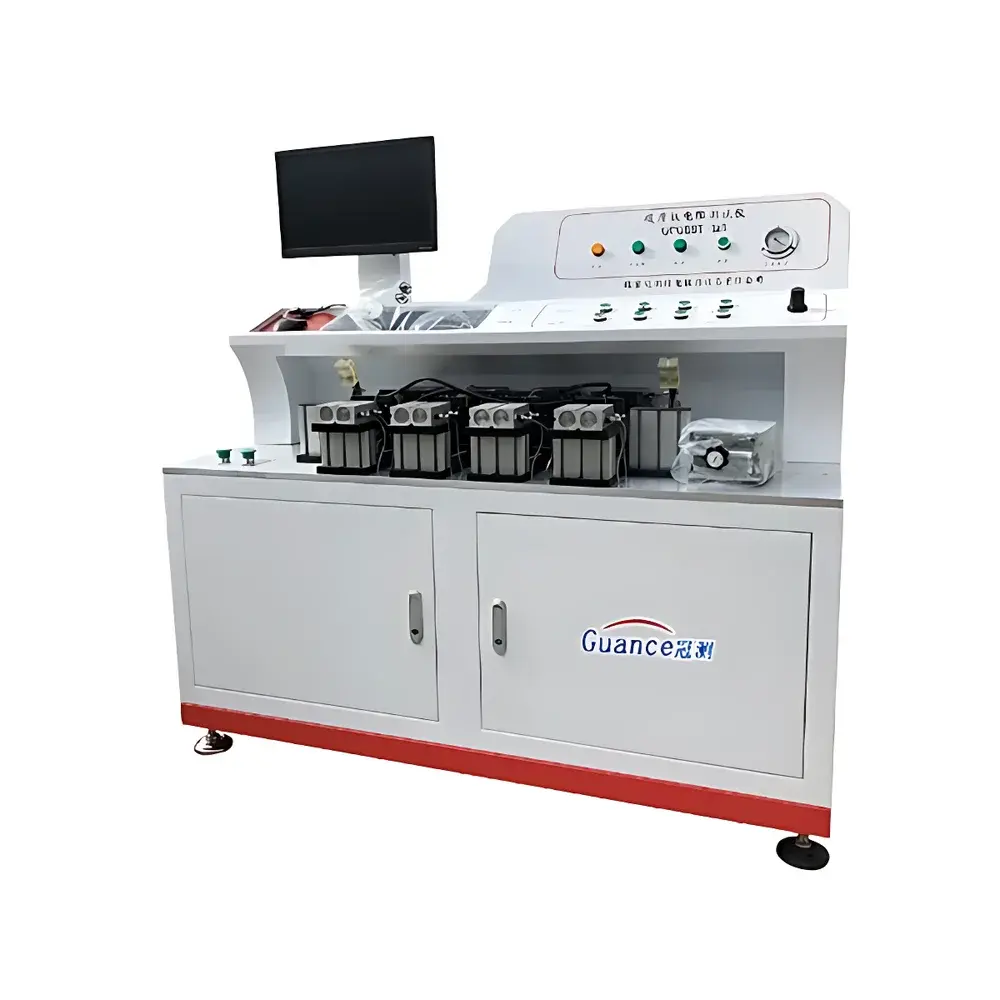
Guance Instruments GCGEST123 Carbon Pantograph Strip Electrical Resistance & Abrasion Tester
| Brand | Guance Instruments |
|---|---|
| Origin | Beijing, China |
| Model | GCGEST123 |
| Instrument Type | Tribological Tester for Electrical Contact Resistance and Wear Evaluation |
| Max Applied Pressure | 0.6–0.8 MPa |
| Operating Ambient Temperature | −30 °C to +40 °C |
| Relative Humidity Limit | ≤85% RH |
| Test Current | 10 A (constant) |
| Resistance Measurement Range | 10 μΩ to 100 Ω (RMS) |
| Electrode Pairs | 4 |
| Current Electrode Material | Brass (ID 20 mm, OD 35 mm) |
| Voltage Electrode Material | Nickel-plated Copper |
| Voltage Probe Switching | Automatic front/side selection |
| Clamping Mechanism | Pneumatic dual-axis cylinder actuation with spring-loaded elastic contact |
| Integrated Air Supply | Built-in silent air compressor (also supports external pneumatic source) |
| Control System | Siemens PLC-based real-time acquisition and logic control |
| Data Interface | Desktop PC via USB and industrial Ethernet |
Overview
The Guance Instruments GCGEST123 Carbon Pantograph Strip Electrical Resistance & Abrasion Tester is a specialized tribological evaluation system engineered for the quantitative assessment of electrical contact integrity and mechanical stability in carbon–aluminum composite current-collecting interfaces—specifically designed for railway pantograph carbon strips bonded to aluminum carrier plates. Unlike conventional wear testers that prioritize mechanical loss metrics alone, the GCGEST123 integrates four-quadrant resistive metrology with controlled normal loading and automated electrode positioning to simultaneously monitor interfacial resistance evolution under simulated operational pressure and thermal boundary conditions. Its measurement principle relies on the four-terminal (Kelvin) method: a stable 10 A DC current is injected across the carbon–aluminum junction while voltage drops are measured at two distinct geometrical configurations—front-face (carbon top surface to aluminum bottom surface) and side-edge (carbon lateral face to aluminum lateral face)—enabling decoupled evaluation of bulk conductivity, interfacial adhesion quality, and localized delamination onset. This dual-mode voltage acquisition architecture provides traceable, reproducible data essential for QC/QA compliance in rail component manufacturing per EN 50119, IEC 62236-2, and GB/T 21563-2018.
Key Features
- Four-pair independent electrode array with brass current electrodes (20 mm ID / 35 mm OD) and nickel-plated copper voltage probes ensuring low-noise, oxidation-resistant contact.
- Spring-loaded elastic contact design between current electrodes and carbon surface minimizes point-load-induced microfracture during high-current injection.
- Automated dual-axis pneumatic clamping system with real-time pressure monitoring (0.6–0.8 MPa range), enabling repeatable normal force application compliant with EN 50317 Annex C test protocols.
- Integrated silent air compressor eliminates dependency on external compressed air infrastructure while supporting external supply via standard ISO 8573-1 Class 4 interface.
- Siemens S7-1200 PLC core ensures deterministic timing, fault-safe logic sequencing, and electromagnetic compatibility (EMC) certification per EN 61000-6-2/6-4.
- Front/side voltage probe switching executed via solenoid-driven mechanical translation—no manual repositioning required between measurement modes.
Sample Compatibility & Compliance
The GCGEST123 accommodates standard carbon pantograph strip dimensions up to 120 mm × 60 mm × 25 mm (L × W × H), with adjustable fixture blocks for varying aluminum carrier thicknesses (6–12 mm). It supports both monolithic carbon strips and segmented composites with embedded metallic inserts. All electrical measurements adhere to ASTM D257 (Standard Test Methods for DC Resistance or Conductance of Insulating Materials) principles adapted for conductive composites, and resistance resolution (10 μΩ) meets the minimum detectability threshold specified in EN 50367 Annex B for contact resistance validation. The system’s ambient operating envelope (−30 °C to +40 °C, ≤85% RH) satisfies storage and functional requirements outlined in UIC 651 and TB/T 2073-2013. Full audit trail logging—including timestamped pressure, current, voltage, and clamp status—is implemented to support GLP/GMP-aligned documentation workflows.
Software & Data Management
Data acquisition and instrument control are managed through a Windows-based application communicating with the Siemens PLC via OPC UA over industrial Ethernet. The software provides synchronized waveform capture (voltage vs. time, resistance vs. cycle count), configurable pass/fail thresholds, and automated report generation in PDF and CSV formats. All raw datasets include embedded metadata: operator ID, sample ID, test date/time, environmental readings (temperature/humidity from onboard sensors), and calibration certificate IDs. Audit trail records preserve user actions, parameter changes, and system alarms with SHA-256 hashing for integrity verification—fully compatible with FDA 21 CFR Part 11 electronic record requirements when deployed with domain-authenticated login and digital signature modules.
Applications
- Quality conformance testing of carbon–aluminum bonding integrity in OEM and aftermarket pantograph strips.
- Accelerated aging studies evaluating resistance drift under cyclic mechanical loading and thermal cycling.
- R&D validation of new carbon formulations (e.g., Cu/graphite hybrids, SiC-reinforced matrices) against baseline conductivity–wear trade-off curves.
- Root cause analysis of field failures linked to interfacial delamination, oxidation at the carbon–aluminum interface, or adhesive degradation.
- Supporting third-party certification testing per CRCC (China Railway Certification Centre) and TÜV SÜD rail component approval schemes.
FAQ
What is the purpose of the dual-voltage measurement configuration (front vs. side)?
Front-face measurement evaluates total series resistance across the full carbon–aluminum interface; side-edge measurement isolates resistance contributions from the bond line itself, enabling differentiation between bulk carbon resistivity changes and interfacial debonding events.
Can the system operate without the built-in air compressor?
Yes—the unit features an ISO 8573-1-compliant external pneumatic inlet port, allowing integration into centralized lab air networks with regulated 0.6–0.8 MPa supply.
Is calibration traceable to national standards?
Resistance calibration is performed using NIST-traceable shunts (±0.01% uncertainty); pressure transducers are certified to ISO/IEC 17025 by CNAS-accredited laboratories.
Does the software support automated statistical process control (SPC)?
Yes—real-time X-bar/R charting, Cp/Cpk calculation, and out-of-spec alerting are available via optional SPC module licensed per workstation.
What maintenance intervals are recommended for long-term reliability?
Electrode cleaning every 50 test cycles; pneumatic filter replacement every 6 months; annual full-system verification including current source accuracy, voltage measurement linearity, and clamp force repeatability.



