
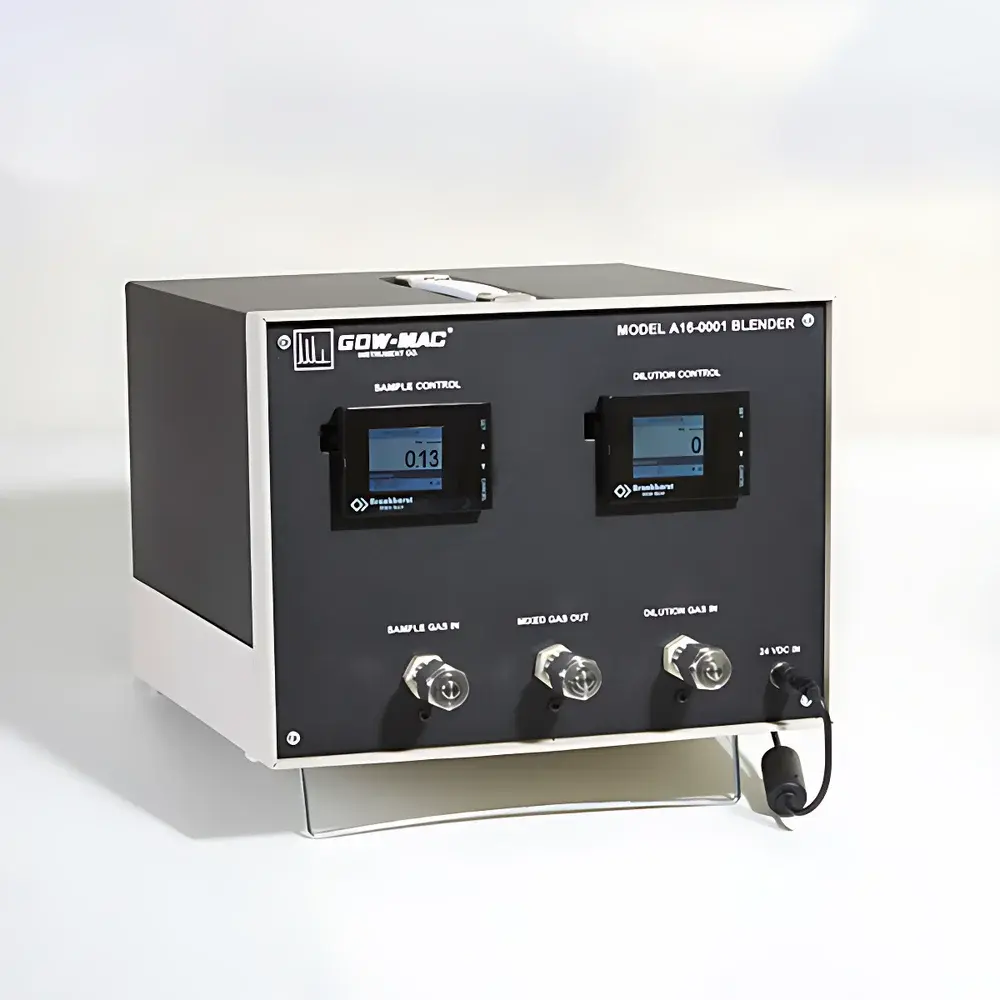
GOW-MAC A16 Gas Dilution Calibrator
| Brand | GOW-MAC |
|---|---|
| Origin | USA |
| Model | A16 |
| Instrument Type | Laboratory Gas Dilution Calibrator |
| Application Scope | Universal Calibration for Trace Gas Analyzers |
| Dilution Ratio Range | 1:10 to 1:10,000 (typical) |
| Flow Control Accuracy | ±0.5% of setpoint |
| Pressure Regulation Range | 0–100 psig |
| Temperature Stability | ±0.1 °C (ambient-controlled environment) |
| Output Port Configuration | Dual independent calibrated outlets |
| Compliance | ASTM D6420, ISO 6145-3, EPA Method 205 |
Overview
The GOW-MAC A16 Gas Dilution Calibrator is a precision-engineered instrument designed to generate highly accurate, gravimetrically traceable gas standards for calibration and verification of trace-level gas analyzers—including gas chromatographs (GC), photoionization detectors (PID), electrochemical sensors, FTIR systems, and laser-based analyzers. Operating on the principle of dynamic volumetric dilution via mass flow control and pressure-regulated blending, the A16 delivers stable, repeatable gas mixtures with certified uncertainty down to ±0.8% (k=2) across its full dilution range. Unlike static cylinder-based standards—which degrade over time or suffer from adsorption effects—the A16 enables on-demand generation of fresh, matrix-matched calibration gases, minimizing drift and improving long-term method robustness in regulated laboratory environments.
Key Features
- High-precision dual-channel mass flow controllers (MFCs) with NIST-traceable calibration certificates, supporting independent primary and secondary gas streams
- Integrated pressure-regulated blending manifold ensuring laminar, pulse-free output flow essential for GC injector compatibility
- Real-time digital display of dilution ratio, primary/secondary flow rates, absolute pressure, and elapsed operation time
- Modular architecture enabling field-upgradable firmware and optional integration with LIMS via RS-232 or Ethernet (Modbus TCP)
- Stainless-steel 316 wetted parts and electropolished internal surfaces compliant with ultra-high-purity (UHP) gas handling requirements
- Passive thermal stabilization design—no active oven required—minimizing power dependency and thermal lag during rapid ratio transitions
Sample Compatibility & Compliance
The A16 supports calibration of gaseous analytes across multiple chemical families: hydrocarbons (e.g., CH₄, C₂H₆), inorganic species (CO, CO₂, NO, SO₂, NH₃), volatile organic compounds (VOCs), and specialty gases (e.g., H₂, He, SF₆, silanes). It accommodates both inert carrier gases (N₂, Ar, He) and reactive matrices (air, synthetic air, humidified N₂) without cross-contamination risk due to segregated flow paths and zero-dead-volume fittings. The system meets functional requirements of ASTM D6420 (standard test method for determination of gaseous compounds by GC), ISO 6145-3 (gas mixture preparation—dynamic method), and EPA Method 205 (verification of calibration gases for ambient air monitoring). All operational parameters—including flow setpoints, pressure logs, and user authentication events—are timestamped and stored internally to support GLP/GMP audit readiness and 21 CFR Part 11-compliant data integrity workflows.
Software & Data Management
The A16 operates autonomously via front-panel interface but integrates seamlessly with GOW-MAC’s optional CaliSoft™ PC software for advanced protocol scripting, multi-step calibration sequences, and automated report generation (PDF/CSV). CaliSoft™ enforces role-based access control (RBAC), electronic signatures, and immutable audit trails—capturing operator ID, session start/end times, parameter modifications, and calibration certificate metadata. Raw sensor outputs and MFC diagnostics are logged at 1 Hz resolution and exportable for third-party statistical process control (SPC) analysis. Data files conform to ASTM E1461 and ISO/IEC 17025 documentation frameworks, facilitating accreditation audits and inter-laboratory comparison studies.
Applications
- Primary calibration of environmental air monitoring stations (e.g., EPA SLAMS, EMEP networks)
- Verification of GC-FID/TCD/ECD detector linearity and detection limits per USP and ISO 17025 clause 5.9
- Preparation of challenge gases for safety instrumented systems (SIS) and fixed gas detection panels
- Method validation for hydrogen purity testing in fuel cell supply chains (ISO 8573-8, ASTM D7652)
- Trace impurity quantification in high-purity electronic specialty gases (SEMI F57, SEMI F63)
- Reference standard generation for metrology labs participating in CCQM key comparisons
FAQ
Does the A16 require external gas cylinders for operation?
Yes—it requires two certified source gases: one high-concentration standard (e.g., 100 ppm CH₄ in N₂) and one ultra-high-purity diluent (e.g., 99.999% N₂ or synthetic air). No internal gas storage is provided.
Can the A16 be used with corrosive or condensable gases?
Only with optional chemically resistant MFC modules (e.g., Hastelloy C-276 wetted parts) and heated sample lines (up to 150 °C); standard configuration is rated for non-corrosive, non-condensing gases at ambient dew point.
Is firmware update capability included?
Yes—field updates are performed via USB flash drive or network connection using signed firmware packages validated against SHA-256 checksums.
What documentation accompanies shipment?
Each unit ships with NIST-traceable MFC calibration certificates, ISO 9001-certified manufacturing records, EU Declaration of Conformity (CE), and a complete IQ/OQ protocol template aligned with ASTM E2500.
How often does the A16 require recalibration?
Annual recalibration is recommended; however, built-in self-diagnostic routines and daily flow verification protocols enable extended calibration intervals under controlled ISO/IEC 17025 quality management systems.
Related Products






