
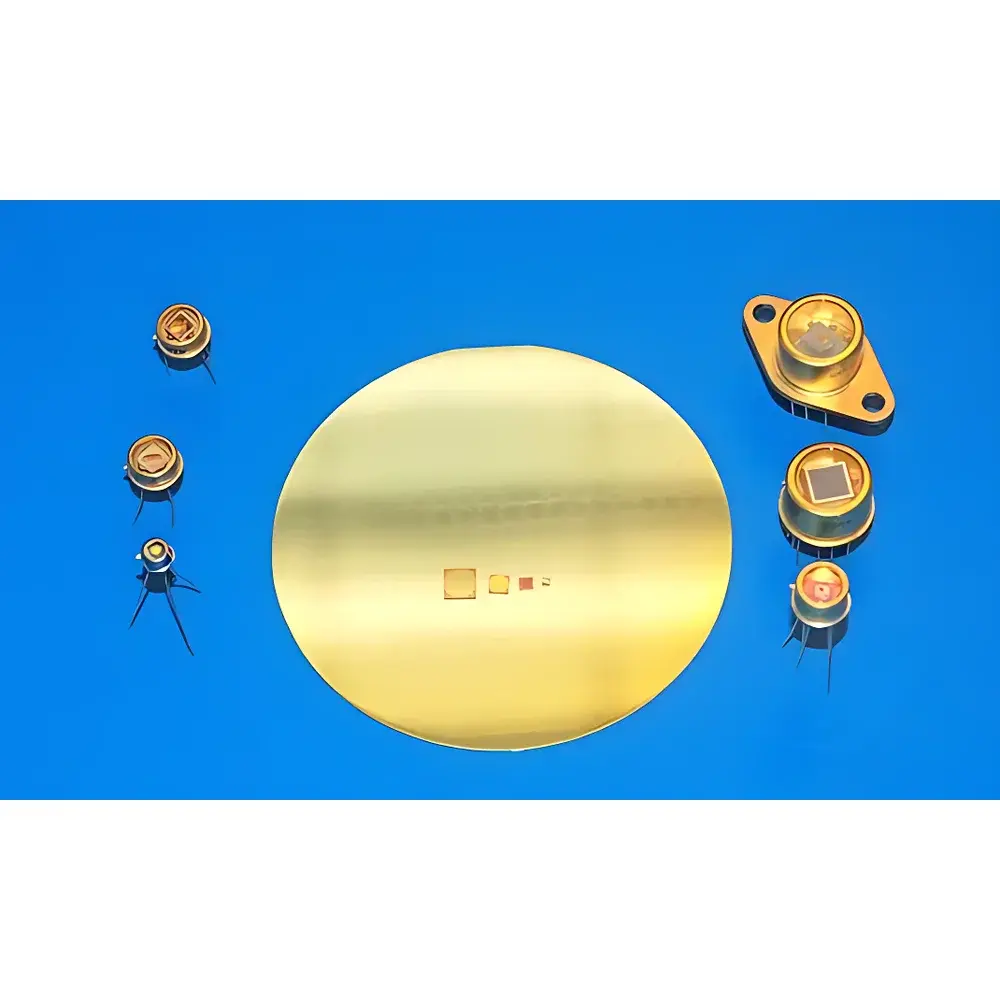
GPD GAP 1.9–2.6 µm Broadband InGaAs Photodiode
| Brand | GPD |
|---|---|
| Origin | USA |
| Model | GAP 1.9–2.6 µm |
| Cutoff Wavelengths | 1.9 µm, 2.05 µm, 2.2 µm, 2.6 µm |
| Active Diameter | 0.3 mm – 3.0 mm |
| Package Options | TO-46, TO-18, TO-5 |
| Lens Options | Double-Convex, Plano-Convex, Spherical |
| Filter Compatibility | Neutral Density (ND), Bandpass Filters |
Overview
The GPD GAP 1.9–2.6 µm Broadband InGaAs Photodiode is a high-performance, uncooled photodetector engineered for precise radiometric and photometric measurements in the short-wave infrared (SWIR) spectral region. Based on lattice-matched or extended InGaAs epitaxial structures grown on InP substrates, this photodiode operates via the internal photoelectric effect—generating electron-hole pairs upon photon absorption within the depletion region. Its spectral responsivity spans from approximately 900 nm to the specified cutoff wavelength (1.9–2.6 µm), with peak quantum efficiency exceeding 70% across the operational band. Designed for stability under continuous illumination and low dark current operation, the device exhibits high shunt resistance (>1 GΩ typical at room temperature), enabling low-noise signal acquisition in high-impedance transimpedance amplifier configurations. It is optimized for integration into calibrated optical measurement systems requiring traceable, repeatable response in industrial, analytical, and research-grade SWIR applications.
Key Features
- Four standard cutoff wavelength options: 1.9 µm, 2.05 µm, 2.2 µm, and 2.6 µm—enabling tailored spectral selectivity for gas absorption lines and material-specific reflectance bands
- Active area diameter configurable from 0.3 mm to 3.0 mm—supporting trade-offs between sensitivity, spatial resolution, and field-of-view requirements
- High shunt resistance (>1 GΩ) and low dark current (<5 nA at 50 mV bias for 1.9 µm variant)—critical for DC-coupled and low-frequency detection schemes
- Hermetically sealed metal-can packages (TO-46, TO-18, TO-5) with optional anti-reflection coated windows—ensuring long-term reliability in controlled and semi-rugged environments
- Interchangeable lens mounts compatible with double-convex, plano-convex, and spherical optics—facilitating collimation, focusing, or fiber coupling without custom mechanical redesign
- Integrated mounting compatibility with industry-standard ND and bandpass interference filters—enabling spectral isolation for multi-gas analysis or background suppression in flame detection
Sample Compatibility & Compliance
The GAP series is compatible with both free-space and fiber-coupled optical paths (e.g., SMF-28, HI1060, or PM980 fibers with FC/PC or SMA connectors). Its planar mesa structure and passivated surface minimize surface recombination, ensuring consistent responsivity across batch-manufactured units. Devices are tested per MIL-STD-750D Method 1030 for thermal shock and Method 2005 for humidity resistance. While not certified to IEC 61000-4-x EMC standards as a standalone component, the photodiode complies with RoHS 2015/863/EU and REACH SVHC guidelines. When integrated into final instrumentation, it supports compliance with ISO/IEC 17025 calibration traceability frameworks and aligns with spectral responsivity characterization practices defined in CIE Publication 69 and NIST SP 250-95.
Software & Data Management
As a passive analog sensor, the GAP photodiode does not include embedded firmware or digital interfaces. However, it is routinely interfaced with commercially available data acquisition systems—including National Instruments PXIe-4139 source-measure units, Keysight B2902B SMUs, and Thorlabs PM100D power meters—using standardized BNC or SMA connections. Raw photocurrent output is linear over six decades (pA to µA range) when operated in photovoltaic or reverse-biased modes. For system-level validation, users may apply NIST-traceable calibration certificates (available upon request) that report absolute responsivity (A/W) at discrete wavelengths (e.g., 1310 nm, 1550 nm, 1900 nm, 2350 nm) with ±2.5% expanded uncertainty (k=2). Audit-ready calibration logs support GLP/GMP documentation workflows where instrument qualification (IQ/OQ/PQ) is required.
Applications
- Gas sensing platforms targeting CH₄, CO₂, NH₃, and H₂O absorption features near 1.65 µm, 2.0 µm, and 2.3 µm—leveraging tunable diode laser absorption spectroscopy (TDLAS) or non-dispersive infrared (NDIR) architectures
- Hydrocarbon leak detection systems deployed in petrochemical refineries and pipeline monitoring networks—where flame flicker modulation at 2.2–2.5 µm provides superior immunity to solar loading and blackbody interference
- Fourier-transform infrared (FTIR) spectrometers operating in the SWIR extension range—particularly in benchtop and portable OEM modules requiring high dynamic range and low polarization dependence
- Industrial process control sensors for moisture content analysis in pharmaceutical granules, polymer films, and agricultural commodities—utilizing water’s overtone bands at 1450 nm and 1940 nm
- Research-grade spectroscopic ellipsometers and photothermal deflection setups—where stable, low-drift photodetection enables sub-millidegree phase resolution in thin-film metrology
FAQ
What is the typical junction capacitance at zero bias for the 2.6 µm cutoff variant?
Typical junction capacitance ranges from 15 pF (0.3 mm active area) to 120 pF (3.0 mm active area) at VR = 0 V, measured at 1 MHz.
Can this photodiode be used in pulsed laser detection applications?
Yes—its rise time is <1 ns for the smallest active area (0.3 mm) under 50 Ω termination; bandwidth decreases inversely with active area size and load impedance.
Is thermoelectric cooling required for stable operation?
No—these devices are specified for uncooled operation from −40 °C to +85 °C ambient; dark current drift remains within ±5% over 8 hours at 25 °C.
Are custom spectral filter integrations available directly from GPD?
GPD offers factory-installed interference filters (OD >4, CWL tolerance ±2 nm, FWHM 10–50 nm) as part of its OEM service portfolio; lead time and MOQ apply.
Does the TO-5 package include a built-in thermistor for temperature compensation?
No—the standard TO-5, TO-18, and TO-46 packages do not integrate temperature sensors; external thermistors or RTDs are recommended for high-accuracy radiometric applications.




