GrainSense GO Handheld, Lab Benchtop & Combine-Mounted Grain Analyzer
| Brand | GrainSense |
|---|---|
| Origin | Finland |
| Model | GrainSense GO (Handheld), GrainSense Lab (Benchtop), GrainSense Combine (In-Field Flow Sensor) |
| Measurement Principle | Near-Infrared (NIR) Spectroscopy in the Third Overtone Region (~1150–1350 nm) |
| Sample Throughput | Handheld — single seed batch (5–20 g) |
| Power | Handheld — rechargeable Li-ion battery (8+ hrs) |
| Data Output | Real-time % w/w protein, moisture, starch (carbohydrate proxy), and crude fat |
| Compliance | CE marked |
| Software | GrainSense Cloud platform with API access, audit trail, user role management, and FDA 21 CFR Part 11–ready optional modules |
Overview
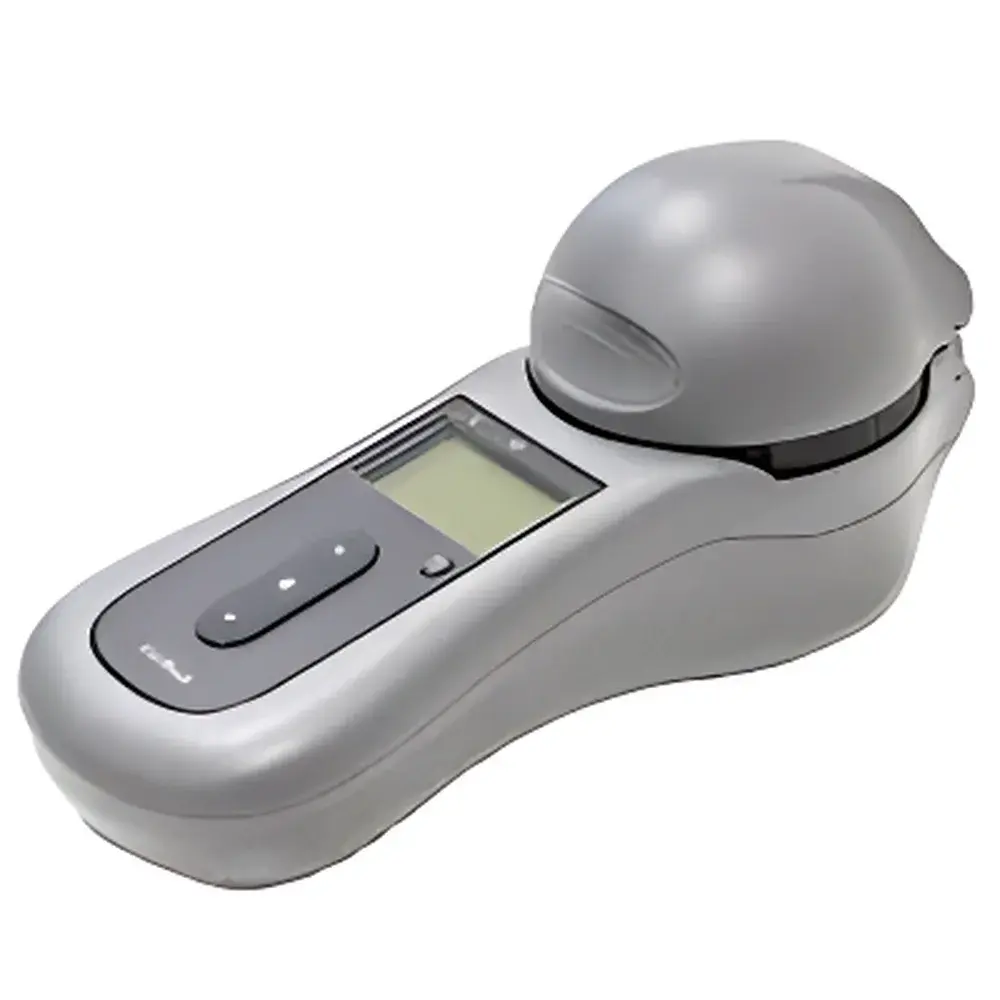
The GrainSense GO Handheld, GrainSense Lab Benchtop, and GrainSense Combine analyzers constitute a unified, multi-form-factor near-infrared (NIR) spectroscopic platform engineered for rapid, non-destructive quantification of key compositional parameters in cereals and oilseeds. All three variants operate on the same fundamental physical principle: absorption spectroscopy within the third overtone region of the NIR spectrum (1150–1350 nm), where C–H, O–H, and N–H bond vibrations produce distinct, quantifiable absorbance features. This spectral window enables simultaneous regression modeling of protein (% w/w, dry basis), moisture (% w/w, wet basis), starch (as total carbohydrate proxy), and crude fat content—each calibrated against reference methods compliant with ISO 20483 (cereals – determination of nitrogen content), ISO 712 (moisture), and AOAC 991.36 (fat). Unlike dispersive or Fourier-transform NIR systems requiring complex optical alignment, GrainSense instruments utilize an integrated integrating sphere design in the handheld and benchtop models—enhancing photon collection efficiency by >300× versus conventional reflectance geometries—thereby enabling miniaturization without sacrificing signal-to-noise ratio. The Combine variant implements a proprietary GrainSense Flow® sensing module, optimized for turbulent, high-velocity grain streams in harvesting environments.
Key Features
- Multi-form-factor architecture: Interoperable calibration models across handheld (field scouting), benchtop (quality control lab), and combine-mounted (real-time harvest monitoring) configurations.
- Integrating sphere optics: Maximizes diffuse reflectance capture in handheld and benchtop units, enabling robust performance with heterogeneous, irregularly shaped seeds (e.g., barley, oats, wheat, rapeseed) without grinding or homogenization.
- Real-time flow analytics: GrainSense Combine integrates directly into elevator discharge chutes of modern combines, supporting continuous measurement at ≥1 kg/min throughput with <±0.3% w/w repeatability (RSD) for moisture and protein under field conditions.
- Battery-operated portability: GrainSense GO delivers full-spectrum NIR acquisition and onboard chemometric inference in 8 hours of operation on a single charge.
- No consumables or moving parts: Solid-state optical path, sealed detector housing, and tool-free sample chamber cleaning reduce maintenance overhead and long-term cost of ownership.
Sample Compatibility & Compliance
The system is validated for intact kernels of major cereal and oilseed species including Triticum aestivum (bread wheat), Hordeum vulgare (barley), Avena sativa (oat), Zea mays (maize), Secale cereale (rye), and Brassica napus (rapeseed). Calibration models are developed using representative regional cultivars and validated per ASTM E1655 (standard practices for NIR quantitative analysis) and ISO 12099 (cereals and pulses – requirements for near-infrared instruments). All instruments comply with CE marking directives (2014/30/EU EMC, 2014/35/EU LVD) and meet IEC 61326-1 immunity requirements for industrial environments. Data integrity features—including electronic signatures, time-stamped audit logs, and configurable user permissions—are available in GrainSense Cloud to support GLP and GMP-aligned workflows.
Software & Data Management
GrainSense Cloud serves as the central data hub, providing secure web-based access to instrument configuration, spectral libraries, calibration updates, and historical datasets. Each measurement generates a timestamped record containing raw spectra, predicted values, confidence intervals, and diagnostic metrics (e.g., spectral residual, outlier flagging). The platform supports RESTful API integration with farm management information systems (FMIS), ERP platforms (e.g., SAP S/4HANA), and LIMS environments. Optional 21 CFR Part 11 compliance packages include electronic signature enforcement, immutable audit trails, and role-based data access controls—enabling use in regulated agricultural bioprocessing and contract testing laboratories.
Applications
- Pre-harvest quality assessment: Rapid protein/moisture screening in breeding trials or varietal selection programs.
- Grain receiving & storage: On-site verification of delivery specifications prior to silo entry, reducing dockage disputes.
- Process optimization: Real-time feedback during drying, conditioning, or milling to maintain target moisture and protein windows.
- Yield mapping integration: Combine-mounted data synchronized with GPS coordinates enables spatial grain quality mapping at sub-field resolution.
- Research applications: Longitudinal phenotyping studies tracking compositional changes under abiotic stress (drought, heat) or nutrient treatments.
FAQ
How are calibration models transferred between handheld, benchtop, and combine instruments?
Calibration coefficients and preprocessing algorithms are stored in vendor-managed, version-controlled spectral libraries hosted in GrainSense Cloud. Instrument firmware synchronizes model updates over Wi-Fi or cellular connection—ensuring identical prediction logic across all form factors.
Can the system analyze ground or milled samples?
While optimized for whole kernels, the benchtop model accommodates finely ground samples (≤0.5 mm particle size) when required for specific regulatory submissions; however, whole-kernel analysis is recommended to preserve biological relevance and minimize preparation bias.
Is third-party calibration development supported?
Yes—GrainSense provides SDKs and spectral data export tools (CSV, HDF5) for custom PLS, PCR, or machine learning model development in MATLAB, Python (scikit-learn, PyTorch), or R environments.
What is the typical recalibration interval?
Under normal usage, factory calibrations remain stable for ≥12 months; annual verification against certified reference materials (CRM) is recommended per ISO/IEC 17025 guidelines.
Does the Combine unit require external computing hardware?
No—the GrainSense Flow® sensor includes an embedded ARM-based processing unit; only a CAN bus or RS-485 interface to the combine’s display terminal is needed for real-time visualization.