
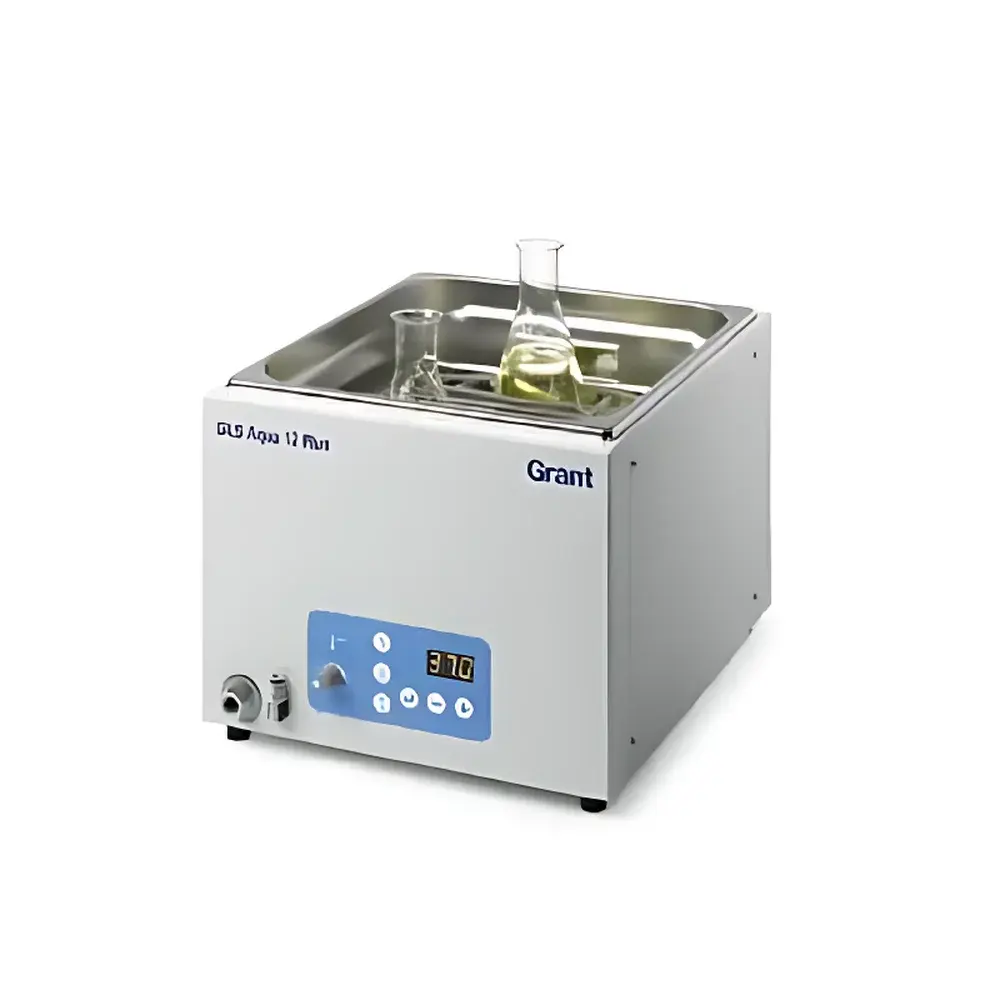
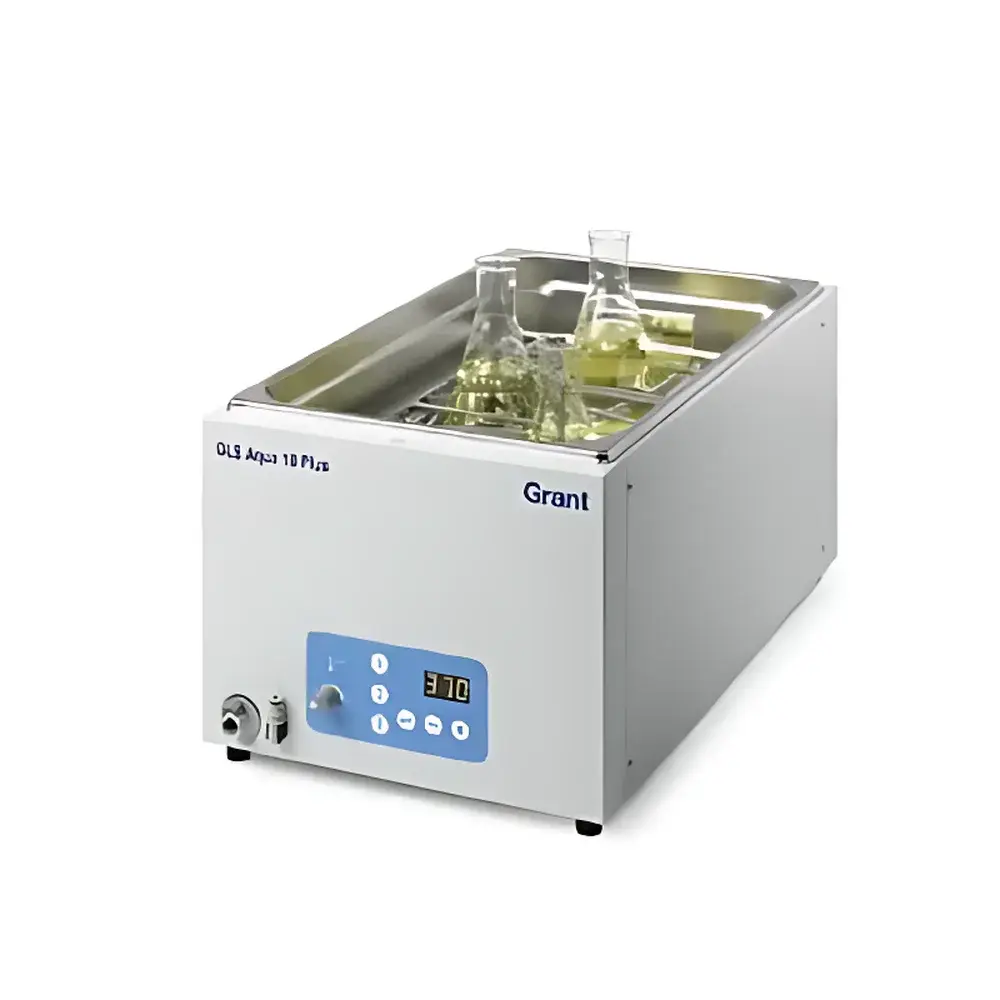
Grant GLS Aqua 12/18 Plus Linear Water Bath Shaker
| Brand | Grant Instruments (UK) |
|---|---|
| Origin | United Kingdom |
| Model | GLS Aqua 12 Plus / GLS Aqua 18 Plus |
| Temperature Range | Ambient +5°C to 99°C |
| Temperature Stability | ±0.1°C @ 37°C |
| Temperature Uniformity | ±0.1°C @ 37°C |
| Linear Oscillation Range | 40–400 rpm |
| Oscillation Amplitude | 18 mm |
| Bath Capacity | 12 L or 18 L (stainless steel, electropolished AISI 316) |
| Display | 3-digit LED, 0.1°C resolution |
| Power Supply | 120 V / 230 V, 50–60 Hz |
| Max. Power Consumption | 0.8 kW (GLS Aqua 12 Plus), 1.15–1.5 kW (GLS Aqua 18 Plus) |
| Safety Features | Overtemperature cut-off, low-level fluid alarm, user-configurable timer with audible alert |
| Dimensions (H×D×W) | 270 × 390 × 335 mm (12L), 270 × 570 × 335 mm (18L) |
| Immersion Depth | 0–60 mm |
| Tray Dimensions | 240 × 235 mm (12L), 420 × 235 mm (18L) |
Overview
The Grant GLS Aqua 12/18 Plus Linear Water Bath Shaker is an engineered platform for precise temperature-controlled agitation of aqueous samples in life science, pharmaceutical, and quality control laboratories. Designed around a linear reciprocating motion mechanism—distinct from orbital or rotary shakers—the system delivers consistent, low-shear oscillation ideal for applications requiring gentle yet uniform mixing without vortex formation or splashing. Its core architecture integrates a high-stability water bath reservoir with digitally regulated PID temperature control, enabling rapid thermal equilibration and sustained accuracy across the full operating range (ambient +5°C to 99°C). The unit’s stainless steel bath (AISI 316, electropolished finish) ensures corrosion resistance, ease of cleaning, and long-term compatibility with saline, buffered, or enzymatic solutions. Built and tested in Cambridge, UK, the GLS Aqua series conforms to IEC 61010-1:2010 for laboratory electrical safety and meets CE marking requirements for electromagnetic compatibility (EMC) and low-voltage directives.
Key Features
- Linear oscillation drive delivering 40–400 rpm with fixed 18 mm amplitude—optimized for reproducible sample homogenization and suspension maintenance
- Dual independent preset programs: users can store two complete temperature/oscillation/time profiles for rapid method recall
- Front-panel LED interface with three-digit temperature display (0.1°C resolution) and rpm readout (1 rpm resolution)
- Integrated drain valve for safe, tool-free bath emptying—critical for routine maintenance and cross-contamination prevention
- Configurable audible timer alert with adjustable countdown interval; supports unattended operation with fail-safe termination
- Programmable safety interlocks: overtemperature cutoff, low-fluid-level detection, and user-defined thermal override limits
- Modular tray system supporting interchangeable accessories—including universal platforms, tube racks, microcentrifuge carriers, and custom-fit clamping fixtures
Sample Compatibility & Compliance
The GLS Aqua 12/18 Plus accommodates a broad spectrum of sample formats: standard glass or plastic test tubes (10–30 mm diameter), microtubes (1.5 mL), multiwell plates (up to 96-well), flasks (Erlenmeyer and baffled), and custom vessels up to 60 mm immersion depth. Its uniform thermal field (±0.1°C at 37°C) and mechanical consistency meet critical validation criteria for assays governed by ISO 17025, USP , and CLSI EP23-A guidelines. When operated under documented SOPs, the system supports GLP-compliant workflows—including audit-ready parameter logging when paired with optional data acquisition modules. All wetted surfaces comply with FDA 21 CFR Part 11–ready software configurations (via external PC interface), and the stainless steel construction satisfies ISO 10993 biocompatibility prerequisites for non-invasive device testing environments.
Software & Data Management
While the GLS Aqua operates as a stand-alone instrument with embedded firmware, it features an RS-232 serial port (optional USB-to-serial adapter available) for integration into centralized lab management systems. Third-party software packages—including LabVIEW-compatible drivers and Python-based control libraries—enable remote parameter setting, real-time temperature/rpm streaming, and time-stamped event logging. Data export follows CSV or XML schema conventions, facilitating traceability in regulated settings. Firmware updates are distributed via Grant’s secure customer portal and include version-controlled release notes aligned with IEC 62304 medical device software lifecycle standards. No proprietary cloud service is required; all local data storage remains under institutional IT governance.
Applications
- Enzyme kinetics studies requiring stable thermal conditions and controlled shear input
- Cell culture maintenance during incubation or transfection protocols
- Antibody-antigen binding assays where convection-driven aggregation must be minimized
- DNA hybridization and blotting procedures demanding uniform buffer temperature distribution
- Stability testing of biologics per ICH Q5C guidelines under accelerated thermal stress
- Calibration of thermistors and RTDs using reference-standard water baths
- Extraction efficiency optimization in environmental sample preparation (e.g., EPA Method 3510C)
FAQ
What is the maximum recommended operating temperature for continuous use?
The GLS Aqua Plus series is rated for continuous operation up to 99°C. For extended durations above 85°C, ensure adequate ventilation and verify bath fluid level before initiation to prevent dry-run activation of thermal cutoffs.
Can the unit operate below ambient temperature?
No—this is a heating-only water bath shaker. Sub-ambient operation requires integration with an external recirculating chiller (e.g., Grant TC120) and compatible heat-exchange coil assembly (sold separately).
Is the stainless steel bath suitable for use with aggressive solvents?
The electropolished AISI 316 stainless steel resists corrosion from water, saline buffers, and mild organic mixtures. It is not recommended for prolonged exposure to halogenated solvents (e.g., chloroform, DCM) or strong acids/bases without prior compatibility verification.
How often should calibration be performed?
Grant recommends annual verification against NIST-traceable references per ISO/IEC 17025 Clause 6.5. Internal self-diagnostics run at power-on; field calibration uses dual-point (25°C and 37°C) probe comparison with certified reference thermometers.
Are replacement parts and service support available globally?
Yes—Grant Instruments maintains authorized service centers in North America, EMEA, and APAC regions. All mechanical components (drives, heaters, sensors) carry a 24-month warranty; firmware updates and technical bulletins are accessible via registered user accounts on grant-instruments.com.



