
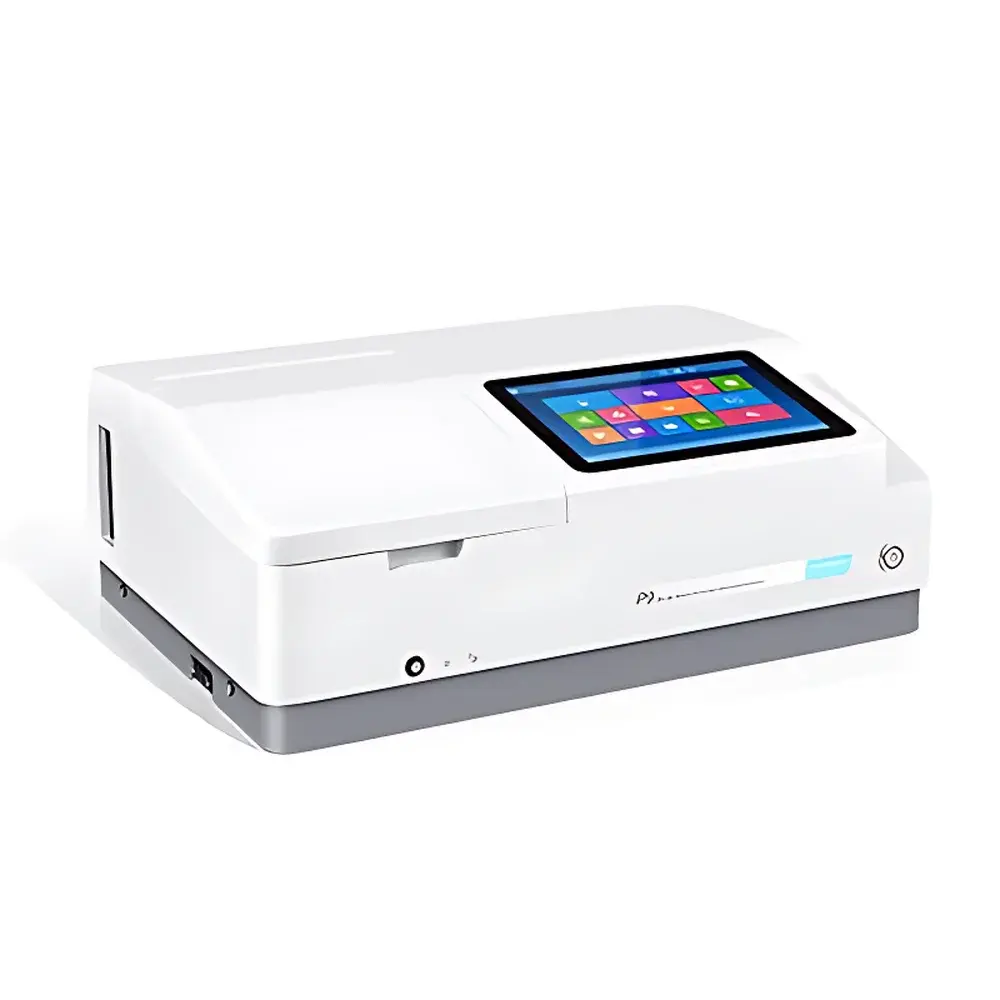
MPD P8 Dual-Beam Ultraviolet-Visible Spectrophotometer
| Brand | MPD |
|---|---|
| Origin | Shanghai, China |
| Manufacturer Type | Original Equipment Manufacturer (OEM) |
| Product Origin | Domestic (China) |
| Model | P8 |
| Instrument Architecture | Dual-Beam |
| Detector Type | Photocell |
| Wavelength Range | 190–1100 nm |
| Wavelength Scanning Mode | Automatic |
| Spectral Bandwidth | 1 nm |
| Wavelength Accuracy | ±0.3 nm |
Overview
The MPD P8 Dual-Beam Ultraviolet-Visible Spectrophotometer is an engineered analytical instrument designed for routine and research-grade quantitative and qualitative analysis of chemical species in solution across the ultraviolet, visible, and near-infrared spectral regions. Based on the dual-beam optical architecture, the P8 continuously splits the light path into sample and reference channels using a rotating mirror or beam splitter—enabling real-time compensation for source intensity drift, lamp aging, and electronic noise. This design ensures high photometric stability and measurement reproducibility over extended acquisition periods, making it suitable for time-resolved kinetic studies, concentration profiling, and compliance-driven QC workflows in pharmaceutical, environmental, food, and academic laboratories. The instrument operates on Beer–Lambert law principles, measuring absorbance (A), transmittance (T), and energy (E) with traceable wavelength calibration across its full 190–1100 nm range.
Key Features
- Dual-beam optical system with real-time background correction, minimizing baseline drift and enhancing long-term measurement fidelity.
- Automated wavelength scanning with ±0.3 nm accuracy and 1 nm spectral bandwidth—meeting ISO 9001-aligned performance expectations for UV-Vis instrumentation.
- Integrated photocell detector offering robust signal response across the entire operational range without requiring cryogenic cooling or external amplification.
- One-touch A/T/E mode switching for immediate conversion between absorbance, percent transmittance, and energy units—streamlining routine assay execution.
- Single-point calibration functionality: users may input a known extinction coefficient (K) to directly compute unknown sample concentrations via the Beer–Lambert equation (C = A / K·l).
- Custom method development environment supporting user-defined mathematical expressions—including arithmetic operations, logarithmic functions, and conditional logic—for application-specific data transformation.
- Method portability: saved formulas are reusable across multiple measurement modules (e.g., quantitation, kinetics, spectrum scanning) and persist through instrument power cycles.
Sample Compatibility & Compliance
The P8 accommodates standard 10 mm rectangular quartz or glass cuvettes (pathlengths from 1–50 mm supported via optional holders), enabling compatibility with aqueous, organic, and mildly corrosive solvents. It complies with general laboratory safety standards per IEC 61010-1 and electromagnetic compatibility requirements per CISPR 11. While not pre-certified for GMP or FDA 21 CFR Part 11 environments, its firmware supports audit-trail-ready operation when paired with validated third-party LIMS or ELN systems. Users may implement procedural controls—including operator logins, method versioning, and raw data export logs—to align with GLP and ISO/IEC 17025 documentation requirements.
Software & Data Management
The P8 is operated via Windows-compatible desktop software providing intuitive graphical interface navigation, spectral overlay, peak identification, and derivative analysis. All raw spectral data are stored in vendor-neutral ASCII (.txt) and CSV formats, ensuring interoperability with MATLAB, Python (NumPy/Pandas), and commercial chemometrics platforms. Software supports timestamped data capture, automatic file naming conventions, and batch report generation compliant with internal QA templates. Exported datasets include metadata such as wavelength calibration date, lamp usage hours, and operator ID—facilitating traceability in regulated settings.
Applications
- Pharmaceutical QC: assay of active pharmaceutical ingredients (APIs) per USP and EP 2.2.25 guidelines.
- Environmental monitoring: nitrate, phosphate, and COD determination in wastewater per APHA Standard Methods.
- Food & beverage analysis: colorimetric quantification of anthocyanins, carotenoids, and preservatives.
- Academic teaching labs: demonstration of electronic transitions, ligand field theory, and enzyme kinetics (e.g., NADH oxidation).
- Material science: thin-film transmittance/absorbance characterization for optical coating evaluation.
FAQ
Does the P8 support wavelength calibration verification using NIST-traceable holmium oxide or didymium filters?
Yes—the instrument includes a dedicated calibration verification routine compatible with standard reference materials including Holmium Oxide (NIST SRM 2034) and Didymium filters.
Can the P8 perform kinetic measurements at user-defined time intervals?
Yes—time-scan mode allows configurable sampling intervals from 0.1 s to 600 s, with up to 10,000 data points per run.
Is the software compatible with Windows 11 and 64-bit architectures?
Yes—the latest firmware and control software have been validated on Windows 10 and Windows 11 (64-bit) operating systems.
What is the typical warm-up time required before photometric measurements?
The deuterium and tungsten lamps achieve thermal and radiometric stability within 20 minutes of startup; automated self-check routines confirm readiness prior to measurement initiation.
Are cuvette holders available for non-standard pathlengths or microvolume applications?
Yes—optional accessories include 5 mm, 20 mm, and 50 mm pathlength holders, as well as a 2 µL microcell adapter with integrated alignment guides.



