
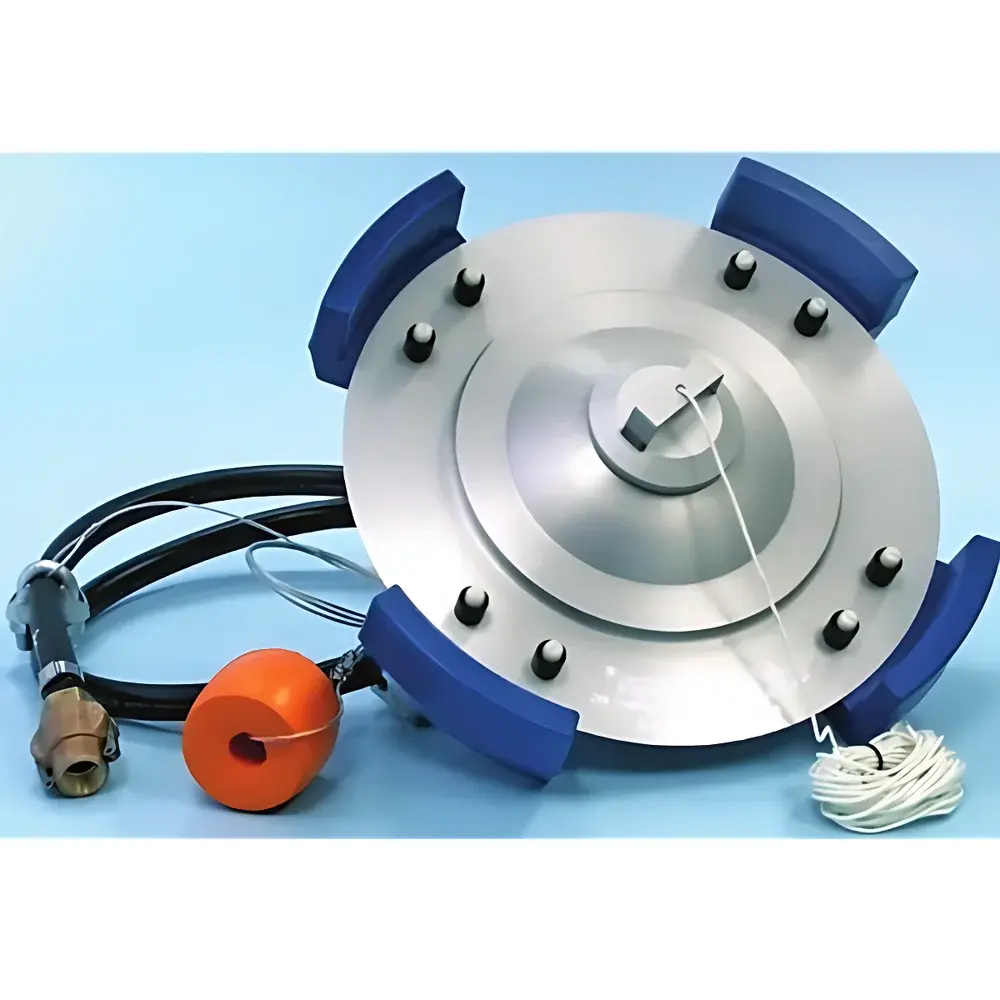
Gravity Feed Filter Scavenger by SAIL HERO
| Brand | SAIL HERO |
|---|---|
| Origin | Hebei, China |
| Manufacturer Type | Manufacturer |
| Country of Origin | China |
| Model | Gravity Feed Filter Scavenger |
| Pricing | Upon Request |
Overview
The Gravity Feed Filter Scavenger by SAIL HERO is a passive, gravity-driven hydrocarbon recovery device engineered for continuous, energy-free skimming of free-phase petroleum hydrocarbons from the water surface. Operating on the principle of density differential—where hydrocarbons with specific gravity < 1.0 naturally float atop aqueous phases—the unit leverages buoyancy and hydrostatic head to draw oil through a submerged intake into an integrated filtration chamber. Unlike active mechanical skimmers requiring pumps or motors, this system relies solely on gravitational flow and interfacial tension dynamics, making it inherently fail-safe, silent in operation, and suitable for intrinsically safe environments such as underground storage tank (UST) containment sumps, fueling station forecourts, and stormwater retention basins where explosion-proof certification or electrical infrastructure is unavailable or impractical.
Key Features
- Zero-energy operation: No electrical supply, motor, or compressed air required—ideal for remote, hazardous, or off-grid locations.
- Lightweight, modular construction: Engineered for rapid deployment and manual handling; unit weight optimized for single-operator installation without lifting equipment.
- Low-maintenance design: Absence of moving parts eliminates wear-related servicing; periodic visual inspection and filter media replacement constitute primary maintenance.
- Interchangeable filter mesh options: Standard configurations include 60-mesh (250 µm) and 100-mesh (150 µm) stainless steel or polymer-reinforced screens, selected based on target hydrocarbon viscosity and particulate load.
- Hydrocarbon selectivity: Optimized for free-floating light hydrocarbons—including gasoline, diesel, kerosene, and light crude—with specific gravity ranging from 0.70 to 0.95 and Saybolt Universal Viscosity (SSU) between 50 and 400 at 100 °F (37.8 °C).
- Chemical resistance: Housing and wetted components constructed from UV-stabilized polyethylene (PE) or polypropylene (PP), compatible with common petroleum fractions and resistant to oxidation and hydrolysis under ambient environmental exposure.
Sample Compatibility & Compliance
The Gravity Feed Filter Scavenger is validated for use with non-emulsified, low-surface-tension hydrocarbons exhibiting minimal water-in-oil or oil-in-water emulsification. It is not intended for recovered fluids containing >5% water content, suspended solids exceeding 100 mg/L, or highly viscous residues (e.g., heavy fuel oil No. 6, asphaltic sludge). Deployment complies with U.S. EPA guidance documents for passive oil recovery in UST secondary containment (40 CFR Part 280) and aligns with ASTM F1713–22 “Standard Guide for Selection of Oil Skimmers” for gravity-fed systems. While not certified to ATEX or IECEx standards, its intrinsic safety profile supports use in Class I, Division 2 hazardous locations per NEC Article 500 when installed per manufacturer-specified separation distances and venting protocols.
Software & Data Management
This is a purely mechanical, analog recovery system with no embedded electronics, firmware, or digital interface. Consequently, it does not incorporate software, data logging, telemetry, or connectivity features. Operational verification is performed visually—via observation of oil accumulation in the collection chamber and consistent flow through the discharge hose. For regulatory reporting or maintenance tracking, users are advised to integrate the unit into facility-wide environmental management systems (EMS) using manual logbooks or CMMS platforms compliant with ISO 14001:2015 and EPA RCRA Subpart J recordkeeping requirements.
Applications
- Secondary containment monitoring in underground storage tank systems (e.g., sump pits beneath dispensers or fill ports)
- Pre-treatment interception in fuel spill containment berms and drainage swales
- Stormwater treatment train integration upstream of oil-water separators or API separators
- Leak detection and mitigation at pipeline right-of-way access points and valve vaults
- Temporary spill response during tank truck unloading or mobile refueling operations
- Long-term passive surveillance in environmentally sensitive zones where power availability is constrained
FAQ
Does this unit require electricity or compressed air to operate?
No. The Gravity Feed Filter Scavenger operates exclusively via gravity and interfacial density differentials—no external power source is needed.
Can it recover emulsified or water-contaminated oil?
No. It is designed only for free-phase, non-emulsified hydrocarbons with low water content (<5% v/v); emulsions must be broken prior to skimming.
What maintenance intervals are recommended?
Inspect weekly for debris blockage and screen integrity; replace filter mesh after 200–300 cumulative hours of oil contact or upon visible clogging—frequency depends on site-specific hydrocarbon loading and particulate concentration.
Is calibration or performance verification required?
Not applicable. As a passive mechanical device without sensors or flow meters, performance is verified qualitatively through visual oil accumulation rate and consistency of discharge flow.
Can it be used in saltwater or brackish environments?
Yes—housing materials exhibit resistance to chloride-induced stress cracking; however, prolonged immersion in high-salinity water may accelerate biofouling on mesh surfaces, necessitating more frequent cleaning.







