
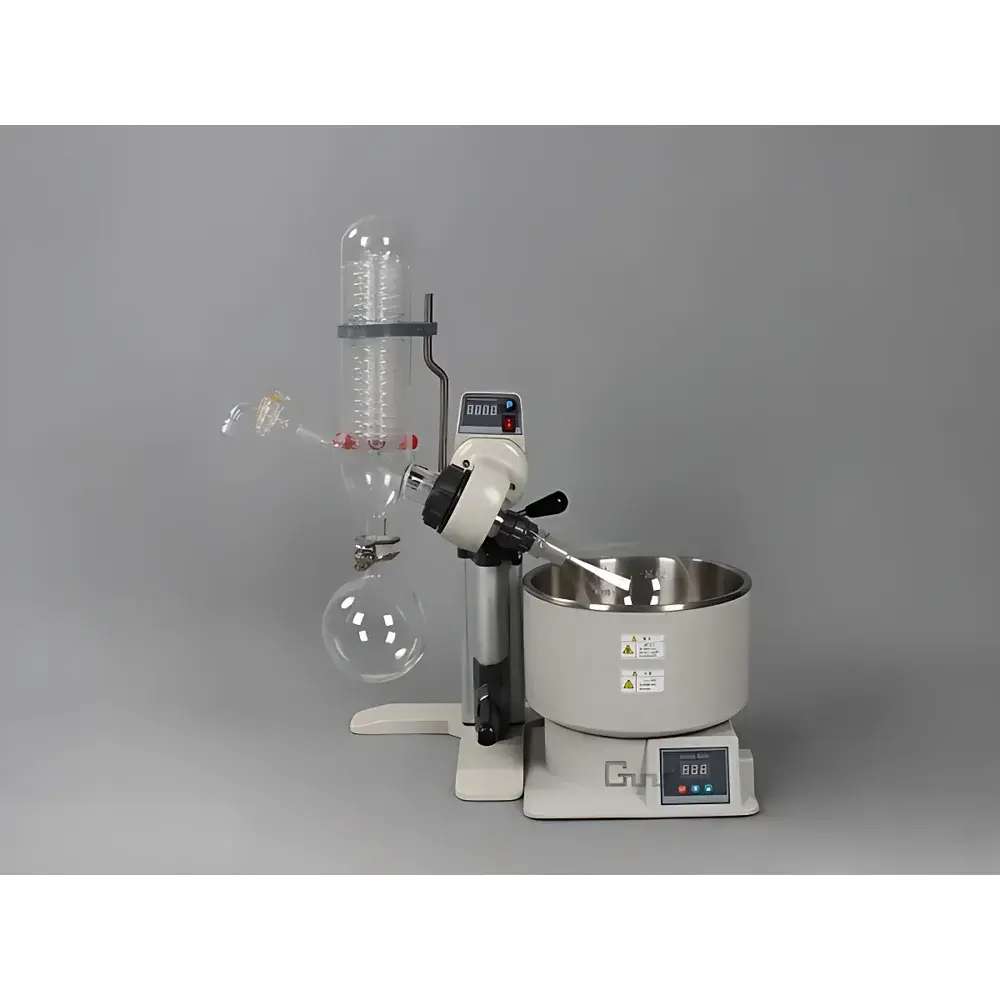
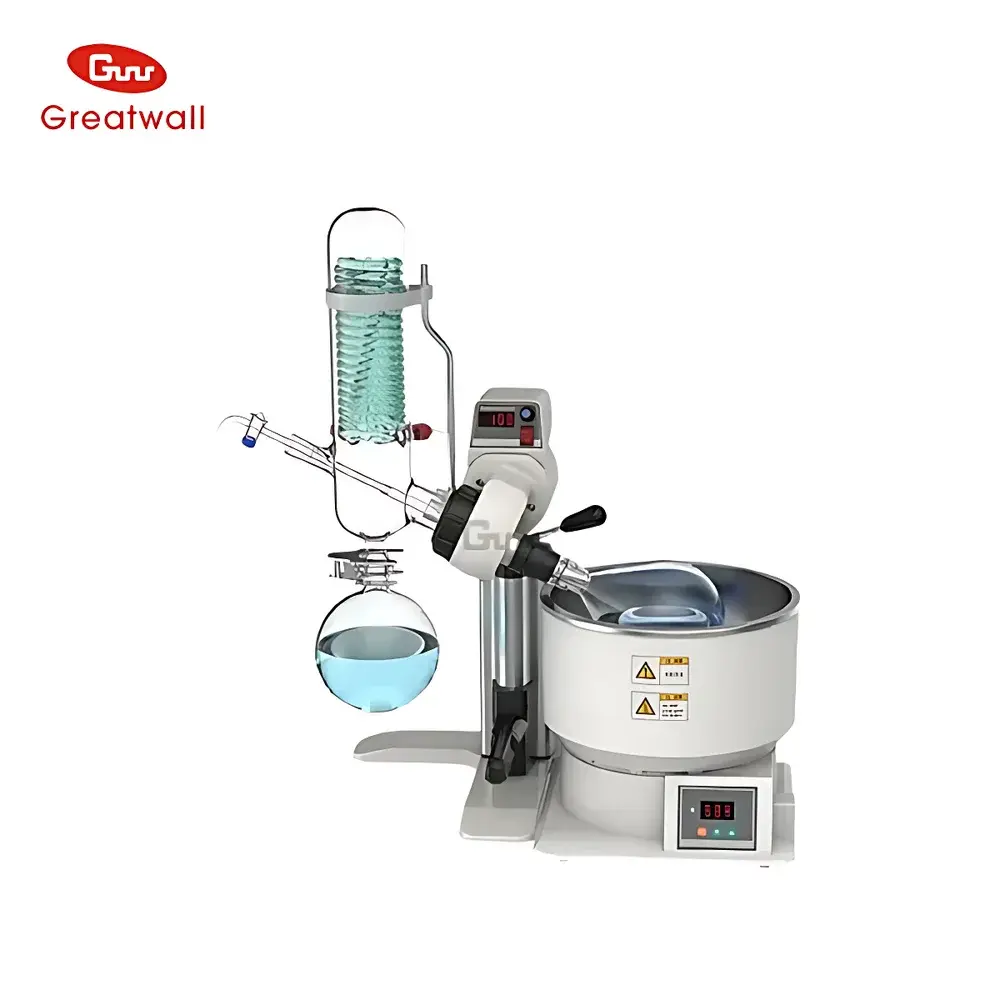
The Great Wall R-1001VN Rotary Evaporator
| Brand | The Great Wall |
|---|---|
| Origin | Henan, China |
| Manufacturer Type | Direct Manufacturer |
| Origin Category | Domestic (China) |
| Model | R-1001VN |
| Price Range | USD 700–1,400 (FOB) |
| Collection Flask Capacity | 1000 mL |
| Rotation Speed | 10–280 rpm |
| Temperature Control Range | Ambient +5°C to 95°C |
| Condensing Area | 0.126 m² |
| Sealing | PTFE-modified + Fluoroelastomer Dual-Seal Ring |
| Condenser Type | Vertical High-Efficiency Double-Return |
| Evaporation Rate (Water) | ~15 mL/min |
| Motor Power | 25 W |
| Display | Digital LED for Speed & Bath Temperature |
| Temperature Control Method | PID |
| Lift Mechanism | Manual Balanced Lift with 100 mm Sliding + 150 mm Manual Extension |
| Protection Functions | Overcurrent & Short-Circuit Protection |
| Operating Environment | 5–40°C, ≤70% RH |
| Power Supply | 220–240 V~, 50/60 Hz |
| Dimensions (W×D×H mm) | 640 × 400 × 670 (920 extended) |
| Net Weight | 9.5 kg |
Overview
The Great Wall R-1001VN Rotary Evaporator is a benchtop vacuum distillation system engineered for precise solvent removal, concentration, and gentle separation of thermally sensitive compounds in academic, pharmaceutical, and industrial R&D laboratories. It operates on the fundamental principle of reducing the boiling point of solvents under controlled vacuum while simultaneously rotating the sample flask to increase surface area and promote uniform thin-film evaporation. The system integrates a vertical high-efficiency double-return condenser (0.126 m² cooling area), digitally regulated heating bath (ambient +5°C to 95°C), and a robust 25 W brushless motor delivering smooth, low-vibration rotation across a wide speed range (10–280 rpm). Its modular architecture—featuring physically separated heating bath and main drive unit—enables flexible configuration with external vacuum pumps, chillers, or solvent traps, supporting both small-scale screening and pilot-scale batch processing.
Key Features
- PTFE-modified + fluoroelastomer dual-seal ring design ensures long-term vacuum integrity with leakage rate ≤0.33 kPa/min—critical for reproducible distillation under deep vacuum (e.g., <10 mbar).
- Vertical double-return condenser maximizes thermal exchange efficiency and minimizes solvent carryover, especially during high-boiling-point or low-volatility compound recovery.
- PID temperature control delivers ±0.5°C stability across the full 5–95°C operating range, enabling precise optimization of evaporation kinetics without thermal degradation.
- Digital LED display provides real-time monitoring of both rotational speed and bath temperature—eliminating analog interpretation errors and supporting documented parameter logging.
- Manually balanced lift mechanism offers 100 mm motorized sliding travel plus 150 mm manual extension, accommodating diverse flask geometries (500 mL or 1000 mL rotation flasks) and simplifying flask installation/removal.
- Overcurrent and short-circuit protection circuits comply with IEC 61010-1 safety requirements for laboratory electrical equipment.
Sample Compatibility & Compliance
The R-1001VN is compatible with standard ISO/DIN 2972 ground-glass joints (e.g., 24/29, 29/32) and accepts common borosilicate glassware—including 500 mL and 1000 mL round-bottom flasks and 1000 mL collection flasks. Its chemically resistant PTFE-fluoroelastomer seal interface maintains compatibility with polar solvents (e.g., methanol, acetone), chlorinated solvents (e.g., DCM, chloroform), and moderately aggressive reagents. While not certified for GMP manufacturing environments, the instrument meets general laboratory safety standards per IEC 61010-1 and supports GLP-aligned workflows when paired with validated vacuum pumps and temperature calibration records. Its open architecture facilitates integration into IQ/OQ protocols for lab qualification.
Software & Data Management
The R-1001VN operates as a standalone analog-digital hybrid system with no embedded firmware or proprietary software. All operational parameters—speed, temperature, and time—are manually set and visually recorded. For traceable data capture, users may integrate external USB data loggers or PLC-based controllers via analog 0–10 V or 4–20 mA signal interfaces (optional accessory). Though lacking FDA 21 CFR Part 11-compliant audit trails out-of-the-box, its stable analog control loop and digital readouts support manual SOP execution and paper-based batch documentation consistent with early-phase research and teaching labs.
Applications
- Solvent recovery and concentration of natural product extracts (e.g., plant alkaloids, essential oils) under mild thermal conditions.
- Removal of low-boiling solvents (e.g., ethyl acetate, hexane) following column chromatography or solid-phase extraction.
- Pre-concentration of aqueous samples prior to HPLC or GC-MS analysis.
- Distillative purification of heat-labile intermediates in synthetic organic chemistry.
- Teaching core principles of vacuum distillation, Raoult’s law, and film evaporation dynamics in undergraduate chemistry laboratories.
FAQ
What vacuum level is recommended for optimal performance with the R-1001VN?
For most organic solvents, a working vacuum of 10–50 mbar—achievable with a two-stage diaphragm pump—is sufficient to balance evaporation rate and condensation efficiency.
Can the R-1001VN be used with corrosive solvents such as concentrated HCl or bromine?
No. While the PTFE-fluoroelastomer seal resists many organics and weak acids, it is not rated for strong oxidizers, halogens, or mineral acids at elevated temperatures.
Is the heating bath interchangeable with other Great Wall models?
Yes—the R-1001VN uses standardized DIN-mounting interfaces; compatible baths include the DF-101S and RE-52AA series, provided voltage and power ratings match.
Does the unit include a vacuum controller or pressure sensor?
No. Vacuum regulation requires an external vacuum controller or manual needle valve; optional pressure sensors (e.g., capacitance manometers) can be added via standard NPT or KF fittings.
What maintenance intervals are recommended for long-term reliability?
Inspect seals every 6 months; lubricate lift mechanism annually; calibrate bath temperature sensor biannually using a traceable PT100 reference probe.



