
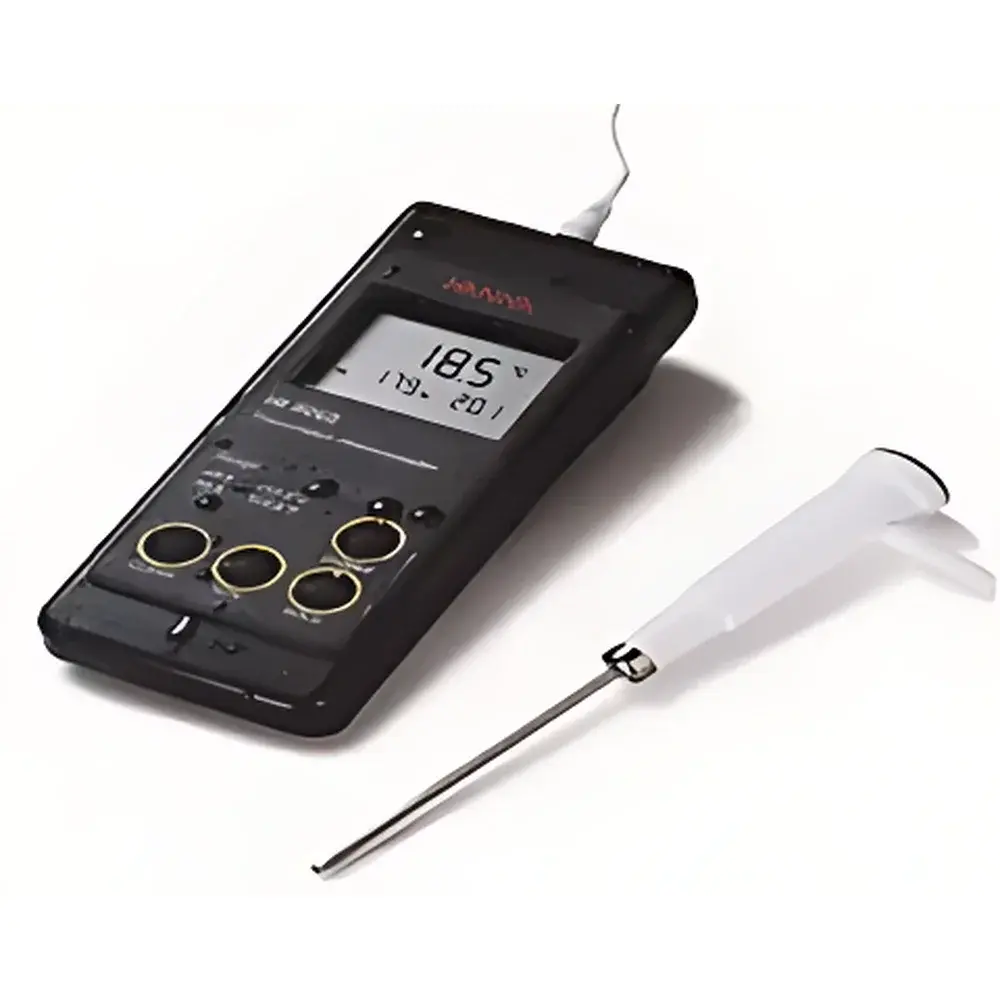
The Great Wall 272-1 Metal-Cased Psychrometer
| Brand | The Great Wall |
|---|---|
| Origin | Shanghai, China |
| Model | 272-1 Metal-Cased |
| Instrument Type | Psychrometer (Wet-and-Dry Bulb Thermometer) |
| Category | Thermo-Hygrometer |
| Manufacturing Status | Domestic Production |
| Distributor Type | General Distributor |
| Pricing | Upon Request |
Overview
The Great Wall 272-1 Metal-Cased Psychrometer is a manually operated, dual-sensor mechanical hygrometric instrument engineered for reliable determination of ambient relative humidity (RH) and dry-bulb air temperature in non-automated field and laboratory environments. Based on the fundamental principle of evaporative cooling, this device employs two identical mercury-in-glass thermometers mounted side-by-side within a robust galvanized steel housing: one with an exposed bulb (dry bulb) and the other wrapped with a water-saturated muslin wick (wet bulb). As ambient air flows across both bulbs—either by natural convection or via optional hand-held ventilation—the differential temperature depression between the wet and dry bulbs is measured. This depression, combined with the dry-bulb reading, is referenced against standardized psychrometric tables (e.g., ASHRAE Fundamentals Handbook, ISO 7726) to derive RH with typical accuracy of ±5% RH under stable conditions. Designed for long-term durability and minimal drift, the 272-1 complies with basic metrological requirements for Class B mechanical psychrometers per GB/T 9348–2008 (Chinese National Standard for Mechanical Hygrometers) and aligns with general-purpose environmental monitoring needs in settings where electronic data logging is not mandated.
Key Features
- Metal-cased construction using corrosion-resistant galvanized steel for enhanced mechanical integrity and longevity in humid, dusty, or semi-industrial environments
- Two matched mercury-in-glass thermometers calibrated as a pair to minimize systematic error in wet-bulb depression measurement
- Integrated wick holder and water reservoir cup facilitating consistent wet-bulb saturation during operation
- Clear, engraved scale with dual graduations: °C (−10 to +50°C, 1°C divisions) for dry-bulb; °C (0 to +40°C, 0.5°C divisions) for wet-bulb
- Fixed mounting bracket and hanging hook enabling wall or tripod installation for stationary monitoring
- No battery, power supply, or firmware required—fully passive operation ensuring intrinsic safety and zero electromagnetic interference
Sample Compatibility & Compliance
The 272-1 is intended exclusively for ambient air sampling under atmospheric pressure (80–106 kPa) and moderate airflow conditions (≥0.5 m/s recommended for optimal evaporation). It is unsuitable for use in sealed enclosures, high-velocity airstreams (>5 m/s), corrosive gas environments (e.g., Cl₂, NH₃), or locations with condensing moisture on instrument surfaces. While not certified to ISO/IEC 17025 for accredited calibration, its design conforms to functional requirements outlined in GB/T 9348–2008 and supports routine verification against NIST-traceable reference hygrometers. For regulated environments—including GLP-compliant agricultural research stations, tobacco curing facilities operating under national quality standards (e.g., YC/T 236–2008), or food processing QA checkpoints—the instrument serves as a primary field reference where traceable digital loggers are deployed downstream for audit trails.
Software & Data Management
This is a purely analog, manual-read instrument with no embedded electronics, connectivity interfaces, or software dependencies. All measurements require visual interpolation of thermometer readings followed by manual lookup in printed psychrometric charts or calculation using the August-Roche-Magnus formula. Users may digitize results using external spreadsheet tools or LIMS-compatible templates. No FDA 21 CFR Part 11 compliance features are present, nor is electronic audit trail functionality supported—consistent with its classification as a basic metrological tool rather than a regulated data acquisition system.
Applications
- Grain storage management: Monitoring RH gradients within silos and warehouses to prevent mold growth and aflatoxin risk (per GB 2715–2016)
- Agricultural greenhouse and mushroom cultivation: Maintaining species-specific RH setpoints during critical growth phases
- Sericulture operations: Controlling humidity during silkworm rearing and cocoon drying per industry guidelines (SB/T 10142–2012)
- Tobacco leaf curing barns: Verifying RH profiles during yellowing, fixing, and drying stages to ensure chemical stability and aroma retention
- Food dehydration and baking facilities: Validating ambient conditions prior to chamber loading to avoid surface case-hardening
- Field meteorological observation: Supporting educational and community-level weather recording programs without reliance on solar charging or signal infrastructure
FAQ
Is the 272-1 suitable for continuous unattended monitoring?
No—it requires periodic manual reading and wick re-saturation; it does not support automatic data recording or remote telemetry.
Can it be used indoors and outdoors interchangeably?
Yes, provided ambient temperatures remain within the specified range (−10°C to +50°C) and the instrument is shielded from direct solar radiation and rain during outdoor use.
Does it require annual recalibration?
While mercury thermometers exhibit excellent long-term stability, users should verify agreement between dry- and wet-bulb scales annually against a certified reference thermometer in a controlled humidity chamber.
What maintenance is required?
Regular cleaning of glass bulbs with isopropyl alcohol, replacement of wicks every 3–6 months depending on usage frequency and water quality, and inspection of housing for galvanic coating integrity.
Related Products



