
HsiangTai SM-3C Cryogenic Knife Mill
| Brand | HsiangTai |
|---|---|
| Origin | Taiwan |
| Model | SM-3C |
| Instrument Type | Cryogenic Knife Mill |
| Sample Applicability | Hard, Heat-Sensitive, High-Fat/High-Moisture Materials |
| Feed Size | ≤10 mm |
| Final Particle Size | 0.01–0.5 mm (typical) |
| Batch Capacity | 150 mL |
| Speed Range | 0–30,000 rpm |
| Motor Power | 700 W |
| Voltage/Frequency | AC 220 V, 50/60 Hz |
| Dimensions | Φ182 × 330 mm |
| Weight | 6 kg |
| Cooling Method | External Circulating Cryogenic Fluid (e.g., Ethylene Glycol/Water or Liquid Nitrogen-Compatible Jacket) |
Overview
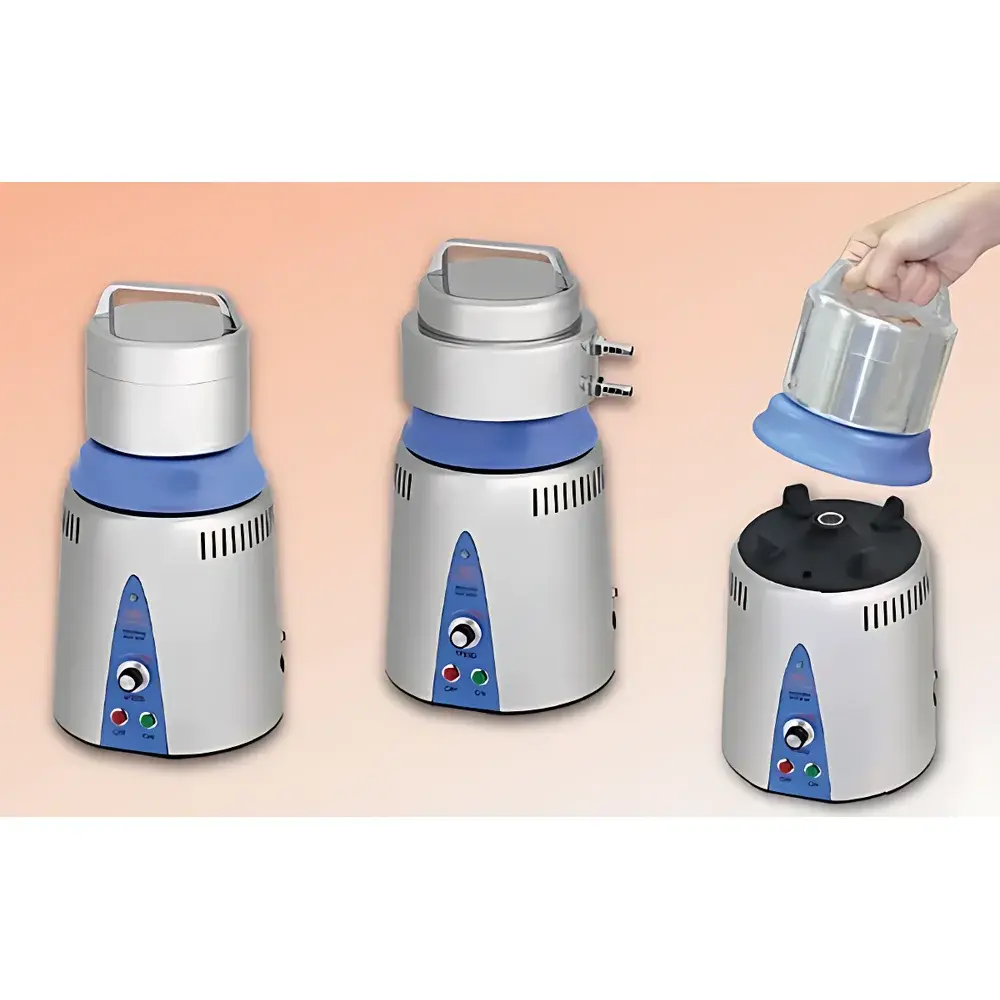
The HsiangTai SM-3C Cryogenic Knife Mill is a compact, high-speed laboratory grinding system engineered for the controlled size reduction of thermally labile, ductile, or high-fat samples. It operates on the principle of high-shear mechanical comminution using a precision-machined rotating knife assembly within a jacketed stainless-steel grinding chamber. Unlike ambient-temperature mills, the SM-3C integrates a double-walled cryogenic cooling jacket that enables continuous circulation of chilled fluid—typically a glycol–water mixture at –20 °C to –40 °C, or liquid nitrogen for ultra-low-temperature applications—to actively extract frictional heat generated during high-RPM shearing. This thermal management preserves sample integrity by maintaining brittle physical behavior in otherwise pliable matrices (e.g., fish tissue, herbal extracts, or fatty seeds), thereby preventing smearing, agglomeration, and thermal degradation of analytes such as lipids, volatile oils, enzymes, or labile phytochemicals.
Key Features
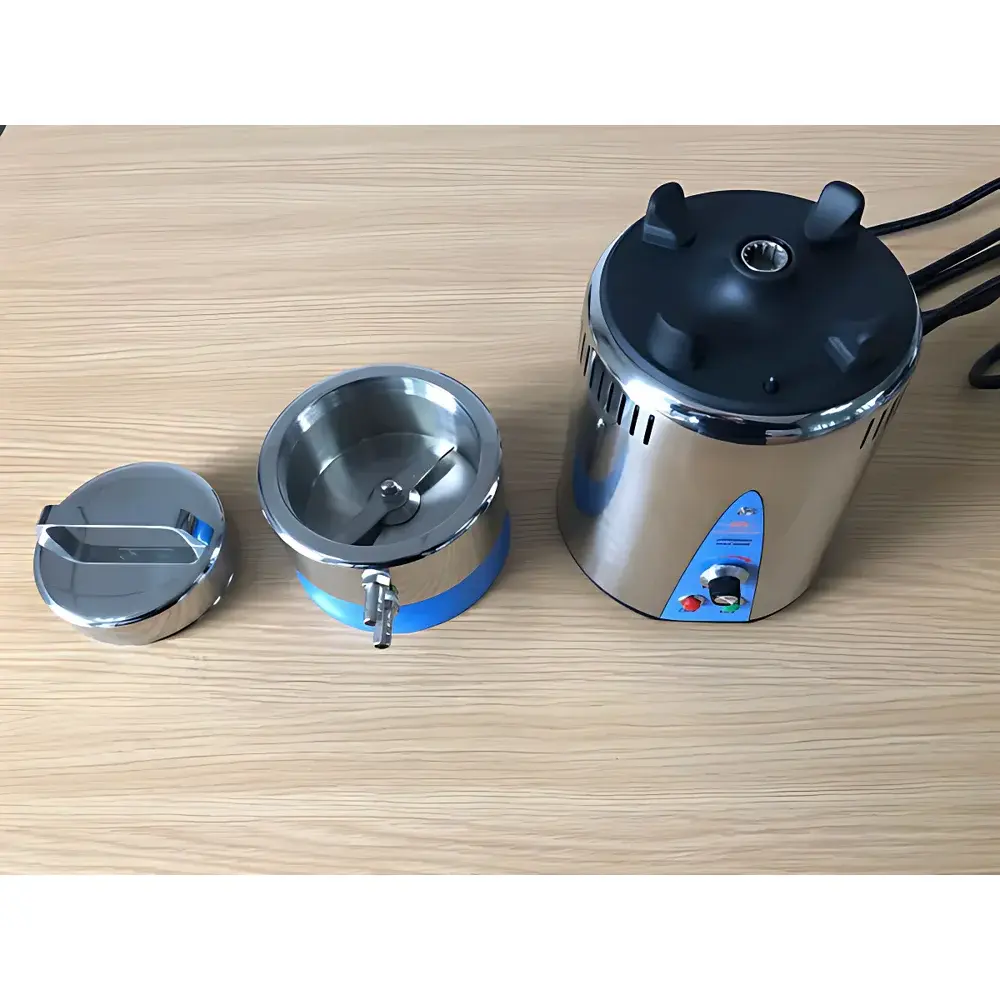
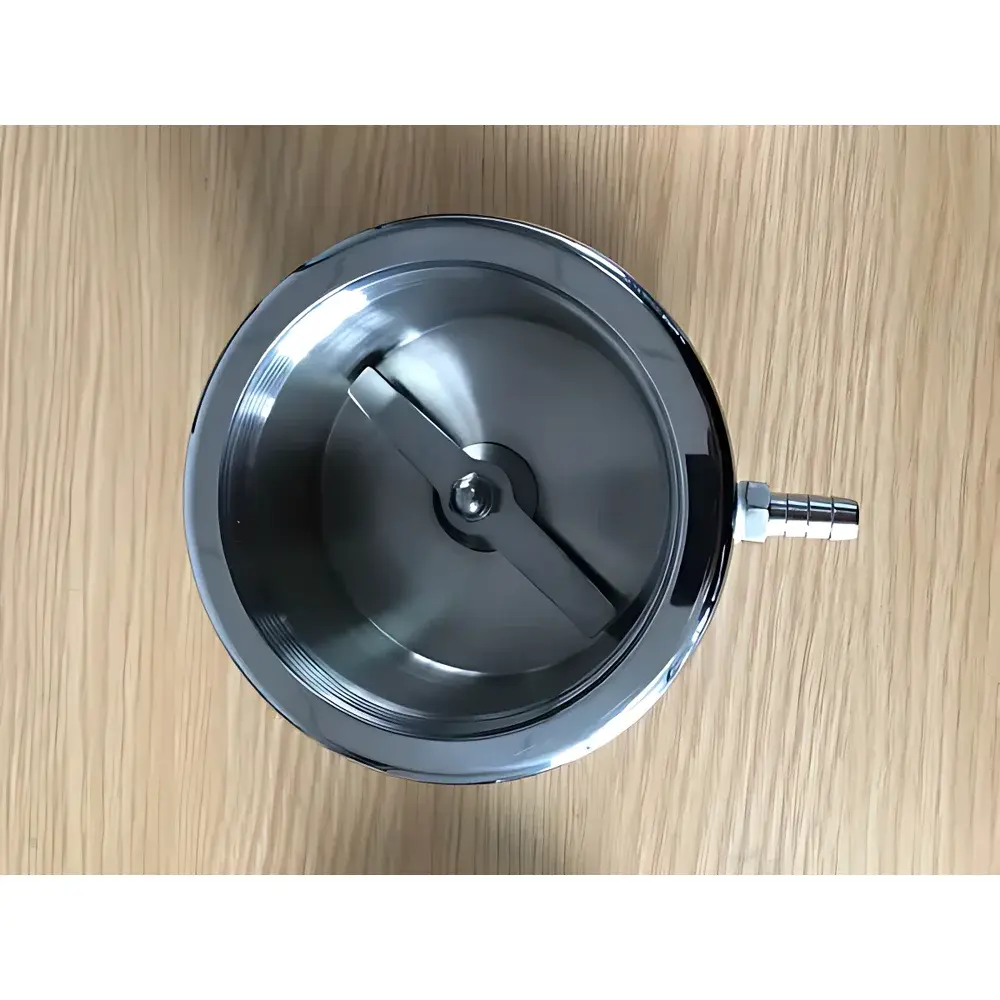
- Cryogenic Jacket Design: Stainless-steel grinding cup features an integrated double-wall cooling jacket compatible with standard recirculating chillers or LN₂ delivery systems—enabling stable sub-zero operating temperatures throughout grinding cycles.
- Modular Separation Architecture: Motor base and grinding cup are mechanically decoupled; the cup mounts via a quick-lock interface, facilitating rapid removal for cleaning, cross-contamination control, and residue-free sample recovery.
- High-Speed Rotor System: Brushless DC motor delivers precise speed control from 0 to 30,000 rpm, supporting reproducible energy input across diverse material classes—from fibrous botanicals to brittle ceramics.
- Integrated Safety Protocols: Includes soft-start acceleration, automatic motor cutoff upon cup disengagement, thermal overload protection, and electronic current monitoring to prevent stalling or overheating under load.
- Tooling Flexibility: Standard L1 blade optimized for general-purpose cryo-grinding; optional EX-LID enables micro-volume processing (<500 mg) and secondary fine grinding; transparent acrylic lid permits real-time visual assessment of particle dispersion and homogeneity.
Sample Compatibility & Compliance
The SM-3C is validated for use with biological tissues (fish muscle, liver, plant leaves), pharmaceutical excipients and APIs, agricultural commodities (grains, seeds, feed pellets), environmental matrices (soil, sediment), and inorganic powders (ceramics, minerals). Its closed-cup configuration minimizes aerosol generation and supports GLP-aligned sample preparation workflows. While not certified to ISO/IEC 17025 or FDA 21 CFR Part 11 out-of-the-box, the system’s repeatable process parameters (speed, time, temperature setpoint) and traceable tooling (blade lot numbers, lid type) facilitate integration into auditable analytical methods compliant with ASTM D7429 (for particle size analysis of biomass), USP <724> (drug product uniformity), and ISO 13320 (laser diffraction particle sizing pre-treatment protocols).
Software & Data Management
The SM-3C operates via front-panel digital controls with rotary encoder and LCD display—no proprietary software required. Speed and runtime are manually set and retained in non-volatile memory. For laboratory information management system (LIMS) integration, users may log operational parameters (e.g., “SM-3C, 25,000 rpm, 6 s, –35 °C coolant temp, EX-LID”) alongside sample IDs in electronic lab notebooks (ELNs) adhering to ALCOA+ principles. Optional external data loggers can record coolant inlet/outlet temperatures and motor current draw for method validation and equipment performance trending.
Applications
- Preparation of homogeneous subsamples for elemental analysis (ICP-MS/OES) of soil and plant tissue without carbon loss or metal redistribution.
- Routine homogenization of frozen animal tissues prior to RNA extraction—preserving transcript integrity by suppressing RNase activity.
- Particle size standardization of herbal powders for HPLC fingerprinting and quantitative phytochemical assays.
- Production of uniformly fine feedstock for XRD and SEM sample mounting—particularly for hygroscopic or low-melting-point organics.
- QC grinding of pharmaceutical granules and tablets to assess content uniformity per USP <905>.
FAQ
What cryogenic fluids are compatible with the SM-3C cooling jacket?
Ethylene glycol–water mixtures (e.g., 30:70 v/v) circulated via external chiller units are recommended for routine operation (–20 °C to –40 °C). Liquid nitrogen may be used with appropriate pressure-regulated delivery and vapor-phase monitoring to avoid thermal shock or condensation-induced ice buildup.
Can the SM-3C achieve sub-micron particle sizes consistently?
While nominal output ranges from 0.01–0.5 mm, achieving ~1 µm requires optimized conditions: use of the EX-LID, pre-chilled samples, short repeated bursts (3 × 3 s), and post-grind sieving or sonication-assisted dispersion—not guaranteed for all materials due to inherent ductility limits.
Is the L1 blade autoclavable?
Yes—the stainless-steel L1 blade and grinding cup are autoclavable (121 °C, 20 min, gravity cycle); however, prolonged exposure to steam may accelerate wear on the blade edge geometry over repeated cycles.
How often should the blade be replaced?
Under typical use (≤50 batches/week of medium-hardness samples), blade replacement is advised every 6–12 months—or sooner if observed reduction in grinding efficiency, increased noise, or visible edge rounding under magnification.
Does the SM-3C comply with CE or UL safety standards?
The unit meets IEC 61000-6-2 (immunity) and IEC 61000-6-4 (emissions) for industrial environments; CE marking applies to the EU-supplied variant. UL listing is not held, but design conforms to UL 61010-1 general safety requirements for laboratory electrical equipment.



