
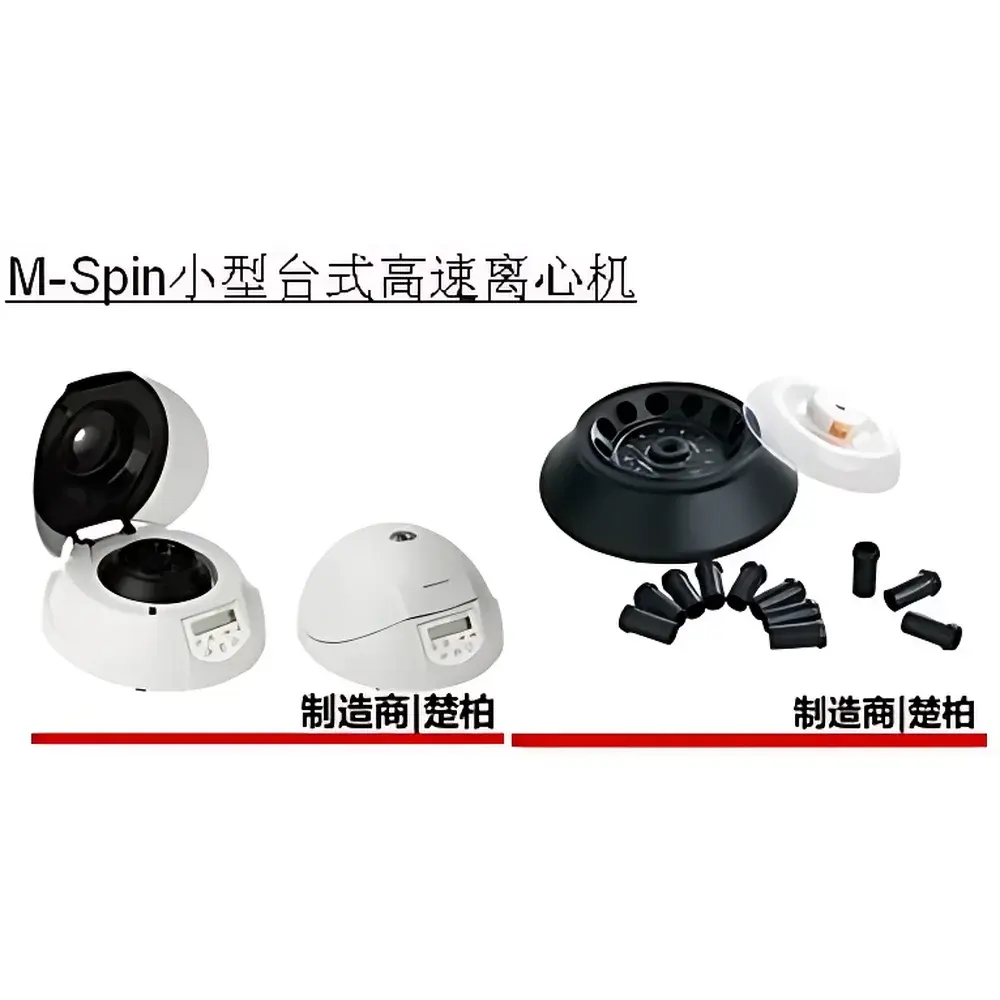
Truelab M-Spin Compact Benchtop High-Speed Centrifuge
| Brand | Truelab |
|---|---|
| Origin | Shanghai, China |
| Type | Benchtop Centrifuge |
| Category | High-Speed Centrifuge (800–14,500 rpm) |
| Max. Capacity | 12 × 2 mL |
| Max. Speed | 14,500 rpm |
| Max. RCF | 14,100 × g |
| Acceleration Time | 13 s (to max speed) |
| Deceleration Time | 12 s |
| Timer Range | 15 s – 99 min |
| Power Supply | 220 V, 50 Hz |
| Power Consumption | 80 W |
| Dimensions (L×W×H) | 22.5 × 24 × 12 cm |
| Net Weight (incl. rotor) | 4.3 kg |
| Safety Certification | IEC 61010-2-020 |
| Rotor Material | Anodized Aluminum Alloy |
| Sterilization Compatibility | Autoclavable (121°C, 20 min) |
| Display | Digital LED |
| Control Interface | Keypad with Instant Spin Button |
| Cooling | Passive Air Exchange System |
| Lid Mechanism | Motorized Auto-Opening Post-Rotation |
Overview
The Truelab M-Spin Compact Benchtop High-Speed Centrifuge is an engineered solution for laboratories requiring precise, repeatable, and space-efficient separation of microliter-scale biological and chemical samples. Designed according to the operational principles of fixed-angle high-speed centrifugation—where sample tubes are held at a fixed angle (typically 45°) relative to the rotation axis—the M-Spin achieves rapid sedimentation of particles based on density, size, and molecular weight differences under controlled gravitational forces. Its compact footprint (22.5 × 24 × 12 cm) and lightweight construction (4.3 kg) make it ideal for crowded benchtop environments, including academic teaching labs, QC/QA facilities, clinical diagnostics support units, and R&D workstations handling routine nucleic acid extraction, protein precipitation, cell pelleting, and microfiltration prep. The unit operates within a precisely regulated speed range of 800–14,500 rpm (in 1,000 rpm increments), delivering up to 14,100 × g RCF—sufficient for pelleting most mammalian cells, bacteria, subcellular organelles, and macromolecular complexes without requiring refrigeration.
Key Features
- Fixed-angle aluminum alloy rotor (12 × 2 mL capacity) with precision-machined tube pockets ensuring balanced load distribution and minimal vibration at high speeds
- Digital LED display with intuitive keypad interface and dedicated instant-spin button for rapid, hands-free short-duration centrifugation (down to 15 seconds)
- Optimized passive thermal management system: engineered airflow channels dissipate rotor heat efficiently, maintaining ambient temperature stability during extended runs—critical for temperature-sensitive biomolecules
- Motorized lid actuation: automatic lid opening upon completion of the run reduces manual handling time and minimizes cross-contamination risk
- IEC 61010-2-020 certified safety architecture, including dual mechanical and electronic lid interlocks, imbalance detection, and over-speed protection circuitry
- Autoclavable rotor assembly compatible with standard steam sterilization cycles (121°C, 20 min), supporting GLP-compliant workflows in microbiology and sterile processing applications
Sample Compatibility & Compliance
The M-Spin accommodates standard 1.5 mL and 2.0 mL conical-bottom microcentrifuge tubes (e.g., Eppendorf-type), including polypropylene, polyethylene, and PCR-grade variants. It is validated for use with common laboratory reagents—including ethanol, isopropanol, chloroform, phenol-chloroform mixtures, and aqueous buffers—without rotor degradation. The anodized aluminum rotor exhibits high resistance to corrosion from organic solvents and mild acids/bases. All electrical and mechanical design elements conform to IEC 61010-2-020 for laboratory equipment safety. While not a regulated medical device, its performance consistency supports adherence to ISO/IEC 17025 quality requirements for testing laboratories when used in validated SOPs.
Software & Data Management
The M-Spin operates as a standalone instrument with no embedded software or network connectivity. All operational parameters—including speed (rpm), RCF (× g), time (seconds/minutes), and acceleration/deceleration profiles—are set directly via front-panel controls and retained in non-volatile memory across power cycles. No data logging, audit trail, or electronic record functionality is provided; therefore, the device does not claim compliance with FDA 21 CFR Part 11. Users intending to integrate the centrifuge into GxP-regulated environments must implement external documentation practices (e.g., handwritten logbooks or LIMS-integrated run records) to satisfy traceability requirements.
Applications
- Routine pelleting of bacterial and yeast cultures prior to DNA/RNA extraction
- Clarification of lysates and supernatants in protein purification workflows
- Separation of phase layers in organic-aqueous extractions (e.g., TRIzol®-based RNA isolation)
- Concentration of viral particles, exosomes, or synthetic nanoparticles
- Microscale cleanup of PCR products and enzymatic reaction mixtures
- Pre-analytical sample preparation for HPLC, mass spectrometry, and ELISA assays
FAQ
Is the rotor autoclavable?
Yes—the aluminum rotor is fully autoclavable at 121°C for 20 minutes. Ensure complete drying before reuse to prevent oxidation.
Can I use this centrifuge for blood serum separation?
It is suitable for microvolume serum separation (e.g., capillary blood samples in 1.5 mL tubes) but not intended for primary whole-blood processing in clinical diagnostic settings.
Does the M-Spin generate significant noise during operation?
Acoustic emission is minimized through precision-balanced rotor dynamics and sound-dampening housing; typical operating noise level is ≤58 dB(A) at 1 m distance.
What is the minimum time increment for timer setting?
The shortest programmable duration is 15 seconds, enabling precise control for quick spin-down of condensation or brief pellet consolidation.
Is a calibration certificate included with shipment?
No factory calibration certificate is supplied by default. Users requiring metrological traceability should engage an accredited third-party service provider for annual speed and timer verification per ISO/IEC 17025 guidelines.



