
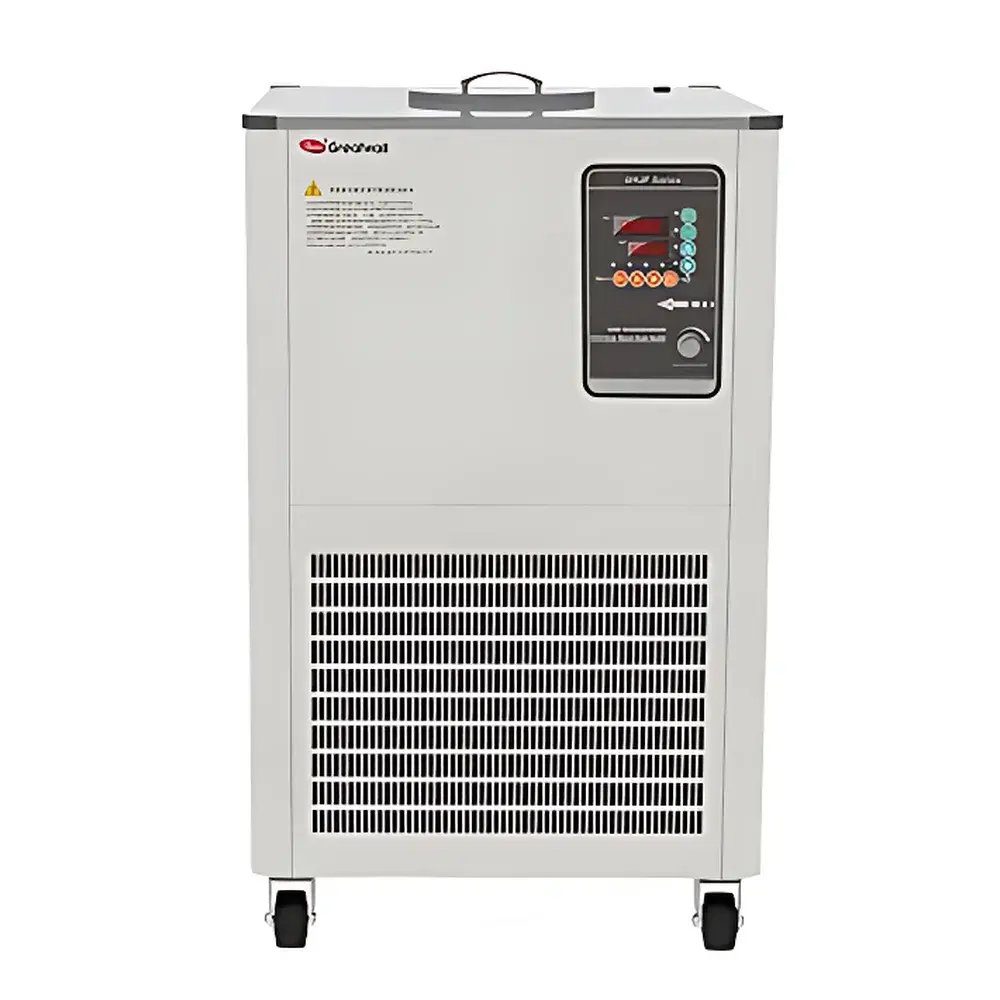
Great Wall DHJF-1010 Low-Temperature Constant-Temperature Stirred Bath
| Brand | The Great Wall |
|---|---|
| Origin | Henan, China |
| Manufacturer Type | Original Equipment Manufacturer (OEM) |
| Country of Manufacture | China |
| Model | DHJF-1010 |
| Quotation | Upon Request |
| Refrigeration System | Single-stage compression with cascade subcooling design |
| Compressor | Tecumseh hermetic piston compressor |
| Condenser | Air-cooled, oxygen-free copper spiral tube |
| Heat Exchanger | Fully welded series-connected multi-stage heat exchanger |
| Throttling Device | Capillary tube |
| Evaporator | Coil-type, immersed in bath reservoir |
| Temperature Control | Digital microprocessor controller with 0.1 °C display resolution |
| Bath Volume | 10 L |
| Operating Temperature Range | −100 °C to −60 °C |
| Temperature Stability | ±2 °C |
| Rated Power | 2050 W |
| Refrigerant | Mixed refrigerant blend (R508B/R23 or equivalent) |
| Cooling Capacity | 160 W at −60 °C |
| Magnetic Stirring Power | 50 W |
| Stirring Speed Range | 100–1000 rpm |
| Ambient Operating Conditions | 5–35 °C, ≤70% RH |
| Power Supply | 3-phase, 380 V ±10%, 50 Hz |
| Drain Port | 1/2″ BSP |
| Reservoir Opening Diameter | Ø210 mm |
| Reservoir Dimensions | Ø250 × 250 mm |
| Max Flask Capacity | 3000 mL |
| Bath Material | AISI 304 stainless steel |
| Overall Dimensions (W×D×H) | 670 × 780 × 1085 mm |
| Net Weight | 150 kg |
Overview
The Great Wall DHJF-1010 Low-Temperature Constant-Temperature Stirred Bath is an engineered solution for laboratory-scale cryogenic reaction control and thermal stabilization of chemical, pharmaceutical, and materials science processes requiring precise subzero temperature maintenance between −100 °C and −60 °C. Unlike conventional single-stage refrigeration baths limited to −40 °C or higher, the DHJF-1010 implements a proprietary single-stage compression with cascade subcooling architecture—enabling deep-cold operation without the complexity, cost, or footprint of true multi-compressor cascade systems. Its core thermodynamic design integrates a Tecumseh hermetic piston compressor, air-cooled copper-spiral condenser, fully welded series-connected heat exchangers, capillary throttling, and a submerged coil-type evaporator housed within a 10 L AISI 304 stainless steel reservoir. This configuration ensures structural integrity, minimal leak paths, and high thermal efficiency under sustained cryogenic load. The unit operates exclusively with azeotropic mixed refrigerants (e.g., R508B/R23 blends), selected for low global warming potential (GWP), compatibility with low-temperature lubricants, and stable vapor pressure characteristics across the target range.
Key Features
- Single-stage compression cascade subcooling system delivering verified cooling capacity of 40 W at −100 °C—validated per ISO 5151 Annex D test methodology for low-temperature performance
- Fully welded refrigerant circuit with minimized brazed joints, enhancing long-term hermeticity and reducing field service downtime
- Digital microprocessor controller with real-time 0.1 °C temperature resolution, programmable ramp-hold profiles, and adjustable PID parameters for dynamic thermal load compensation
- Integrated 50 W magnetic stirrer with 100–1000 rpm continuous-duty operation, independently controllable and synchronized with temperature setpoint via interlock logic
- 304 stainless steel bath reservoir (Ø250 × 250 mm, 10 L volume) supporting standard 3000 mL jacketed reactors or dual-neck flasks; drain port (1/2″ BSP) enables complete solvent recovery
- Comprehensive safety architecture including compressor delay protection (3-min restart lockout), overcurrent cutoff, high-temperature cut-off (≥110 °C internal sensor), and ambient temperature interlock (disabled if ambient >35 °C)
Sample Compatibility & Compliance
The DHJF-1010 is designed for use with low-viscosity organic solvents (e.g., liquid N₂-compatible cryosolvents, THF, diethyl ether, pentane), silicone oils (up to 500 cSt), and aqueous glycol mixtures suitable for subzero operation. Its reservoir geometry accommodates standard ground-glass jointed glassware up to 3000 mL capacity (e.g., 5-L jacketed reactors with 3000-mL working volume). The unit complies with IEC 61010-1:2010 for electrical safety in laboratory equipment and meets EMC requirements per CISPR 11 Group 1 Class A. While not certified for hazardous area use (ATEX/IECEx), its sealed refrigerant loop and non-sparking stirrer motor meet general-purpose lab installation standards under NFPA 45 and ANSI Z9.5. For GLP/GMP environments, audit-ready operational logs can be exported via optional RS-485 interface (Modbus RTU protocol).
Software & Data Management
The embedded controller supports time-stamped temperature/stirring data logging at user-selectable intervals (1–600 seconds), storing up to 30 days of continuous records internally. Data export is enabled via USB flash drive (FAT32 formatted) in CSV format—compatible with LIMS integration, statistical process control (SPC) software, and FDA 21 CFR Part 11–compliant validation workflows when paired with third-party electronic lab notebook (ELN) platforms. Optional PC-based monitoring software provides remote setpoint adjustment, real-time trend visualization, alarm history review, and automated report generation aligned with ISO/IEC 17025 documentation requirements for accredited testing laboratories.
Applications
- Cryogenic Grignard and organolithium reagent synthesis requiring strict thermal control below −80 °C
- Low-temperature polymerization kinetics studies (e.g., anionic ring-opening of lactides at −90 °C)
- Crystallization screening for chiral resolution under ultra-low thermal gradients
- Calibration of low-temperature reference probes (ITS-90 compliant) across −60 °C to −100 °C
- Thermal stress testing of battery electrolytes and solid-state electrolyte membranes
- Pre-cooling of GC injectors and detector transfer lines in specialized gas chromatography applications
FAQ
What refrigerant is used, and is it ozone-friendly?
The DHJF-1010 employs a zeotropic or near-azeotropic blend containing R23 and R508B—both HCFC/HFC compounds with zero ozone depletion potential (ODP = 0) and moderate GWP values. Refill must be performed by certified technicians using EPA Section 608-certified recovery equipment.
Can the unit operate continuously at −100 °C?
Yes—continuous operation at −100 °C is supported under nominal thermal load (≤40 W); however, ambient temperature must remain ≤30 °C and relative humidity ≤60% to ensure condenser efficiency and prevent frost accumulation on heat exchanger surfaces.
Is the magnetic stirrer compatible with PTFE-coated stir bars at −100 °C?
Standard PTFE-coated stir bars retain mechanical integrity down to −196 °C; however, users should verify bar diameter compatibility with the reservoir’s Ø210 mm opening and confirm torque adequacy for high-viscosity cryosolvents at extended dwell times.
Does the controller support external PT100 probe input for bath temperature verification?
No—the internal Pt100 sensor is fixed and calibrated at factory; external probe inputs are not provided. Independent verification requires insertion of a traceable secondary thermometer through the reservoir lid’s auxiliary port (optional accessory).
What maintenance intervals are recommended for long-term reliability?
Compressor oil inspection every 24 months; condenser coil cleaning quarterly in dusty environments; refrigerant charge verification annually via manifold gauge set and superheat/subcooling analysis per ASHRAE Guideline 3-2021.



