
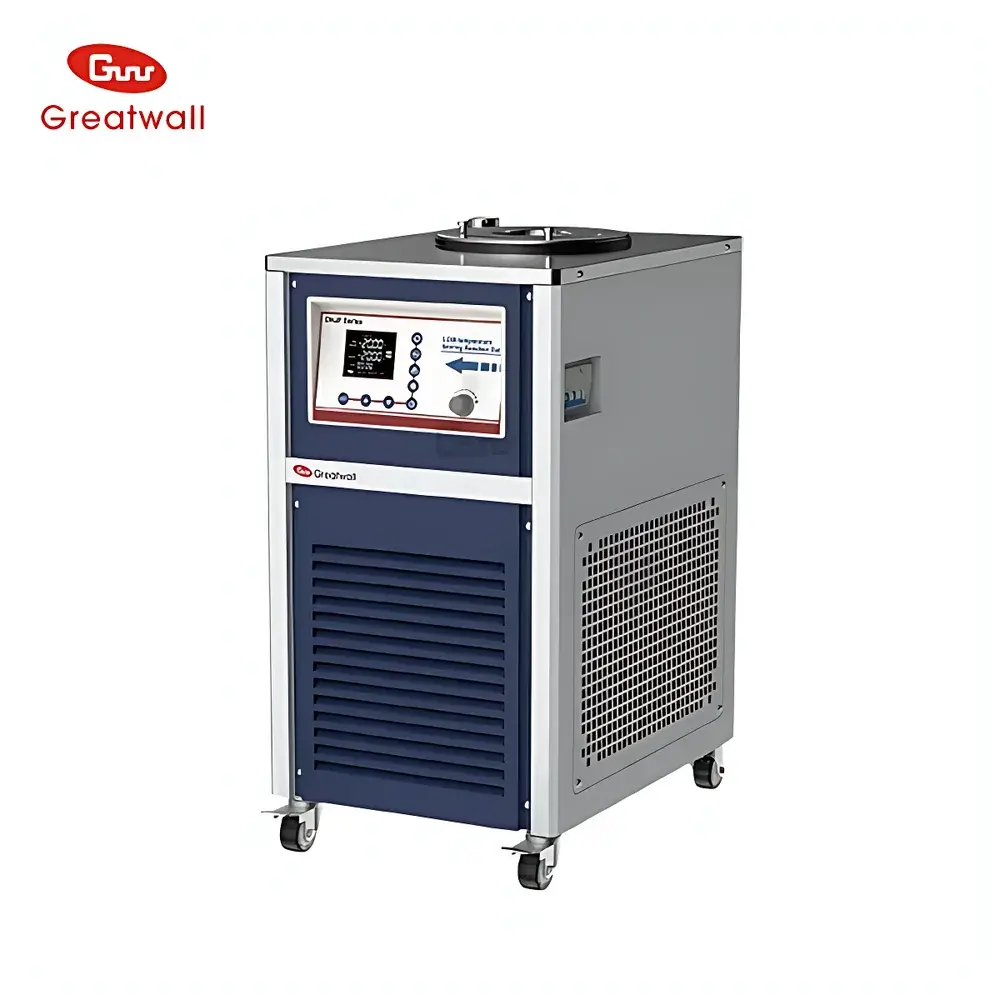
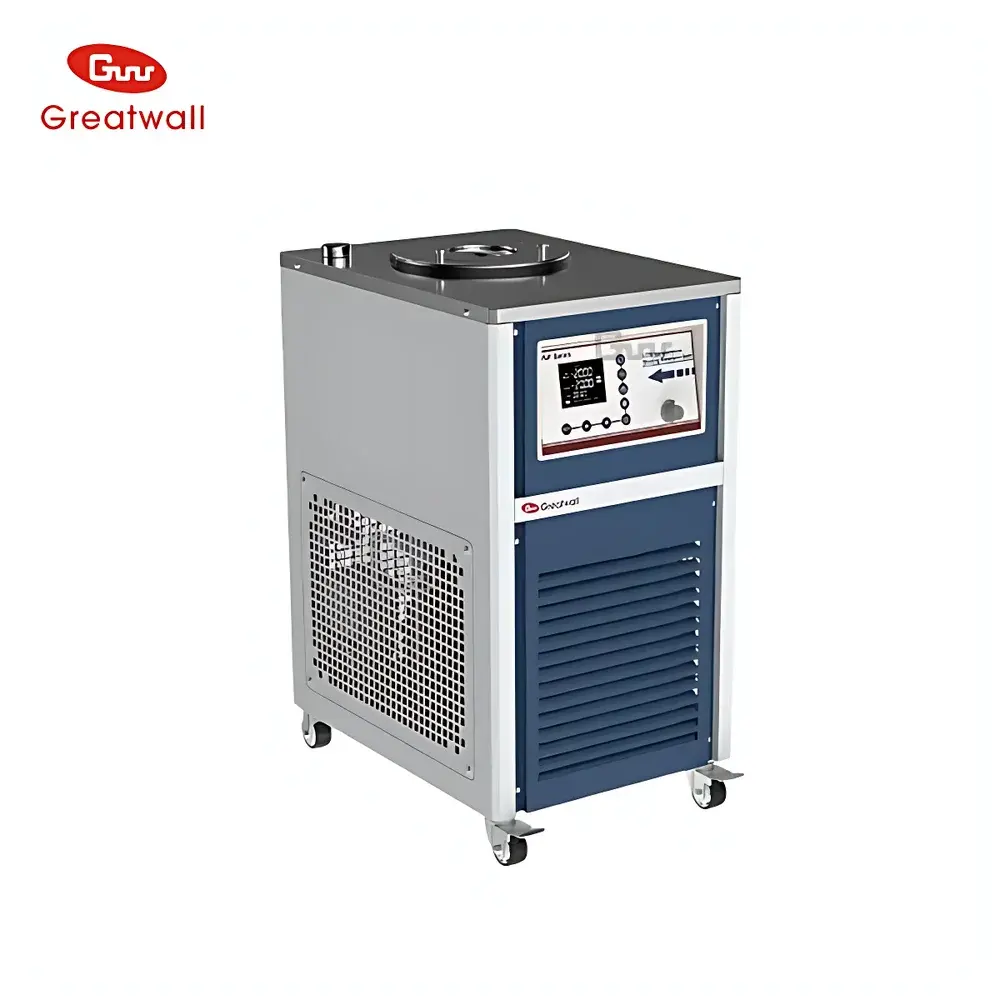
The Great Wall DHJF-2005 Low-Temperature Constant-Temperature Reaction Bath
| Brand | The Great Wall |
|---|---|
| Origin | Henan, China |
| Manufacturer Type | Direct Manufacturer |
| Product Category | Domestic |
| Model | DHJF-2005 |
| Instrument Type | Constant-Temperature Bath |
| Circulation Mode | Internal & External Circulation |
| Temperature Control | Refrigeration & Heating Dual-Mode |
| Bath Volume | 5 L |
| Temperature Range | −20 °C to 99 °C |
| Temperature Stability | ±0.2 °C |
| Total Rated Power | 2130 W |
| Heating Power | 1500 W |
| Refrigerant | R404A |
| Refrigeration Capacity | 570 W @ 10 °C, 470 W @ 0 °C, 385 W @ −10 °C, 230 W @ −20 °C |
| Pump Flow Rate | 20 L/min |
| Pump Pressure | 0.4 bar |
| Magnetic Stirring Power | 50 W |
| Stirring Speed | 100–1000 rpm |
| Input Voltage | 220 V~, 50 Hz |
| Ambient Operating Temperature | 5–35 °C |
| Bath Material | 304 Stainless Steel |
| External Port Thread | Rc1/2 |
| Opening Diameter | Ø210 mm |
| Bath Dimensions (Ø × H) | 250 × 130 mm |
| Max Flask Capacity Supported | 2000 mL |
| Overall Dimensions (W × D × H) | 385 × 560 × 735 mm |
| Net Weight | 55 kg |
Overview
The Great Wall DHJF-2005 Low-Temperature Constant-Temperature Reaction Bath is a dual-mode thermal management system engineered for precise temperature control across a broad operational range of −20 °C to 99 °C. It functions both as a self-contained constant-temperature bath and as an external thermal source/sink—capable of delivering regulated cold or hot fluid via its integrated circulation pump to external reactors, analytical instruments, or jacketed vessels. Its core architecture combines a hermetic refrigeration circuit (using R404A refrigerant) with resistive heating elements, enabling seamless transition between cooling and heating modes without manual intervention. Temperature regulation employs a digital PID algorithm with real-time feedback from a high-stability Pt100 sensor immersed in the 304 stainless steel bath reservoir, achieving ±0.2 °C stability under steady-state conditions. Designed for integration into synthetic chemistry workflows, enzymatic assay setups, material characterization protocols, and calibration laboratories, the DHJF-2005 meets functional requirements aligned with ISO/IEC 17025-compliant thermal environment control and supports GLP documentation practices through repeatable, traceable thermal profiles.
Key Features
- Dual-mode thermal operation: simultaneous refrigeration and heating capability enables uninterrupted temperature ramping and hold cycles across the full −20 °C to 99 °C range.
- Integrated magnetic stirring system (50 W, 100–1000 rpm) drives both internal bath homogenization and direct agitation of reaction vessels placed within the bath, minimizing thermal gradients and improving kinetic reproducibility.
- Adjustable telescopic lid with variable aperture (Ø210 mm max opening) reduces evaporation losses of heat-transfer fluids (e.g., ethanol/water or silicone oil blends) and limits parasitic heat exchange with ambient air.
- Modular mounting rail and fixed support frame accommodate standardized lab accessories—including burettes, pH electrodes, temperature probes, condenser clamps, and external sensors—without compromising bath integrity or safety.
- Comprehensive protection suite includes dry-run prevention (for heating elements), over-temperature cutoff, current overload detection, ground-fault interruption, thermal delay startup, and real-time refrigerant pressure monitoring.
- Rugged 304 stainless steel reservoir (5 L capacity) ensures chemical compatibility with common organic solvents and aqueous media, while the Rc1/2 external circulation port facilitates secure, leak-resistant connection to external systems.
Sample Compatibility & Compliance
The DHJF-2005 accommodates standard laboratory glassware up to 2000 mL (e.g., round-bottom flasks, jacketed reactors, and immersion-cooled spectrophotometer cells) and supports a wide range of heat-transfer fluids—including water, 30% ethylene glycol/water mixtures, and low-viscosity silicone oils—within its specified operating envelope. Its thermal performance complies with ASTM E2877-21 guidelines for verification of temperature uniformity in liquid baths and satisfies foundational requirements for equipment used in USP and ISO 17025 Annex A3 thermal validation protocols. While not certified to IEC 61010-1 as a standalone medical device, its electrical safety design conforms to Class I protection principles, including double insulation, earth bonding, and residual-current device (RCD)-ready wiring. All firmware logic and hardware interlocks are structured to support audit-ready operation in GMP-regulated environments where thermal process consistency must be demonstrable.
Software & Data Management
The DHJF-2005 operates via an embedded microcontroller interface with a high-contrast LCD display and tactile membrane keypad. While it does not feature native Ethernet or USB data logging, its analog output (0–5 V or 4–20 mA) enables connection to external PLCs, SCADA systems, or chart recorders for time-stamped thermal profile capture. Optional RS485 Modbus RTU communication modules (sold separately) allow integration into centralized lab automation platforms compliant with IEEE 1394 or LabVIEW-compatible architectures. All temperature setpoints, ramp rates, hold durations, and stirring parameters are retained in non-volatile memory during power loss. For regulatory traceability, users may manually log operational parameters against batch records; future firmware updates (via authorized service centers) may introduce timestamped event logging aligned with FDA 21 CFR Part 11 electronic record requirements.
Applications
- Controlled-temperature synthesis: exothermic Grignard reactions, low-temperature lithiation, and cryogenic Diels–Alder cyclizations requiring stable sub-zero environments.
- Biophysical assays: thermal denaturation studies of proteins and nucleic acids using UV-Vis spectrophotometers equipped with external cell jackets.
- Calibration support: providing traceable thermal references for thermometer, thermocouple, and RTD verification per ISO/IEC 17025 Clause 6.4.10.
- Materials testing: conditioning polymer samples prior to tensile or rheological analysis under defined thermal histories.
- Chromatography auxiliary: cooling condensers in rotary evaporators or maintaining detector blocks at constant temperature in GC/FID systems.
- Educational labs: demonstrating Arrhenius kinetics, phase-change thermodynamics, and heat transfer coefficients in undergraduate physical chemistry curricula.
FAQ
What types of heat-transfer fluids are compatible with the DHJF-2005?
Water, 30% ethylene glycol/water mixtures, and low-viscosity silicone oils (e.g., DC200 series) are recommended. Avoid halogenated solvents or highly volatile fluids due to vapor pressure and compatibility constraints.
Can the unit maintain temperature while actively circulating fluid externally?
Yes—the integrated 20 L/min, 0.4 bar circulation pump sustains thermal stability during continuous external flow, provided system backpressure remains within specification and heat load does not exceed rated refrigeration/heating capacity.
Is the magnetic stirring function isolated from the bath’s thermal control loop?
No—stirring operation is fully synchronized with temperature regulation; motor speed adjusts dynamically to minimize thermal perturbation during rapid setpoint changes.
Does the DHJF-2005 meet CE or UL certification requirements?
It carries CCC (China Compulsory Certification) and complies with GB 4793.1–2018 (equivalent to IEC 61010-1). CE marking is not applied; UL listing is not available.
How often should maintenance be performed on the refrigeration system?
Annual inspection of refrigerant charge, condenser coil cleanliness, and pump seal integrity is advised. No scheduled oil changes are required—R404A systems use sealed, lubricant-miscible compressors.



