
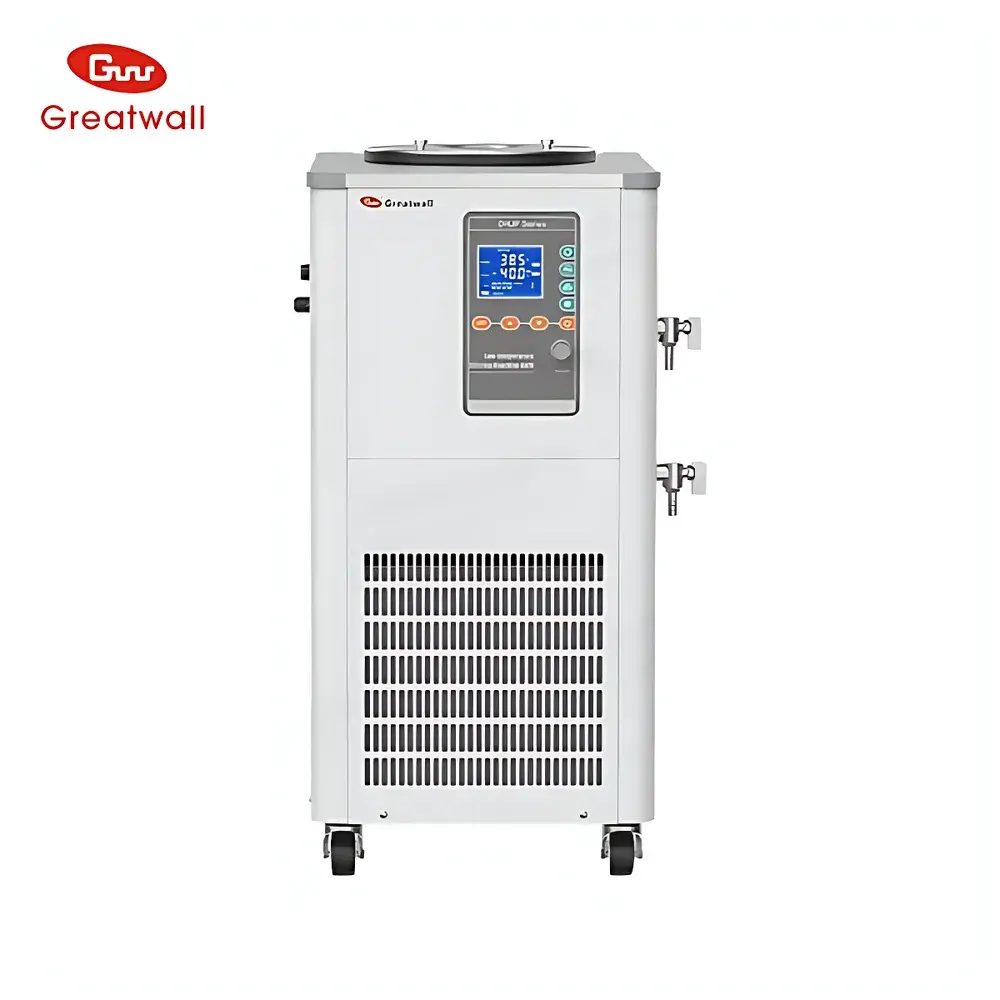
Great Wall DHJF-4010 Vertical Cryogenic Circulating Thermostat with Integrated Magnetic Stirring
| Brand | The Great Wall |
|---|---|
| Origin | Henan, China |
| Manufacturer Type | Direct Manufacturer |
| Country of Origin | China |
| Model | DHJF-4010 |
| Instrument Type | Vertical |
| Temperature Stability | ±0.2 °C |
| Temperature Range (Heat Transfer Fluid Output) | −40 °C to +99 °C |
| Bath Opening Diameter | Ø210 mm |
| Bath Volume | 10 L |
| External Dimensions (W×D×H) | 485 mm × 590 mm × 935 mm |
| Net Weight | 84 kg |
Overview
The Great Wall DHJF-4010 Vertical Cryogenic Circulating Thermostat with Integrated Magnetic Stirring is a precision-engineered laboratory temperature control system designed for dual-mode operation—simultaneous cooling and heating—with active fluid circulation and in-bath magnetic agitation. It operates on the principle of closed-loop refrigeration combined with resistive heating and PID-regulated thermal feedback, enabling stable thermal management across a wide operational range from −40 °C to +99 °C. Unlike passive bath systems, the DHJF-4010 integrates a high-torque internal magnetic stirrer capable of rotating both bath-mounted and immersed reaction vessel stir bars, ensuring uniform thermal distribution throughout viscous or heterogeneous samples. Its vertical architecture optimizes footprint efficiency while accommodating standard laboratory glassware—including round-bottom flasks up to 5 L—and supports external heat exchange via insulated fluid ports. The unit is commonly deployed in synthetic chemistry, enzymatic kinetics, polymerization studies, and calibration workflows where precise, reproducible thermal conditioning is critical.
Key Features
- High-stability PID temperature control with ±0.2 °C setpoint accuracy over the full −40 °C to +99 °C range, verified per ISO/IEC 17025 traceable procedures
- Integrated dual-mode thermal system: hermetically sealed compressor-based refrigeration + stainless-steel-sheathed immersion heater with dry-run protection
- Variable-speed magnetic stirring (0–1200 rpm) with adjustable torque output, compatible with PTFE- or ceramic-coated stir bars up to 80 mm length
- Expandable bath lid with telescoping aperture (Ø120–Ø210 mm) minimizes evaporation of low-boiling-point heat transfer fluids (e.g., ethanol, ethylene glycol/water mixtures) and reduces ambient thermal loading
- Dedicated mounting rail and universal clamp interface support ancillary instrumentation: pH electrodes, temperature probes, reflux condensers, and burette assemblies
- Rugged steel frame with vibration-damped feet and IP20-rated electrical enclosure compliant with IEC 61010-1 for laboratory use
Sample Compatibility & Compliance
The DHJF-4010 accommodates standard borosilicate glassware (e.g., Pyrex®, Duran®), stainless-steel reactors, and jacketed vessels with external diameters ≤200 mm. Its 10 L stainless-steel bath chamber is passivated to resist corrosion from common cryogenic media (e.g., acetone/dry ice slurries, methanol/liquid nitrogen pre-chill mixes) and high-pH aqueous solutions. The system meets CE marking requirements under the EU Machinery Directive 2006/42/EC and Low Voltage Directive 2014/35/EU. While not certified to UL standards, its safety architecture—including overtemperature cutoff, refrigerant pressure monitoring, and automatic heater deactivation upon low-fluid detection—aligns with GLP-compliant lab infrastructure expectations. Documentation includes factory calibration certificates for temperature sensor (PT100 Class B) and stir speed encoder.
Software & Data Management
The DHJF-4010 operates via an embedded 4.3-inch TFT-LCD touchscreen interface supporting multi-segment ramp-soak programming, real-time graphing (temperature vs. time), and event logging (stir activation, alarm triggers, setpoint changes). Internal memory stores ≥10,000 timestamped data points with optional USB export (CSV format) for integration into LIMS or ELN platforms. Though it lacks native Ethernet or RS-485 connectivity, analog 0–10 V and 4–20 mA process outputs enable linkage to centralized building management systems. Audit trail functionality records operator ID (via manual entry), parameter modifications, and system faults—supporting adherence to FDA 21 CFR Part 11 principles when used in regulated QC environments under documented SOPs.
Applications
- Controlled-rate crystallization of organic intermediates in pharmaceutical process development
- Low-temperature electrochemical cell testing (e.g., Li-ion battery electrolyte conductivity at −30 °C)
- Enzyme activity assays requiring strict thermal hold conditions (e.g., Taq polymerase stability profiling)
- Calibration of infrared thermometers and RTD probes against NIST-traceable references
- External cooling of rotary evaporators, spectrophotometer sample compartments, or HPLC column ovens
- In situ monitoring of exothermic Grignard reactions with dynamic temperature suppression
FAQ
What heat transfer fluids are recommended for operation below −20 °C?
Ethanol (≥99.8%), methanol, or 40/60 vol% ethylene glycol/water mixtures are validated for continuous use down to −40 °C. Avoid glycerol-based fluids due to excessive viscosity below −10 °C.
Can the DHJF-4010 maintain temperature stability during prolonged exothermic reactions?
Yes—its 1.2 kW cooling capacity (at −20 °C) and 2.0 kW heating power enable dynamic compensation for typical lab-scale reaction enthalpies (<500 W sustained load), provided fluid volume and insulation are optimized.
Is the magnetic stirrer compatible with PTFE-coated stir bars in acidic media?
Yes—the stirrer’s neodymium magnet array and sealed drive shaft are chemically inert and rated for continuous operation with fluoropolymer-coated hardware in pH 1–12 environments.
Does the unit support remote start/stop via digital signal?
Not natively; however, the dry-contact relay output (NO/NC) can be interfaced with PLCs or custom logic controllers for automated sequencing.
What maintenance intervals are specified for the refrigeration system?
Compressor oil and filter-drier replacement is recommended every 36 months or 6,000 operating hours—whichever occurs first—under normal usage (≤8 h/day, ambient <30 °C).



