
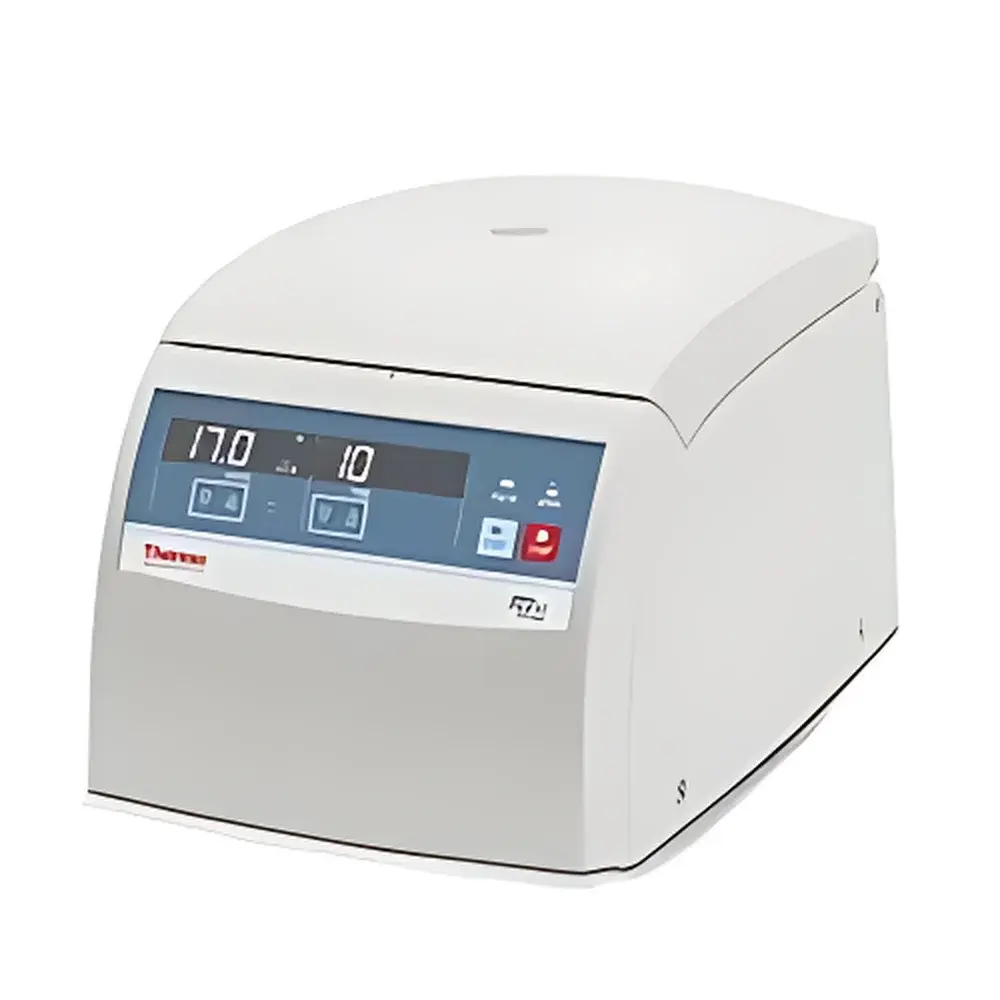
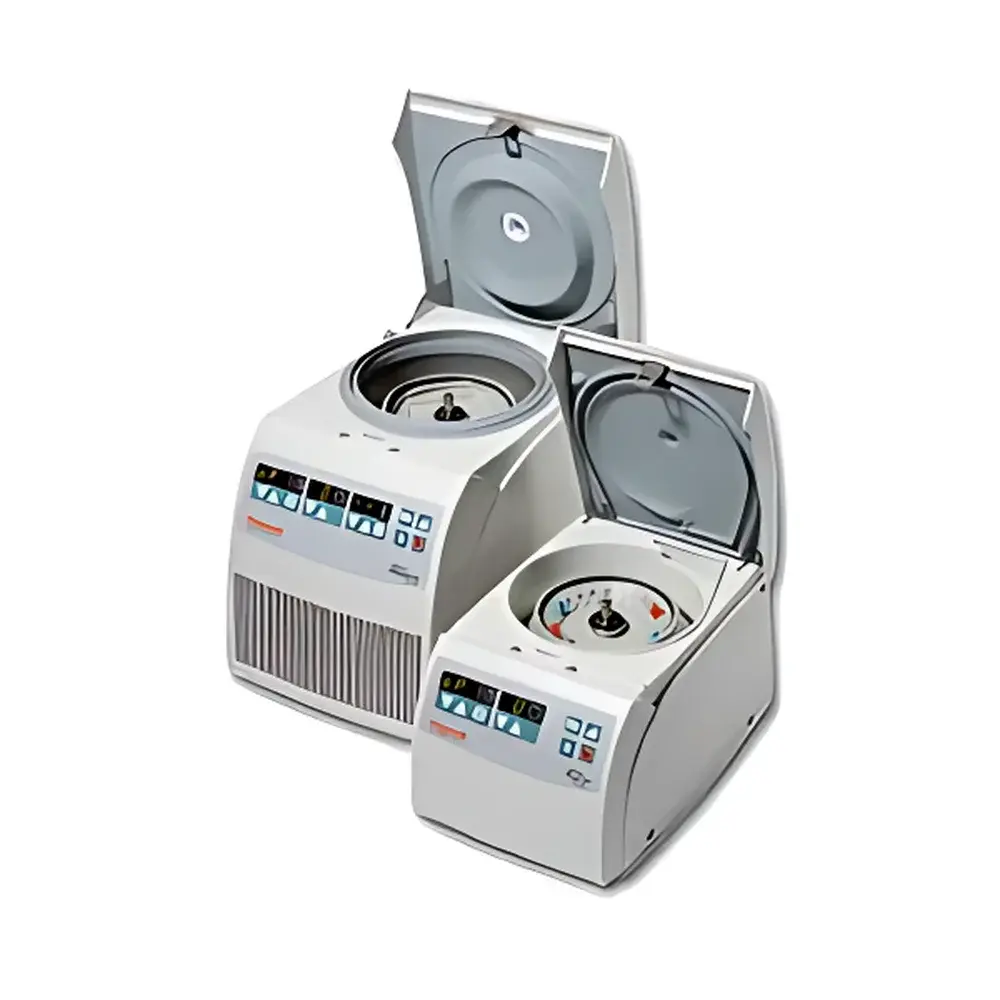
Thermo Scientific Heraeus Pico 17 Benchtop High-Speed Centrifuge
| Origin | USA |
|---|---|
| Manufacturer Type | Authorized Distributor |
| Origin Category | Imported |
| Model | Pico 17 |
| Instrument Type | Benchtop Centrifuge |
| Speed Range | High-Speed (10,000–30,000 rpm) |
| Function | General-Purpose Centrifuge |
| Typical Configuration | Fixed-Angle Rotor Centrifuge |
| Separation Class | Biomacromolecules |
| Maximum Capacity | 24 × 2 mL |
| Maximum Speed | 13,300 rpm |
| Maximum RCF | 17,000 × g |
| Dimensions (H × W × D) | 22.5 × 24.3 × 35.2 cm |
| Noise Level | 56 dB(A) |
| Operating Temperature | Ambient |
| Certifications | CSA, CE, IVD Directive 98/79/EC, IEC 61010-1, IEC 61010-2-020 |
| Rotor Included | 24-position fixed-angle rotor with ClickSeal biocontainment lid |
| Warranty | 2 years |
| Timer Range | 1–99 min (1-min increments), HOLD mode |
| Net Weight | 10.5 kg |
| Electrical Requirements | 230 V, 50/60 Hz |
Overview
The Thermo Scientific Heraeus Pico 17 Benchtop High-Speed Centrifuge is an engineered solution for routine and demanding microcentrifugation tasks in molecular biology, clinical diagnostics, and pharmaceutical quality control laboratories. Designed on the proven Heraeus platform, it operates on fixed-angle rotor centrifugation principles—relying on radial acceleration to separate particles based on sedimentation coefficient, density, and size under high gravitational forces (RCF). With a maximum speed of 13,300 rpm and a peak relative centrifugal force of 17,000 × g, the Pico 17 delivers reproducible pelleting of nucleic acids, proteins, cellular organelles, and virus particles from small-volume samples (1.5–2.0 mL). Its ventilated (non-refrigerated) architecture ensures thermal stability during short-to-medium duration runs while minimizing condensation risks in ambient-lab environments—making it especially suitable for PCR setup, plasmid prep, column-based purification, and post-sequencing cleanup workflows.
Key Features
- Fixed-angle 24-place rotor with integrated ClickSeal biocontainment lid—certified to CAMR (Centers for Advanced Microbial Resource) standards for biosafety containment during high-speed operation.
- Intuitive, membrane-button control panel with backlit LCD display for real-time monitoring of speed, RCF, time, and remaining run duration.
- Tool-free rotor installation and one-touch lid actuation—designed for rapid turnaround between users and protocols.
- Dual-row tube placement geometry accommodates both 1.5 mL and 2.0 mL microtubes without adapters, reducing workflow complexity and cross-contamination risk.
- Polymer composite rotor construction—resistant to corrosion from common reagents including ethanol, chloroform, and low-pH buffers—ensuring long-term mechanical integrity and consistent RCF performance.
- Acoustically optimized cavity and balanced drive system deliver <56 dB(A) noise emission at full speed—supporting compliance with ISO 14040-based lab ergonomics guidelines.
- Compact footprint (22.5 × 24.3 × 35.2 cm) and lightweight design (10.5 kg) enable flexible benchtop deployment in BSL-2 cabinets, cleanrooms, or shared core facilities.
Sample Compatibility & Compliance
The Pico 17 supports standard microcentrifuge tubes (1.5–2.0 mL), filter-based spin columns, and PCR strip tubes—validated for use with DNase/RNase-free consumables and common lysis buffers. It complies with IEC 61010-1 (safety requirements for electrical equipment) and IEC 61010-2-020 (particular safety requirements for laboratory centrifuges), as well as the EU In Vitro Diagnostic Medical Devices Directive (98/79/EC). The ClickSeal lid meets EN 61010-2-020 containment criteria for aerosol suppression at rated speeds. While not a GLP/GMP-certified instrument per se, its traceable timer function (1–99 min, 1-min resolution), stable RCF calibration, and absence of refrigeration-related drift make it suitable for SOP-driven applications in QC labs operating under ISO/IEC 17025 or FDA-aligned internal validation frameworks.
Software & Data Management
The Pico 17 operates as a standalone instrument with no embedded software stack or network interface. All parameter inputs—including speed, time, and HOLD activation—are entered directly via front-panel controls and retained only for the active run cycle. No data logging, audit trail, or electronic record functionality is provided; therefore, it does not comply with FDA 21 CFR Part 11 requirements for electronic signatures or record retention. Users requiring regulatory-compliant documentation must implement external procedural controls (e.g., paper-based run logs, timestamped photography, or integration with LIMS via manual entry). Firmware updates are not supported—calibration and verification follow Thermo Scientific’s published maintenance protocol (TS-PI17-MAN Rev. D).
Applications
- Routine nucleic acid precipitation and ethanol wash steps in plasmid and genomic DNA isolation.
- Clarification of bacterial lysates prior to affinity chromatography or SDS-PAGE analysis.
- Spin-down of PCR master mixes and enzyme reaction components to eliminate air bubbles and ensure uniform distribution.
- Concentration of exosomes and extracellular vesicles from conditioned media (in combination with appropriate density-gradient or ultrafiltration pre-treatment).
- Preparative separation of protein complexes using native buffer-compatible rotors (e.g., Pico 17 with optional aluminum rotor for higher thermal conductivity).
- High-throughput sample archiving in biobanking workflows where temperature-sensitive storage is managed downstream.
FAQ
Is the Pico 17 compatible with refrigerated operation?
No—the Pico 17 is a ventilated (non-refrigerated) model. For temperature-controlled applications, consider the Thermo Scientific Fresco 17 or Fresco 21 series.
Can I use this centrifuge for viral pelletization?
Yes, when paired with appropriate biosafety-certified rotors and lids (e.g., ClickSeal-equipped 24-place rotor), it achieves sufficient RCF for pelleting enveloped and non-enveloped viruses from clarified supernatants.
Does the instrument support rotor auto-recognition?
No—rotor identification is manual; users must verify rotor model and max speed compatibility per Thermo’s rotor matrix before initiating runs.
What maintenance intervals are recommended?
Visual inspection and cleaning of the rotor chamber and lid seal every 50 hours of operation; full rotor balancing and bearing check every 500 hours or annually—whichever occurs first.
Is third-party rotor certification accepted?
Thermo Scientific validates performance only with original-equipment rotors. Use of uncertified or modified rotors voids warranty and compromises safety compliance.



