
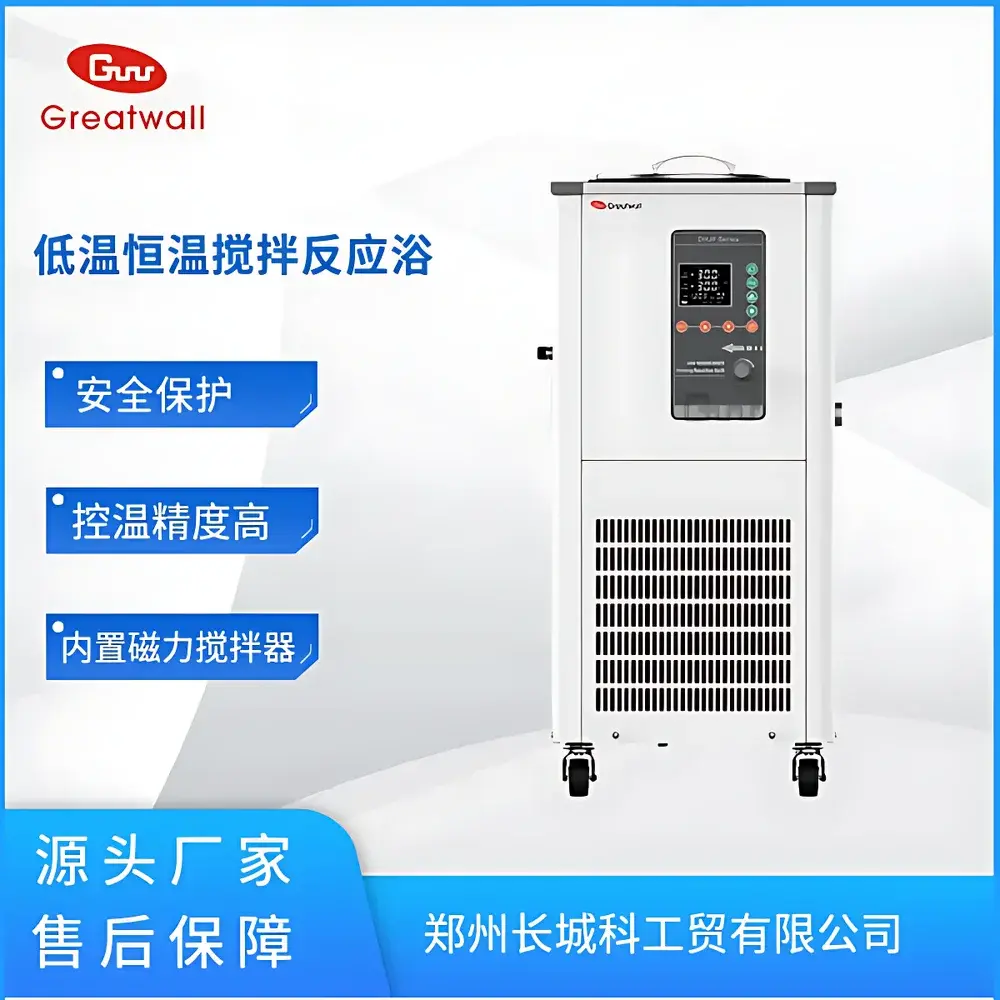
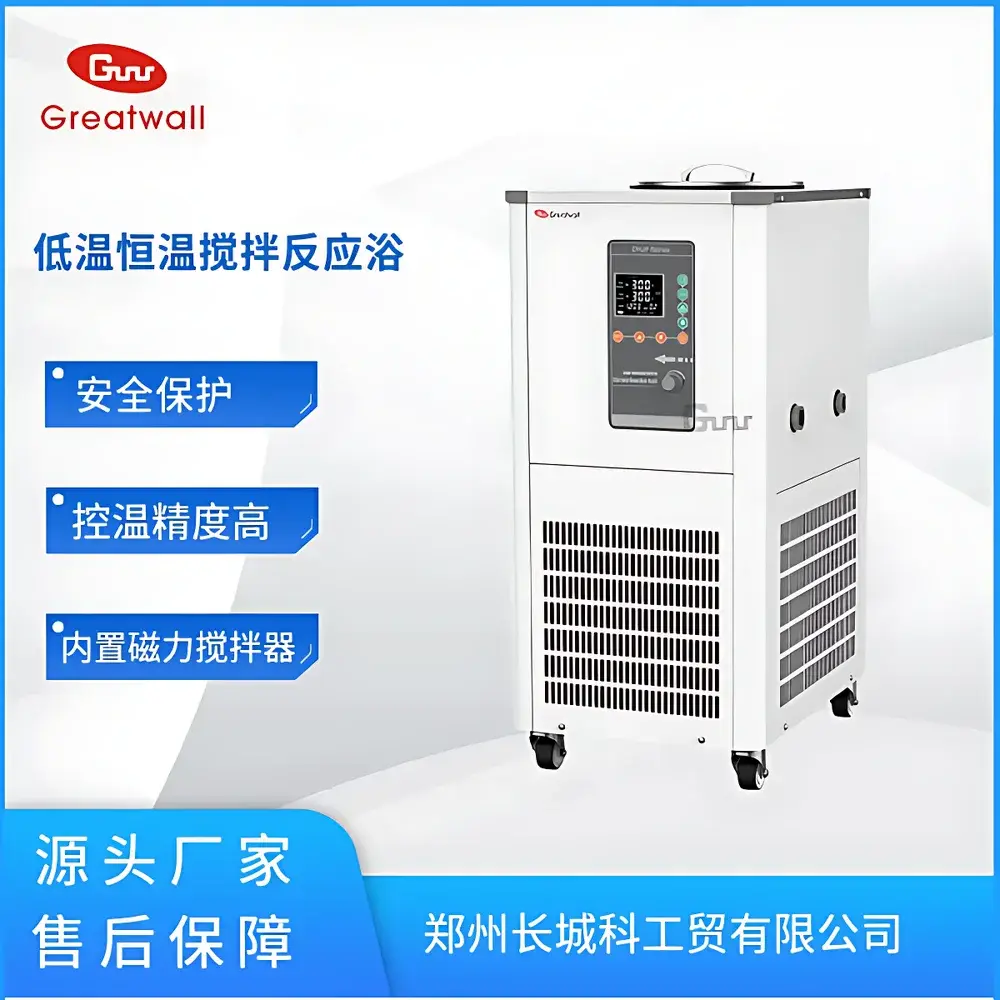
The Great Wall DHJF-8002 Vertical Low-Temperature Constant-Temperature Stirring Bath
| Brand | The Great Wall |
|---|---|
| Origin | Henan, China |
| Manufacturer Type | Direct Manufacturer |
| Product Category | Domestic |
| Model | DHJF-8002 Vertical |
| Instrument Type | Constant-Temperature Bath |
| Circulation Mode | Internal Circulation |
| Bath Volume | 2 L |
| Temperature Range | −80 °C to +10 °C |
| Temperature Stability | ±2 °C |
| Rated Power | 1020 W |
| Voltage/Frequency | 220 V~, 50 Hz |
| Refrigerants | R404A / R23 |
| Cooling Capacity | 200 W at −40 °C, 120 W at −60 °C, 60 W at −80 °C |
| Magnetic Stirring Power | 50 W |
| Stirring Speed | 100–1000 rpm |
| Opening Diameter | Ø140 mm |
| Bath Dimensions | Ø160 × 105 mm (D × H) |
| Max Flask Capacity | 500 mL |
| Bath Material | 304 Stainless Steel |
| Overall Dimensions | 380 W × 450 D × 860 H mm |
| Net Weight | 60 kg |
| Ambient Operating Conditions | 5–35 °C, ≤70% RH |
| Safety Protections | Dry-run prevention (heating models), overcurrent, overtemperature, and delayed startup protection |
Overview
The Great Wall DHJF-8002 Vertical Low-Temperature Constant-Temperature Stirring Bath is an engineered thermal management system designed for precise temperature control and active mixing in laboratory-scale chemical synthesis, low-temperature reaction monitoring, and physical property characterization. It operates on a dual-function principle: closed-loop refrigeration using a cascade compressor system (R404A/R23 refrigerant pair) for sub-ambient cooling down to −80 °C, combined with resistive heating and PID-based digital temperature regulation for stable operation across its full −80 °C to +10 °C range. Unlike passive baths or immersion chillers, the DHJF-8002 integrates a high-torque magnetic stirrer directly into the bath base—enabling simultaneous thermal equilibration and mechanical homogenization of both the heat-transfer medium (e.g., ethanol/methanol mixtures or silicone oil) and the immersed reaction vessel. This co-located stirring architecture minimizes thermal gradients and ensures reproducible kinetic conditions essential for exothermic or cryogenic reactions.
Key Features
- Vertical compact design (380 × 450 × 860 mm) optimized for benchtop space efficiency without compromising bath depth or thermal mass;
- Cascade dual-refrigerant cooling system delivering 60 W of net refrigeration at −80 °C—validated per ISO 5170-2 for low-temperature bath performance testing;
- Digital PID temperature controller with real-time setpoint adjustment, ±0.1 °C resolution, and programmable ramp/soak profiles;
- Integrated 50 W magnetic drive supporting 100–1000 rpm continuous operation with torque compensation across viscosity changes;
- Adjustable telescoping lid (Ø140 mm aperture) reducing solvent evaporation and ambient heat ingress—critical for long-duration cryoreactions;
- Modular stainless-steel (304) bath chamber resistant to corrosion from organic solvents and low-temperature brines;
- Comprehensive safety architecture including dry-run protection (for heating elements), overcurrent cutoff, overtemperature shutdown, and delayed compressor restart to prevent oil carryover.
Sample Compatibility & Compliance
The DHJF-8002 accommodates standard laboratory glassware up to 500 mL capacity—including round-bottom flasks, jacketed reactors, and sample cuvettes—via its 160 mm diameter × 105 mm deep 304 stainless-steel reservoir. The bath’s open-top configuration allows direct integration with external accessories: titration burettes, Pt100 temperature probes, reflux condensers, and inert gas inlets can be secured via the integrated universal mounting bracket. All electrical components comply with IEC 61010-1:2010 for laboratory equipment safety; refrigerant handling adheres to EPA SNAP and EU F-Gas Regulation (No. 517/2014) requirements. While not certified for GMP manufacturing environments, the unit meets GLP documentation standards for instrument qualification (IQ/OQ/PQ protocols) when paired with validated calibration procedures per ASTM E1137/E1142.
Software & Data Management
The DHJF-8002 operates as a standalone analog-digital hybrid system with front-panel LED interface and tactile push-button controls—intentionally omitting embedded software to maximize operational reliability and electromagnetic compatibility in RF-sensitive labs (e.g., NMR or mass spectrometry suites). Temperature and stirring parameters are logged manually or via optional RS-485 serial output (MODBUS RTU protocol) for integration into centralized LabVantage or Thermo Fisher SampleManager LIMS platforms. When connected to a host PC, users may record time-stamped temperature/stirring data at 1 Hz resolution using vendor-provided terminal software compliant with FDA 21 CFR Part 11 for electronic records—supporting audit trails, user access levels, and digital signature capture for regulated QC workflows.
Applications
- Low-temperature Grignard and organolithium reactions requiring sustained −78 °C operation with mechanical agitation;
- Cryogenic crystallization studies where nucleation kinetics depend on uniform thermal history and shear rate;
- Enzyme activity assays under controlled hypothermic conditions (0–10 °C) with concurrent mixing to prevent localized denaturation;
- Calibration of differential scanning calorimeters (DSC) and thermogravimetric analyzers (TGA) using NIST-traceable reference materials;
- Pre-cooling of HPLC mobile phases or GC injectors to improve peak shape and retention time stability;
- Material science testing of polymer solutions and colloidal dispersions under shear-coupled thermal stress.
FAQ
What refrigerants does the DHJF-8002 use, and are they compliant with international environmental regulations?
The unit employs a cascade refrigerant system using R404A (high-stage) and R23 (low-stage), both approved under current EPA SNAP and EU F-Gas provisions for laboratory cold baths. R23 has a GWP of 14,800; proper recovery and reclamation per ISO 8573-1 are required during servicing.
Can the bath maintain −80 °C while stirring at 1000 rpm?
Yes—the magnetic drive and refrigeration system are thermally decoupled. Full-speed stirring does not compromise minimum temperature performance, though cooling recovery time increases by ~15% under maximum mechanical load.
Is external temperature feedback supported for cascade control?
The unit accepts optional Pt100 input (via rear DB9 port) for external probe feedback, enabling jacketed reactor temperature control where bath setpoint is dynamically adjusted based on internal reaction temperature.
What maintenance intervals are recommended for compressor longevity?
Compressor oil inspection every 12 months; full refrigerant charge verification and filter-drier replacement every 24 months—per ASHRAE Guideline 3-2021 for low-temperature lab equipment.
Does the stainless-steel bath resist acetone, THF, and liquid nitrogen contact?
304 stainless steel is compatible with acetone and THF at temperatures ≥ −40 °C. Direct liquid nitrogen immersion is prohibited; thermal shock may exceed material ductility limits and cause microfracture.



