
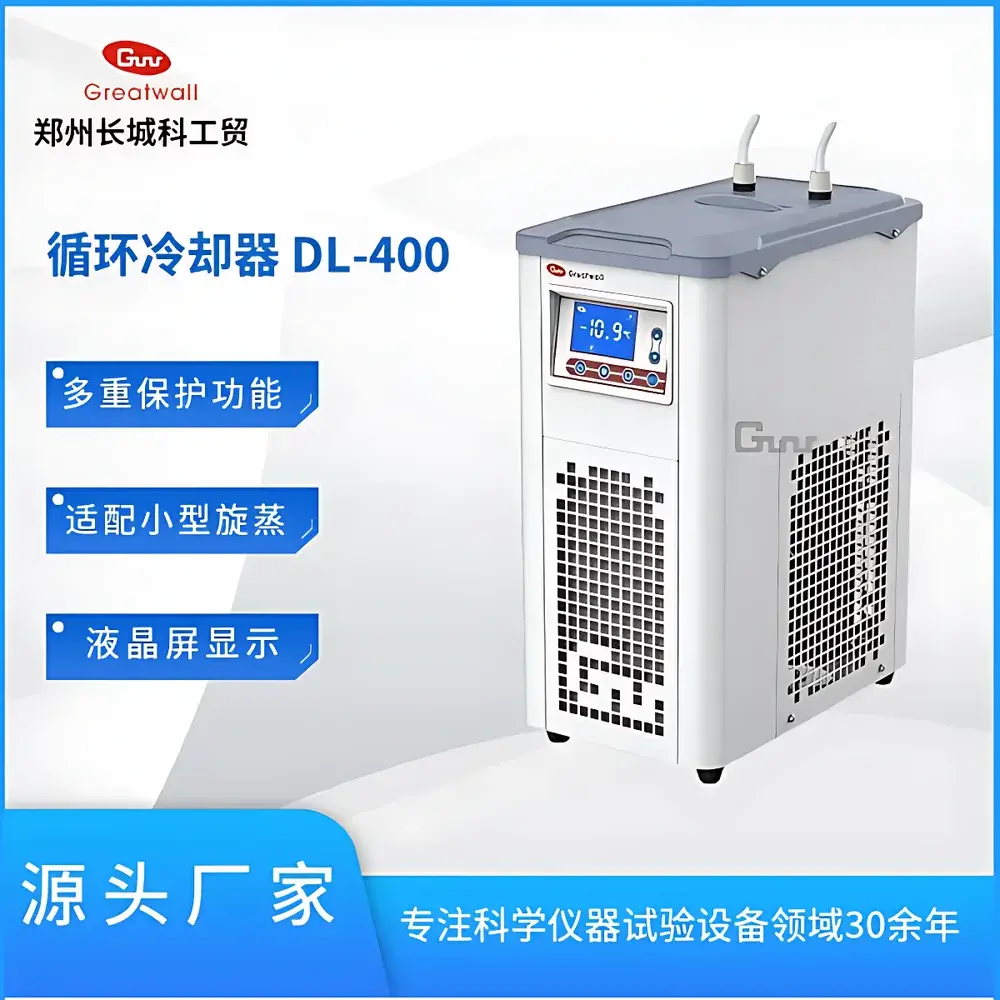
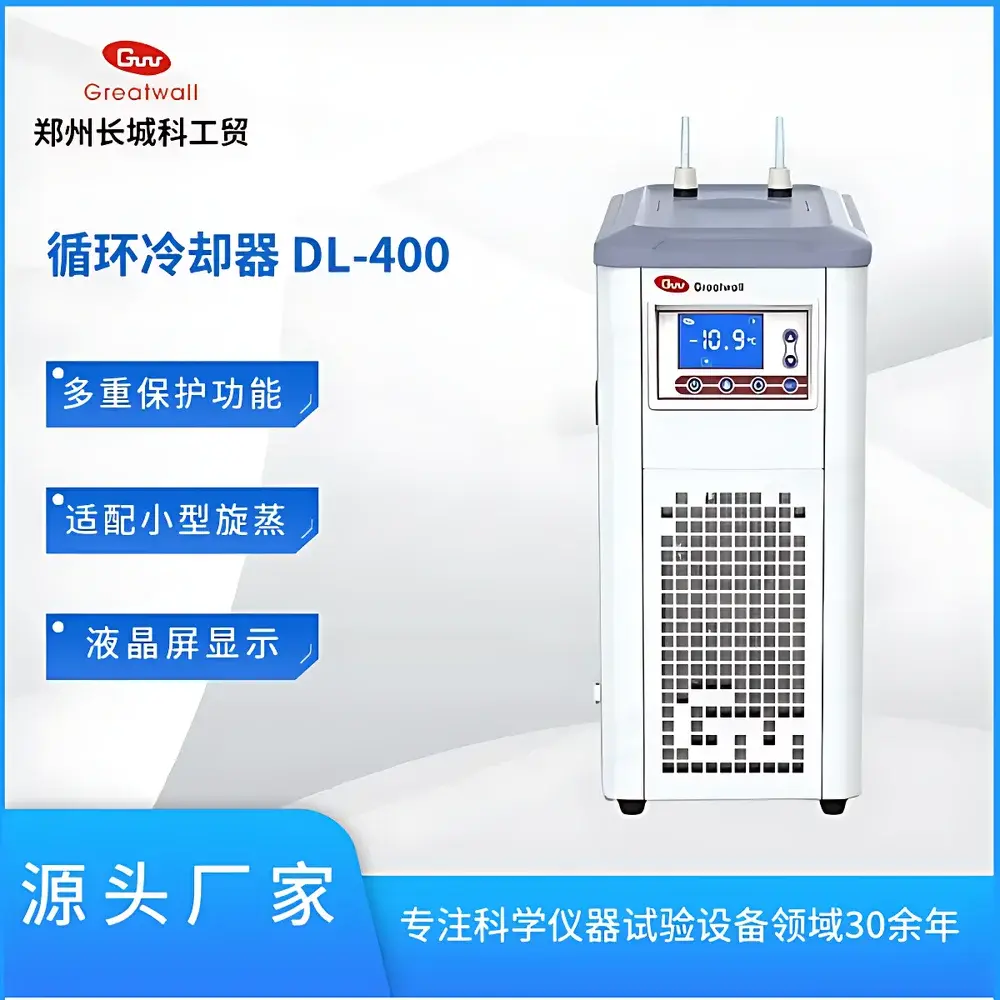
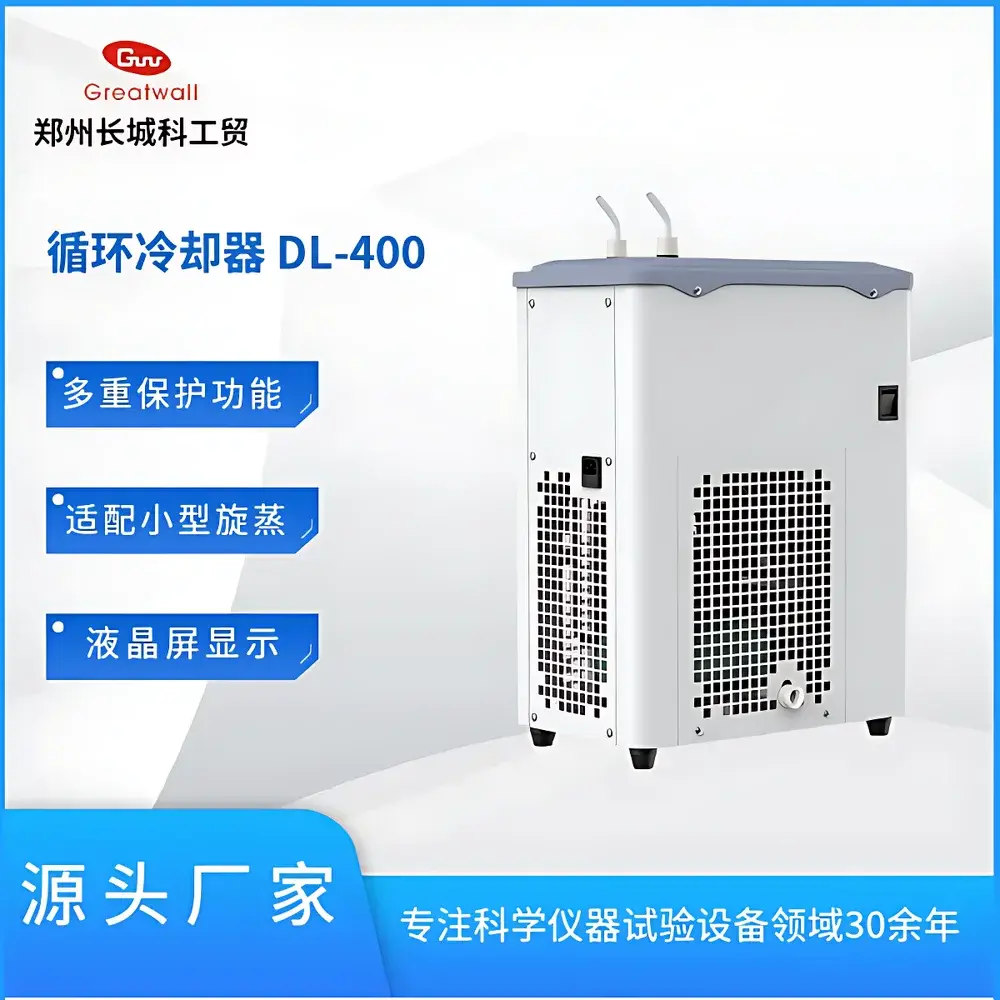
The Great Wall DL-400 Circulating Chiller
| Brand | The Great Wall |
|---|---|
| Origin | Henan, China |
| Manufacturer Type | Direct Manufacturer |
| Instrument Type | Integrated Unit |
| Cooling Method | Air-Cooled |
| Temperature Range (Heat Transfer Fluid Output) | –15 to 25 °C |
| Refrigeration Capacity at 0 °C | 400 W |
| Temperature Stability | ±2 °C |
| Circulation Pump Pressure | 0.2 bar |
| Circulation Flow Rate | 17 L/min |
| Reservoir Volume | 3 L |
| Operating Mode | Continuous |
| Display Resolution | 0.1 °C |
| Temperature Sensor | Pt100 |
| Compressor Protection | Delayed Start, Thermal Overload, Overcurrent |
| Refrigerant | R134a |
| Power Supply | 220–240 V~, 50 Hz |
| Ambient Operating Conditions | 5–35 °C, ≤70% RH |
| Reservoir Material | SUS304 Stainless Steel |
| External Connection | Ø10 mm OD fitting, compatible with silicone tubing (Ø13 × Ø9 mm) |
| Dimensions (W×D×H) | 260 × 410 × 550 mm |
| Net Weight | 26 kg |
Overview
The Great Wall DL-400 Circulating Chiller is an air-cooled, integrated refrigeration system engineered for precise thermal management in laboratory environments. It operates on the vapor-compression cycle using environmentally compliant R134a refrigerant and delivers stable, controllable cooling to external equipment via a closed-loop circulation of heat transfer fluid—typically water or water-glycol mixtures. Designed specifically to support low-to-moderate thermal load applications, the DL-400 serves as a dedicated cold source for small-scale rotary evaporators, condensers, reflux setups, and other benchtop instruments requiring consistent sub-ambient temperature control. Its compact footprint, stainless steel reservoir, and continuous-duty operation make it suitable for extended use in chemistry, pharmaceutical development, and materials synthesis laboratories where reliability, safety, and compatibility with GLP-aligned workflows are essential.
Key Features
- Integrated air-cooled architecture eliminates need for external cooling water infrastructure—ideal for labs with limited utility access or space constraints.
- Pt100 platinum resistance thermometer ensures accurate, repeatable temperature sensing with 0.1 °C digital display resolution and ±2 °C stability across the full operating range (–15 to +25 °C).
- 360° rotatable fluid coupling interface simplifies alignment and minimizes hose strain during connection to rotary evaporators, jacketed reactors, or analytical instrumentation.
- Comprehensive electrical and thermal protection suite includes compressor delayed-start logic, thermal overload cutoff, and dual-stage overcurrent monitoring—designed to extend component service life and reduce unplanned downtime.
- SUS304 stainless steel reservoir resists corrosion from common heat transfer fluids and supports long-term compatibility with aqueous and mildly acidic/glycol-based media.
- Continuous-duty circulation pump delivers 17 L/min flow at 0.2 bar pressure head—sufficient for maintaining laminar flow through standard jacketed glassware and small-bore tubing assemblies.
Sample Compatibility & Compliance
The DL-400 is compatible with a wide range of laboratory apparatus requiring active cooling, including but not limited to rotary evaporators (e.g., 1–5 L capacity), condenser coils, vacuum desiccators with chilled traps, and small-volume reaction calorimeters. Its temperature output range (–15 to 25 °C) aligns with common process requirements in organic synthesis, crystallization studies, and solvent recovery protocols. While the unit itself does not carry CE, UL, or FDA certification, its design adheres to baseline IEC 61010-1 safety principles for laboratory electrical equipment. When operated within specified ambient conditions (5–35 °C, ≤70% RH), it meets ISO/IEC 17025-relevant environmental control expectations for method validation and routine QC testing. Documentation—including electrical schematics, refrigerant charge records, and material certifications—is available upon request to support internal audit readiness and equipment qualification (IQ/OQ).
Software & Data Management
The DL-400 operates as a standalone analog-controlled chiller without embedded data logging or network connectivity. Temperature setpoint and real-time output are displayed locally via a fixed-function LCD interface; no software drivers, firmware updates, or PC integration are required. This design prioritizes operational simplicity, electromagnetic immunity, and long-term maintenance predictability—particularly advantageous in environments where IT policy restricts networked peripherals or where regulatory traceability mandates minimal electronic complexity. For laboratories requiring audit-ready temperature records, external USB or RS-485 data loggers (e.g., Omega OM-DAQPRO-5300 series) may be interfaced via the unit’s analog voltage output (0–5 V proportional to temperature), enabling time-stamped acquisition compliant with 21 CFR Part 11 when paired with validated third-party software.
Applications
- Cooling condenser jackets during rotary evaporation of volatile solvents (e.g., diethyl ether, acetone, ethyl acetate) at reduced pressure.
- Maintaining low-temperature reaction baths for exothermic Grignard or lithiation steps.
- Stabilizing detector temperatures in HPLC or GC systems where ambient fluctuations affect baseline noise.
- Providing auxiliary cooling to laser sources, CCD cameras, or electrophoresis power supplies.
- Supporting controlled crystallization trials by enabling gradual ramp-down from dissolution temperature to nucleation threshold.
FAQ
What is the minimum achievable temperature with a loaded system?
The DL-400 achieves –15 °C under no-load (empty reservoir) conditions at 25 °C ambient. Under typical load (e.g., connected to a 2 L rotary evaporator with water-glycol coolant), the practical lower limit is approximately –10 to –12 °C depending on heat load, flow resistance, and ambient temperature.
Can this chiller be used with flammable solvents in the external loop?
No. The DL-400 is designed for use with non-flammable heat transfer fluids only (e.g., deionized water, 30% propylene glycol/water). Circulating flammable liquids externally poses fire hazard and voids all safety protections.
Is the reservoir volume sufficient for extended operation?
Yes. The 3 L stainless steel tank provides adequate thermal mass to buffer transient load changes and supports uninterrupted 8+ hour operation when paired with appropriately sized external equipment and insulated tubing.
Does the unit require periodic refrigerant servicing?
Under normal operation and proper installation (level placement, unobstructed airflow), the sealed R134a circuit requires no scheduled refrigerant replenishment. Leak detection and recharge should only be performed by qualified technicians using certified recovery equipment.
How is temperature calibration verified?
Users may perform field verification using a NIST-traceable calibrated thermometer immersed directly in the reservoir fluid. Deviations exceeding ±0.5 °C from the displayed value warrant adjustment per the manufacturer’s service manual or technical support consultation.



