
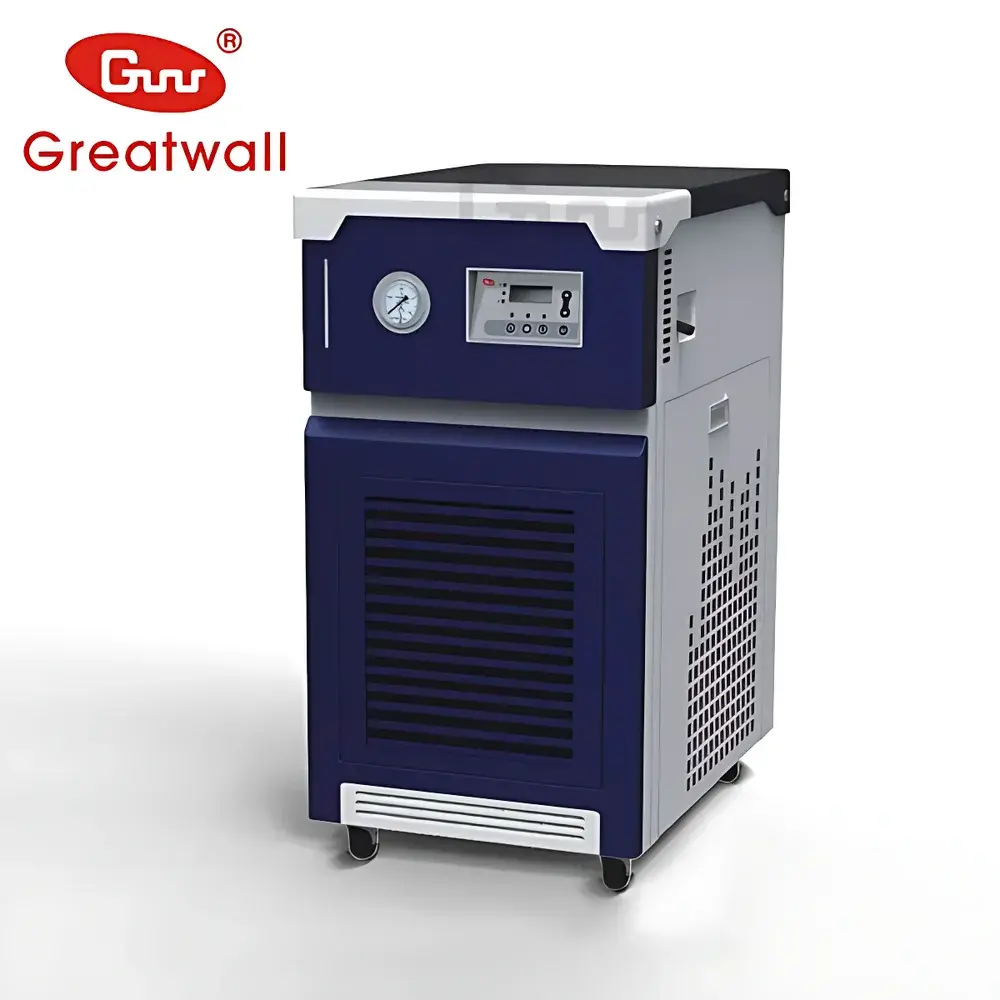
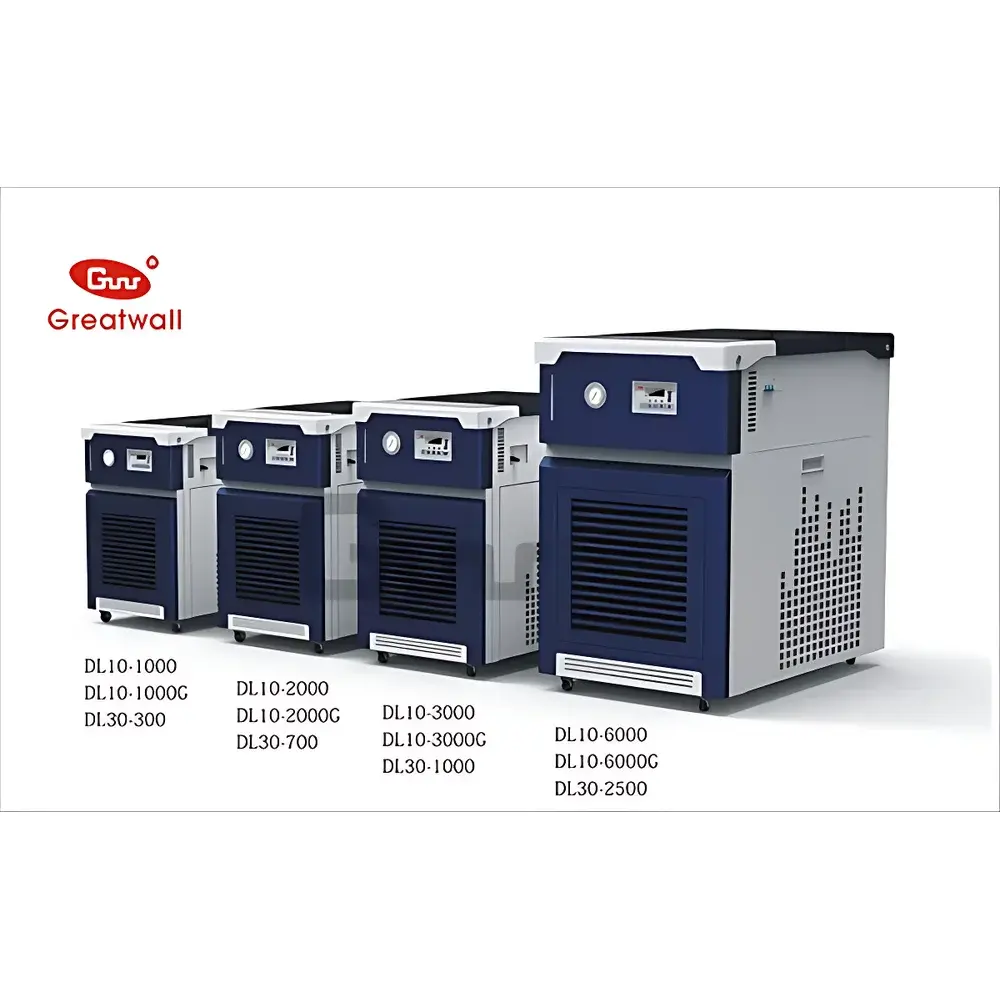
The Great Wall DL10-1000 Circulating Chiller
| Brand | The Great Wall |
|---|---|
| Origin | Henan, China |
| Manufacturer Type | Direct Manufacturer |
| Product Category | Domestic |
| Model | DL10-1000 |
| Instrument Type | Integrated Unit |
| Cooling Method | Air-Cooled |
| Temperature Range | –10 °C to 25 °C |
| Temperature Stability | ±2 °C |
| Refrigeration Capacity | 1000 W @ 15 °C |
| Circulation Pump Pressure | 1 bar |
| Circulation Flow Rate | 30 L/min |
| Reservoir Volume | 10 L |
| Operation Mode | Continuous |
Overview
The Great Wall DL10-1000 Circulating Chiller is an integrated, air-cooled refrigeration system engineered for precise and stable thermal management in demanding laboratory environments. It operates on the principle of vapor-compression refrigeration using a hermetically sealed compressor and R134a — a non-ozone-depleting, low-global-warming-potential (GWP) refrigerant compliant with international environmental standards including the Montreal Protocol and EU F-Gas Regulation. Designed for continuous-duty operation, the unit delivers consistent cooling performance across a wide operational temperature range (–10 °C to 25 °C), with temperature stability maintained within ±2 °C under dynamic load conditions. Its compact footprint (675 × 426 × 695 mm) and 10 L insulated reservoir enable seamless integration beneath fume hoods, adjacent to analytical instruments, or within confined lab spaces where spatial efficiency is critical.
Key Features
- Hermetically sealed, high-efficiency compressor from a globally recognized brand — ensuring low acoustic emission (<65 dB(A)), extended service life, and minimal maintenance intervals.
- High-performance circulation pump delivering up to 30 L/min at 1 bar pressure, compatible with both standard and high-backpressure applications (e.g., vacuum jacketed reactors, multi-instrument manifolds).
- Sealed, closed-loop circulation system with integrated particulate filtration (5–10 µm nominal retention) to prevent contamination and protect sensitive instrument cooling jackets from blockage or corrosion.
- Real-time monitoring via front-panel liquid level indicator and analog pressure gauge — enabling proactive maintenance and leak detection without system shutdown.
- Tool-free removable side panels for rapid access to internal components, facilitating routine cleaning, descaling, and refrigerant circuit inspection per ISO 5171 and manufacturer-recommended service protocols.
- Ergonomic industrial design with corrosion-resistant stainless steel reservoir lining, reinforced polypropylene housing, and IP20-rated electrical enclosure for safe operation in general laboratory environments.
Sample Compatibility & Compliance
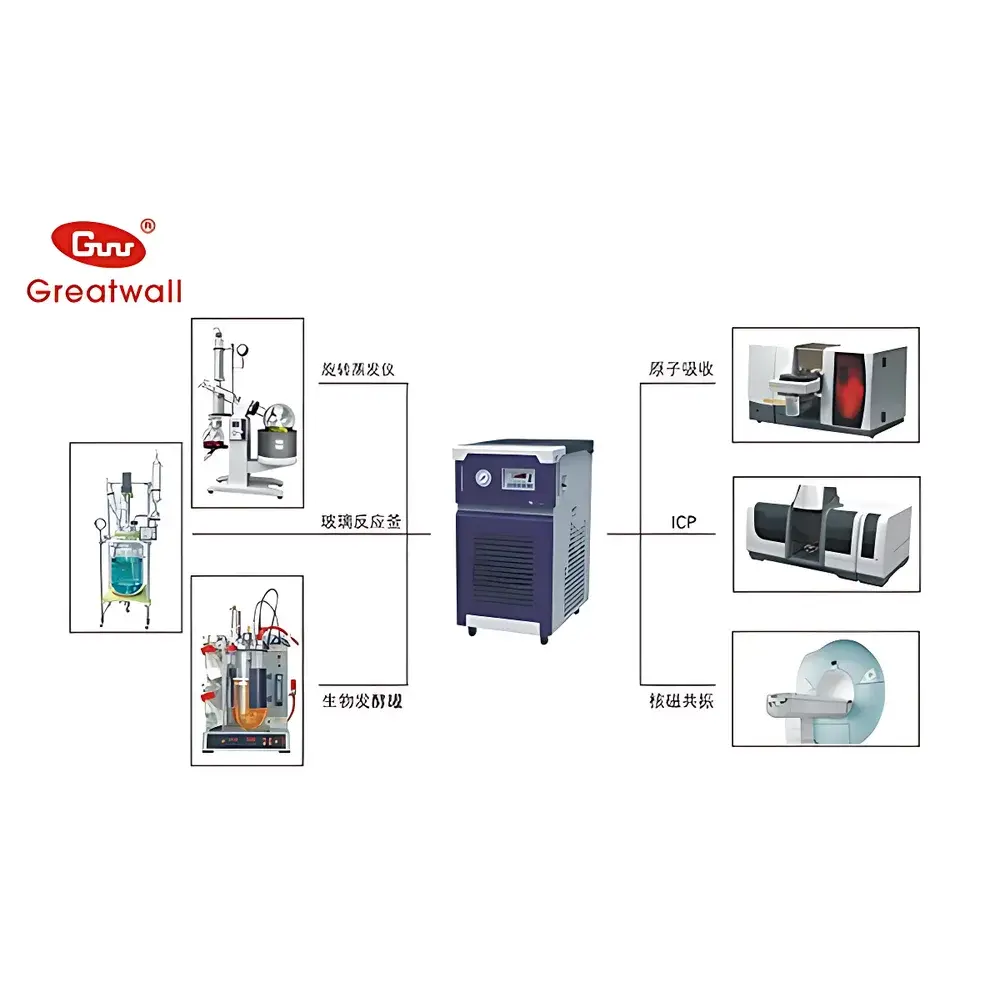
The DL10-1000 is validated for use with a broad spectrum of laboratory instrumentation requiring active heat extraction or sub-ambient stabilization. It is routinely deployed as a cold source for atomic absorption spectrometers (AAS), inductively coupled plasma (ICP-OES/ICP-MS) systems, NMR console chillers, CCD detectors, laser-based analytical platforms (e.g., Raman, LIBS), and bioreactor temperature control modules. In materials science, it supports cryo-SEM sample stages, XRD goniometer cooling, magnetron sputtering targets, and vacuum deposition chambers. The unit complies with IEC 61010-1:2010 for electrical safety in laboratory equipment and meets EMC requirements per CISPR 11 Group 1, Class B. While not certified for medical device use (IEC 62304), its thermal output stability and traceable calibration procedures support GLP-compliant workflows when paired with external temperature validation sensors (e.g., NIST-traceable Pt100 probes).
Software & Data Management
The DL10-1000 operates as a standalone, microprocessor-controlled chiller with no embedded software interface or remote connectivity. All setpoints and status indicators are managed via a dedicated digital display panel with tactile buttons. For integration into automated lab environments, optional analog (0–10 V / 4–20 mA) and digital (RS485 Modbus RTU) output modules are available — enabling temperature feedback logging, interlock signaling with reactor controllers, and centralized monitoring via LIMS or SCADA platforms. Audit trails for temperature deviations exceeding ±2.5 °C can be recorded externally using third-party data loggers compliant with FDA 21 CFR Part 11 when configured with electronic signature and user-access controls.
Applications
- Cooling of rotary evaporators (e.g., R1005 series) during solvent removal under reduced pressure, preventing bumping and improving condensation efficiency at low bath temperatures.
- Thermal regulation of exothermic chemical synthesis reactors — maintaining reaction kinetics within narrow ΔT windows during catalytic hydrogenation or Grignard reactions.
- Stabilization of detector housings in spectroscopic instruments (FTIR, UV-Vis-NIR), minimizing thermal drift in wavelength calibration and signal-to-noise ratio degradation.
- Support of cryogenic sample preparation workflows in pharmaceutical QC labs, including cold-stage microscopy and low-temperature HPLC column conditioning.
- Process cooling for food microbiology incubators, enzymatic assay platforms, and controlled-environment bioreactors operating below ambient setpoints.
FAQ
What is the maximum allowable backpressure the DL10-1000 circulation pump can overcome?
The standard pump is rated for continuous operation at 1 bar (100 kPa) static pressure; intermittent operation up to 1.4 bar is permissible with flow rate reduction. For sustained high-backpressure applications (>1.2 bar), the DL10-1000G variant with adjustable pressure regulation is recommended.
Can this chiller operate continuously at –10 °C in a 35 °C ambient environment?
Yes — but refrigeration capacity degrades approximately 15–20% at ambient temperatures above 30 °C. Performance verification per ASTM E1526-19 is advised for mission-critical low-temperature applications in warm laboratories.
Is R134a compatible with ethylene glycol/water mixtures commonly used as secondary coolants?
Yes. The system’s seals and wetted materials (EPDM, stainless steel 316, brass) are chemically resistant to aqueous glycol solutions up to 40% v/v concentration. Glycol addition improves freeze protection but reduces thermal conductivity by ~10–15% versus pure water.
Does the unit include factory calibration documentation?
Each unit ships with a Certificate of Conformance listing serial-number-specific test data (temperature stability, flow rate, pressure drop) measured at 15 °C setpoint under ISO/IEC 17025-accredited conditions. NIST-traceable calibration certificates are available as a value-added service.
Related Products



