
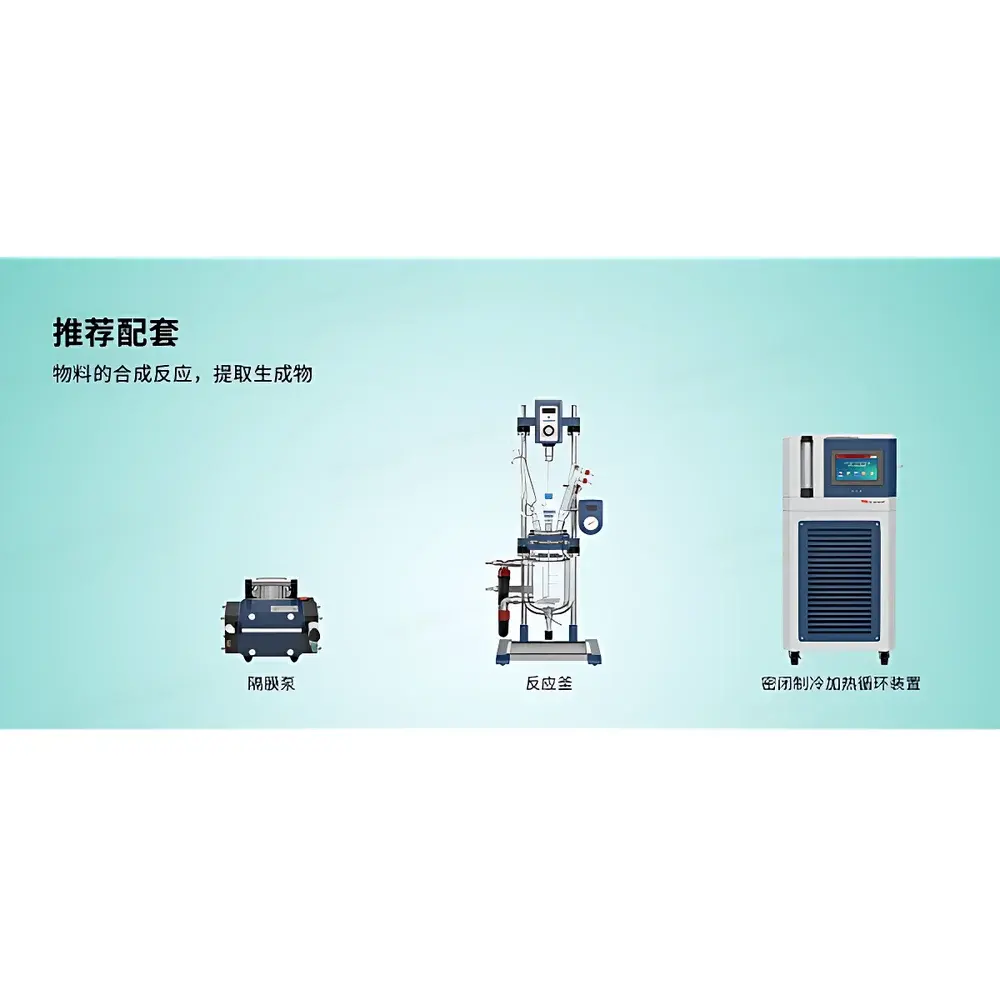
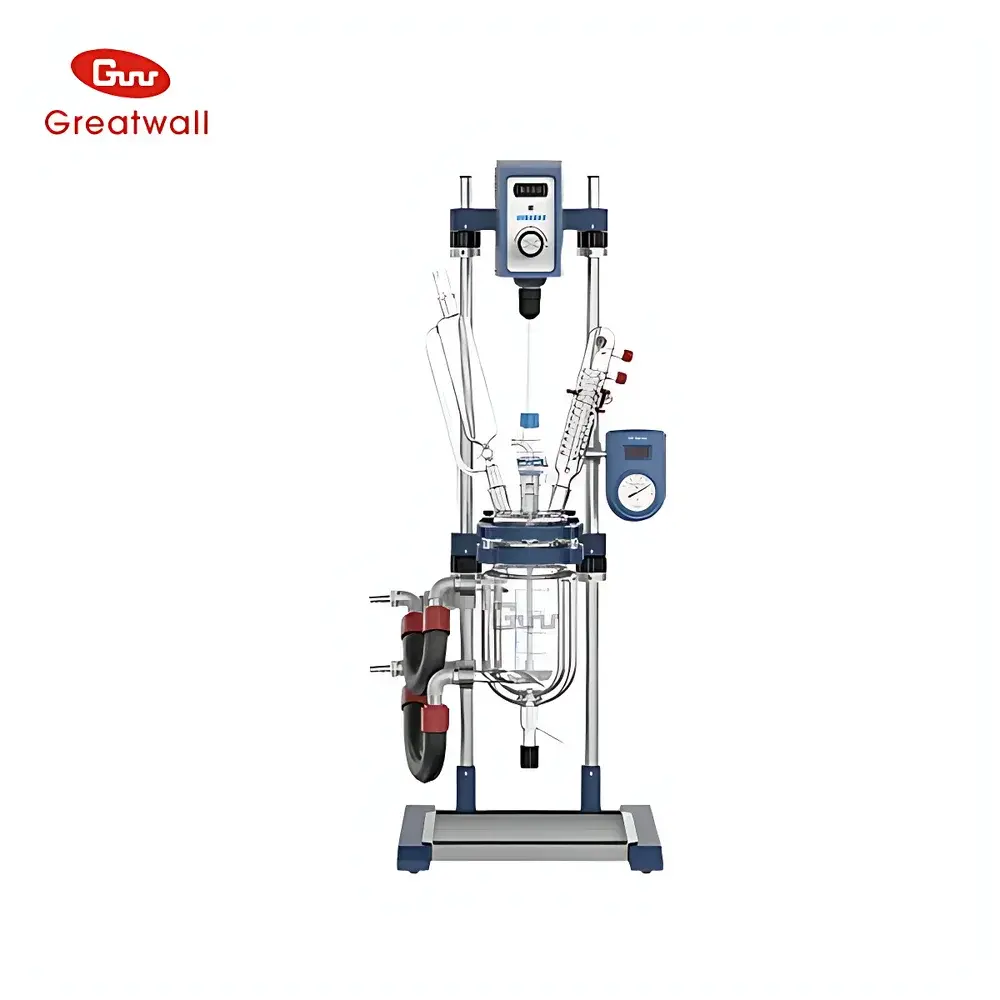
The Great Wall GR-2 Dual-Jacketed Variable-Speed Glass Reactor
| Brand | The Great Wall |
|---|---|
| Origin | Henan, China |
| Manufacturer Type | Direct Manufacturer |
| Equipment Category | Domestic |
| Model | GR-2 |
| Reactor Type | Jacketed Glass Reactor |
| Working Volume | 2 L |
| Vessel Material | Borosilicate Glass 3.3 |
| Temperature Range | −80 °C to +200 °C |
| Pressure Rating | −0.1 MPa to 0 MPa (Vacuum to Ambient) |
| Stirring Drive | Top-Mounted, Tilted Discharge Configuration |
| Jacket Inlet/Outlet | Stainless Steel Insulated Flexible Hoses |
| Frame Material | 06Cr19Ni10 (AISI 304) + Carbon Structural Steel with Epoxy Powder Coating + Anodized Aluminum |
| Stirring Shaft | AISI 304 Core with PTFE Cladding |
| Impeller Material | PTFE |
| Sealing System | Proprietary Magnetic Coupling & Mechanical Seal Hybrid Bearing Assembly |
| Control | Electronic Speed Regulation (0–600 rpm typical range) |
Overview
The Great Wall GR-2 Dual-Jacketed Variable-Speed Glass Reactor is an engineered laboratory-scale synthesis platform designed for controlled chemical reactions under vacuum, inert atmosphere, or mild heating/cooling conditions. Its core architecture employs a double-walled borosilicate glass 3.3 vessel—compliant with DIN ISO 3585—enabling precise thermal management via circulating fluid in the outer jacket while maintaining optical clarity for real-time reaction monitoring. Unlike single-wall reactors, the dual-jacket design supports simultaneous temperature control of both reaction mass and condensate path (e.g., when integrated with a reflux condenser), minimizing thermal gradients and improving reproducibility in exothermic or equilibrium-sensitive syntheses. The reactor operates within a certified pressure envelope of −0.1 MPa (100 mbar abs) to ambient, making it suitable for solvent removal, low-boiling-point reactions, and moisture-sensitive transformations under nitrogen or argon purge. Its top-mounted drive system features a hermetically sealed magnetic coupling combined with a proprietary mechanical bearing assembly, eliminating dynamic seal failure points common in conventional shaft-entry configurations.
Key Features
- Borosilicate glass 3.3 construction (DIN ISO 3585) for exceptional thermal shock resistance (ΔT ≥ 150 °C), hydrolytic stability (Class 1 per ISO 8536-1), and chemical inertness toward organic solvents, strong acids (excluding HF), and alkalis.
- Integrated dual-jacket thermal management: inner vessel wall thickness optimized for mechanical strength at elevated temperatures; outer jacket ports configured with stainless steel insulated flexible hoses to decouple thermal expansion stress from circulation manifolds.
- Tilted top-discharge mechanism enables complete, residue-free emptying without disassembly—critical for viscous intermediates or crystalline precipitates in multi-step syntheses.
- Corrosion-resistant structural frame combining AISI 304 stainless steel load-bearing elements, epoxy-powder-coated carbon steel substructure, and anodized aluminum housing panels—designed for long-term exposure to lab-grade cleaning agents and incidental solvent splashes.
- PTFE-clad stirring shaft (AISI 304 core + seamless fluoropolymer overmold) and solid PTFE impeller ensure non-contaminating agitation across pH 0–14 and temperatures up to 200 °C.
- Stepless electronic speed control (typical range: 0–600 rpm) with torque feedback monitoring, supporting viscosity-dependent protocol adaptation during polymerization or heterogeneous catalysis.
Sample Compatibility & Compliance
The GR-2 accommodates homogeneous solutions, slurries, emulsions, and suspended catalysts within its 2 L working volume. Its glass transparency permits visual endpoint detection, colorimetric monitoring, and integration with external analytical probes (e.g., pH, conductivity, or FTIR transceivers). All wetted surfaces comply with USP Class VI biological safety requirements for extractables profiling. The reactor’s pressure containment system meets EN 13445-1 Annex C for non-fired pressure equipment operating below 0.5 MPa, and its electrical components conform to IEC 61010-1:2010 for laboratory electrical equipment safety. When operated with validated SOPs, it supports GLP-compliant documentation workflows and satisfies baseline criteria for FDA 21 CFR Part 11–aligned electronic record integrity where paired with compliant data acquisition software.
Software & Data Management
While the GR-2 operates as a standalone instrument with analog speed and temperature setpoints, it is fully compatible with third-party process control systems via 4–20 mA or 0–10 V analog I/O interfaces (optional retrofit). Integration with LabVIEW™, DeltaV™, or Siemens Desigo CC allows centralized logging of jacket inlet/outlet temperatures, stirrer RPM, and vacuum level (when connected to a digital pressure transducer). Audit trails, user access levels, and electronic signature capture are implemented at the supervisory SCADA layer—not within the reactor’s native controller—ensuring compliance with ALCOA+ data integrity principles in regulated environments.
Applications
- Small-batch fine chemical synthesis under reflux, distillation, or vacuum concentration (e.g., API intermediate purification).
- Catalytic hydrogenation and cross-coupling reactions requiring inert gas blanketing and precise thermal ramping.
- Polymerization kinetics studies (free radical, condensation) with in-situ viscosity tracking via torque correlation.
- Extraction and phase-transfer processes involving immiscible solvent systems (e.g., aqueous/organic biphasic catalysis).
- Material science precursor synthesis—metal-organic frameworks (MOFs), quantum dot nucleation, and sol-gel processing under controlled hydrolysis rates.
- Teaching laboratories for unit operations training: heat transfer coefficient measurement, reaction calorimetry fundamentals, and seal integrity validation protocols.
FAQ
What is the maximum allowable operating temperature for continuous use?
Continuous operation is rated to +200 °C; short-term excursions to +220 °C are permissible for ≤30 minutes per cycle, provided thermal ramp rates remain below 5 °C/min.
Can the GR-2 be used for hydrogenation reactions?
Yes—when equipped with a gas dispersion impeller, calibrated H₂ mass flow controller, and pressure-rated condenser cap, it supports batch hydrogenations up to 0.5 MPa gauge pressure (requires optional high-pressure upgrade kit and separate certification).
Is the glass vessel replaceable as a spare part?
Yes—the GR-2 vessel assembly (including jacketed body, lid, and condenser port) is available as P/N GR-2-VES-33, manufactured to original dimensional tolerances and hydrostatically tested per ISO 7806.
Does the stirring system support overhead stirring with external motor mounts?
No—the GR-2 uses an integrated top-drive motor with fixed alignment; however, its flange interface complies with ISO-KF 40 standards, enabling aftermarket motor swaps using ISO-certified magnetic drive units.
How is vacuum integrity verified during commissioning?
A helium leak test per ASTM E493 is performed at the factory; end users may verify integrity using a calibrated digital vacuum gauge and hold-test protocol (≤5 mbar/h drift over 30 min at −0.095 MPa).



