
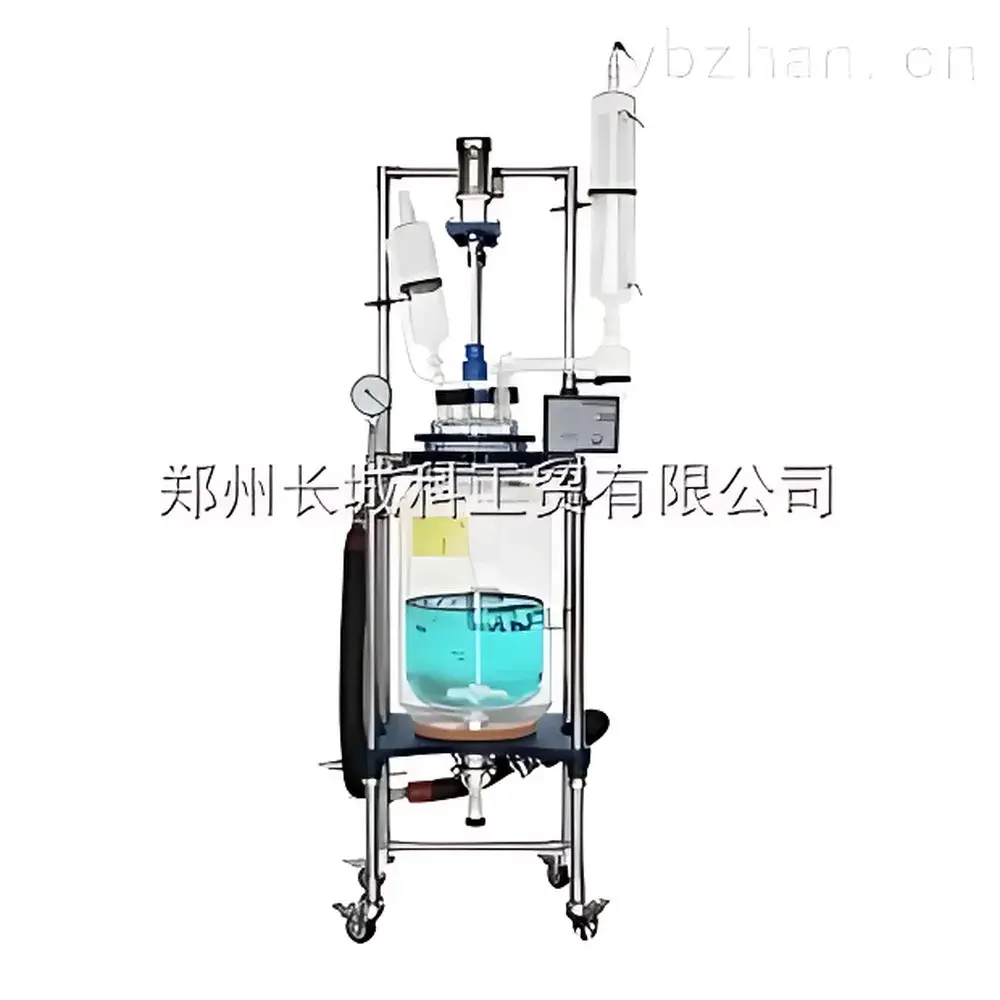
Great Wall GR-20 Triple-Layer Glass Reactor
| Brand | The Great Wall |
|---|---|
| Origin | Henan, China |
| Manufacturer Type | Direct Manufacturer |
| Country of Origin | China |
| Model | GR-20 |
| Capacity | 20 L |
| Vessel Material | GG17 Borosilicate Glass (3.3) |
| Operating Pressure | Low-pressure (up to 0.1 MPa gauge) |
| Vacuum Level | –0.098 MPa (absolute) |
| Jacket Configuration | Triple-layer (inner reaction vessel + dual insulating/temperature-control jackets) |
| Stirring Motor | AC Gearmotor with Frequency Control |
| Sealing System | PTFE-faced mechanical seal + ground-glass joints |
| Temperature Sensor | Pt100 RTD probe |
| Discharge Valve | PTFE-lined adjustable bottom valve |
| Frame | Stainless steel mobile column-type support structure |
Overview
The Great Wall GR-20 Triple-Layer Glass Reactor is an engineered laboratory-scale synthesis platform designed for controlled chemical reactions under variable temperature, pressure, and vacuum conditions. Based on the Couette flow principle and jacketed thermal management architecture, it enables precise regulation of reaction thermodynamics via independent circulation of heating or cooling media (e.g., silicone oil, ethylene glycol/water mixtures, or cryogenic fluids) through its dual-jacket system — one for primary temperature control and a second for thermal insulation or secondary process conditioning. Constructed entirely from ASTM F1356-compliant GG17 borosilicate glass (linear expansion coefficient α = 3.3 × 10⁻⁶/K), the reactor exhibits exceptional resistance to thermal shock (up to 120 °C ΔT), chemical corrosion (including concentrated acids, alkalis, and organic solvents), and UV transparency for in-situ visual monitoring. Its low-pressure operational envelope (≤0.1 MPa gauge) and high-vacuum capability (–0.098 MPa absolute) make it suitable for distillation, reflux, solvent removal, catalytic hydrogenation (with inert gas purging), and moisture-sensitive syntheses — all while maintaining full optical access and traceable process integrity.
Key Features
- Triple-layer glass construction: Inner reaction chamber + primary thermal jacket + outer insulating jacket — minimizes heat loss, improves energy efficiency, and enhances operator safety during exothermic/endothermic operations.
- PTFE-faced mechanical seal with alloy steel housing and integrated wear debris collection groove — ensures long-term vacuum integrity (≤–0.098 MPa) and eliminates cross-contamination from seal degradation.
- Frequency-controlled AC gearmotor (Japan-derived design) delivering high torque (>15 N·m) at low noise (<55 dB(A)) across 0–250 rpm range; spark-free operation compliant with IEC 60079-0 general requirements for non-incendive equipment.
- Dual PTFE-coated impeller assembly — optimized for shear-sensitive suspensions and high-viscosity media (up to 50,000 mPa·s); compatible with anchor, paddle, and turbine configurations via standardized ISO-KF 25 mm shaft interface.
- Five-neck standard top plate (Φ100 mm central port + four 34/45 ground-glass side ports) supports simultaneous installation of condenser, addition funnel, thermometer, pH/ORP probe, and inert gas inlet — configurable per ASTM E2500 Annex A for modular process validation.
- Pt100 Class B RTD sensor (IEC 60751) embedded in vessel wall near reaction zone — provides ±0.3 °C accuracy over –20 °C to +200 °C range; output compatible with PID controllers and data loggers supporting FDA 21 CFR Part 11 audit trails.
Sample Compatibility & Compliance
The GR-20 accommodates heterogeneous, viscous, crystallizing, and gas-evolving reaction mixtures without risk of thermal runaway or seal failure. Its GG17 glass body meets ISO 3585 specifications for laboratory glassware and complies with USP requirements for extractables testing in pharmaceutical development. All wetted PTFE components conform to ASTM D471 and FDA CFR Title 21 §177.1550 for food-contact and GMP-relevant applications. The frame-mounted stainless steel (AISI 304) support structure satisfies ISO 14644-1 Class 8 cleanroom compatibility when equipped with optional HEPA-filtered purge lines. Documentation includes material certificates (EN 10204 3.1), pressure test reports (hydrostatic at 1.5× working pressure), and calibration records traceable to NIM (National Institute of Metrology, China).
Software & Data Management
While the base GR-20 operates as a standalone analog-controlled unit, it integrates seamlessly with third-party digital control systems via 4–20 mA temperature/vacuum outputs and dry-contact motor start/stop signals. When paired with Great Wall’s optional TC-2000 temperature controller or external SCADA platforms (e.g., LabVIEW, DeltaV), users achieve automated ramp-hold-cool profiles, real-time parameter logging (≥1 Hz sampling), and electronic batch records compliant with ALCOA+ principles. All recorded data — including setpoints, actual values, alarm timestamps, and operator IDs — are stored in encrypted CSV or SQLite format with immutable audit trails meeting GLP and GMP Annex 11 expectations.
Applications
This reactor serves as a core platform in academic research labs (organic methodology development, polymerization kinetics), pilot-scale API synthesis (ICH Q5A/Q5B), battery electrolyte formulation (LiPF₆ stability studies), nanomaterial precipitation (quantum dot nucleation control), and natural product extraction (supercritical CO₂-assisted fractionation). It is routinely employed in teaching laboratories for undergraduate physical chemistry experiments (Arrhenius activation energy determination), graduate-level reaction engineering modules (residence time distribution analysis), and industry-led training on hazard evaluation (RC1 calorimetry integration via optional heat-flow sensor port).
FAQ
What temperature range can the GR-20 sustain during operation?
The reactor supports continuous operation from –80 °C (with low-temp circulator) to +200 °C (with high-temp oil bath), limited only by the thermal stability of the circulating medium and PTFE sealing elements.
Is the GR-20 suitable for hydrogenation reactions?
Yes — when used with H₂-compatible fittings, palladium-on-carbon catalysts, and appropriate pressure-rated accessories (e.g., reinforced PTFE diaphragm valves), it supports atmospheric-pressure catalytic reductions; pressurized variants require custom engineering per PED 2014/68/EU.
Can the system be validated for GMP manufacturing?
The GR-20 meets foundational URS criteria for lab-scale GMP processes; IQ/OQ protocols are available upon request, including DQ documentation, sensor calibration certificates, and leak-test verification reports per ISO 15848-1.
How is cleaning and maintenance performed between batches?
All glass components are autoclavable (121 °C, 2 bar); PTFE seals are replaceable using standard torque wrench settings (5.5 N·m); jacket drainage ports allow complete evacuation of thermal fluids within 90 seconds.
Does Great Wall provide technical support for international customers?
Yes — English-language engineering support, remote commissioning assistance, and spare parts logistics are provided globally through authorized distributors certified to ISO 9001:2015.



