
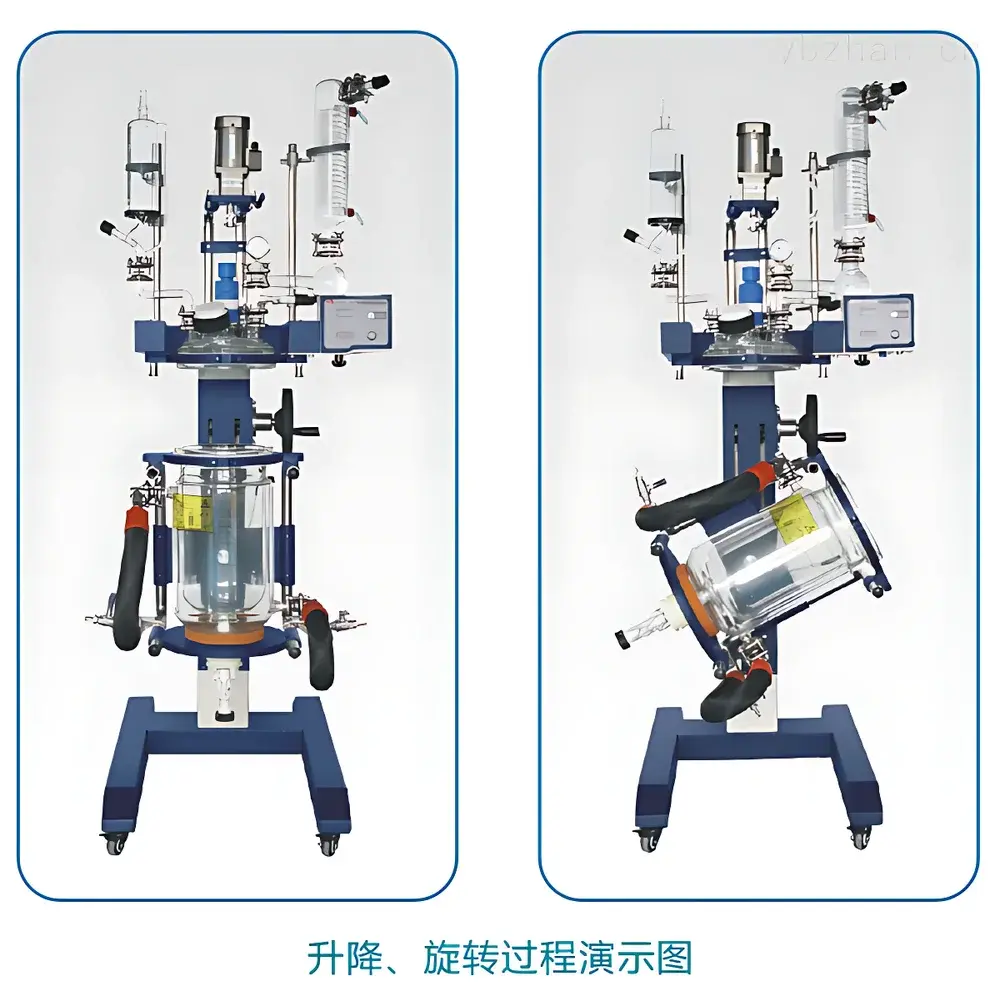
Great Wall GR-20L Elevating & Rotatable Double-Jacketed Glass Reactor
| Brand | Great Wall |
|---|---|
| Origin | Henan, China |
| Manufacturer Type | Direct Manufacturer |
| Country of Origin | China |
| Model | GR-20L (Elevating & Rotatable) |
| Capacity | 20 L |
| Jacket Volume | 6 L |
| Jacket Heat Transfer Area | 0.32 m² |
| Condenser Heat Transfer Area | 0.3 m² |
| Material | Borosilicate Glass 3.3 |
| Operating Temperature Range | −80 °C to +200 °C |
| Thermal Shock Resistance | 90 °C |
| Operating Pressure | Vacuum or Atmospheric |
| Maximum Vacuum | 0.098 MPa (absolute) |
| Stirring Speed Range | 50–500 rpm |
| Motor Power | 90 W |
| Drive Type | Frequency-Controlled Variable-Speed Drive |
| Stirring Seal | Dual Mechanical Seal (PTFE-coated stainless steel shaft & bearing) |
| Bottom Discharge Valve | PTFE-lined DN15 flanged valve with ≥300 mm ground clearance |
| Dimensions (L×W×H) | 660 × 535 × 1950 mm |
| Power Supply | 220 V, 50 Hz |
| Port Configuration | Six standard openings (50 mm stirrer port, two 24/40 standard taper joints, one 50 mm ball joint, one 34 mm taper joint, one 40 mm taper joint, one 80 mm flange for solid feed) |
Overview
The Great Wall GR-20L Elevating & Rotatable Double-Jacketed Glass Reactor is an engineered solution for controlled batch synthesis, crystallization, distillation, and multi-step reaction workflows in R&D laboratories and pilot-scale process development. Designed around the principles of thermal management, vacuum integrity, and operational flexibility, this reactor employs a double-jacketed borosilicate glass 3.3 vessel to enable precise temperature control via external heating/cooling media (e.g., silicone oil, glycol-water mixtures, or dry ice/acetone baths). Its core architecture supports simultaneous application of vacuum (down to 0.098 MPa absolute), mechanical stirring, reflux condensation, and controlled reagent addition — all within a chemically inert, optically transparent environment. The system is purpose-built for applications requiring strict contamination control, visual reaction monitoring, and reproducible scale-up parameters — particularly in pharmaceutical intermediates, fine chemical synthesis, and polymerization studies where material compatibility and cleaning validation are critical.
Key Features
- Manually actuated vertical lift mechanism (±150 mm travel range) and 0–120° rotational capability enable ergonomic loading/unloading of viscous slurries, large crystals, or solid catalysts without disassembly.
- Flange-based sealing interface between lid and vessel eliminates reliance on vacuum grease, ensuring consistent high-vacuum performance and reducing maintenance intervals and cross-contamination risk.
- Zero-dead-volume bottom discharge valve with PTFE-lined stainless steel body and ≥300 mm ground clearance facilitates complete product recovery and meets GLP-compliant cleaning verification requirements.
- Stable parallel-steel base frame with locking casters allows full-system mobility while maintaining vibration-damped operation under continuous stirring at up to 500 rpm.
- Six standardized ports accommodate modular integration of condensers, temperature probes (Pt100), pH electrodes, peristaltic feed pumps, and solid-feeding funnels — supporting ASTM E2500-18-defined equipment qualification protocols.
- Frequency-controlled stirring drive delivers constant torque across the 50–500 rpm range; dual mechanical seals with fluoropolymer-coated shaft ensure long-term vacuum-tight operation in aggressive solvent environments.
Sample Compatibility & Compliance
The GR-20L reactor is compatible with a broad spectrum of organic solvents (e.g., THF, DMF, chlorinated hydrocarbons), aqueous acids/bases (pH 0–14), and reactive intermediates (Grignard reagents, organolithiums) due to its all-borosilicate-glass 3.3 and PTFE-wetted construction. It conforms to ISO 3585 for laboratory glassware dimensional tolerances and meets CE machinery directive (2006/42/EC) requirements when integrated with certified vacuum pumps and temperature controllers. For regulated environments, the system supports 21 CFR Part 11-compliant data acquisition when paired with ZN-series intelligent controllers (optional), providing electronic audit trails for temperature, stirring speed, vacuum level, and dosing events. Cleaning validation is facilitated by full optical access, absence of crevices, and compatibility with automated CIP cycles using validated rinse agents.
Software & Data Management
While the base GR-20L operates as a standalone unit, it is fully interoperable with Great Wall’s ZN Intelligent Biochemical Reaction Control System. This optional controller provides real-time digital display and logging of up to five process variables: jacket temperature, internal medium temperature (via Pt100), stirring speed, torque (as proxy for viscosity), and pH (with optional electrode). It supports segmented programmable control (up to 16 steps), time-synchronized reagent addition via peristaltic pump modulation, and USB/Ethernet connectivity for CSV export and trend analysis in third-party platforms (e.g., LabVIEW, MATLAB). All logged data include timestamps, operator ID, and system status flags — satisfying ALCOA+ data integrity criteria for GMP/GLP documentation.
Applications
- Controlled crystallization of active pharmaceutical ingredients (APIs) under vacuum-assisted solvent removal.
- Multi-stage Grignard or lithiation reactions requiring strict moisture/oxygen exclusion and exotherm management.
- Enzymatic transesterification in biodiesel development, monitored via real-time viscosity tracking.
- Pilot-scale polymer synthesis (e.g., polyesters, polyacrylates) with sequential monomer addition and vacuum devolatilization.
- Extraction and concentration of natural products using rotary evaporation-compatible configurations.
- Method development for ICH Q5A-compliant biocatalyst immobilization studies under sterile conditions (with optional HEPA-filtered gas inlet).
FAQ
What is the maximum allowable temperature differential across the glass wall during rapid heating or cooling?
The borosilicate 3.3 vessel is rated for thermal shock resistance of 90 °C — meaning the difference between jacket fluid temperature and internal reaction mass temperature must not exceed this value to prevent stress-induced fracture.
Can the reactor be used under positive pressure?
No — the GR-20L is designed exclusively for vacuum or atmospheric operation. Positive pressure applications require alternative pressure-rated reactors compliant with PED 2014/68/EU.
Is the stirring system suitable for highly viscous media (e.g., >50,000 mPa·s)?
Yes, with appropriate paddle selection (e.g., anchor or helical ribbon impellers); torque monitoring via the ZN controller enables detection of power draw anomalies indicative of viscosity shifts or solid deposition.
How is calibration traceability maintained for temperature and vacuum sensors?
All Pt100 sensors and vacuum transducers are supplied with individual factory calibration certificates (ISO/IEC 17025-accredited). Field recalibration is supported using NIST-traceable reference standards.
Does the system meet FDA requirements for use in drug substance manufacturing?
As supplied, the GR-20L qualifies as lab-scale R&D equipment. For GMP production use, additional documentation (DQ/IQ/OQ/PQ protocols), material certifications (e.g., USP Class VI for PTFE components), and 21 CFR Part 11-compliant software validation are required — all available upon request.
Related Products



