
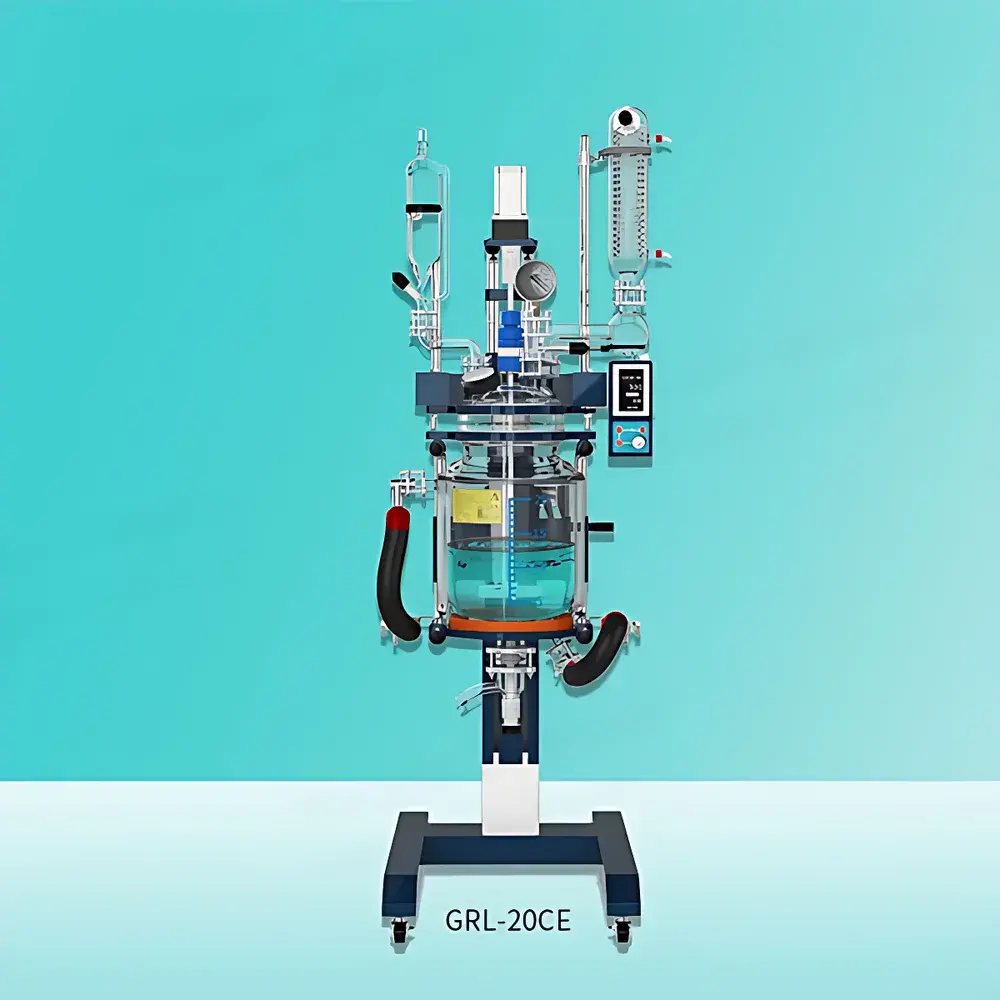
The Great Wall GRL-10–50 Dual-Jacketed Lifting Glass Reactor
| Brand | The Great Wall |
|---|---|
| Origin | Henan, China |
| Manufacturer Type | Direct Manufacturer |
| Country of Origin | China |
| Model | GRL-10~50 |
| Instrument Category | Glass Reactor |
| Volume Range | 10–50 L |
| Vessel Material | Borosilicate Glass 3.3 |
| Jacket Type | Dual (inner/outer jacket) |
| Operating Pressure Range | –0.1 MPa to 0.0 MPa (vacuum to ambient) |
| Temperature Range | –80 °C to +200 °C |
| Vessel Mobility | Motorized vertical lift + 120° rotational capability |
| Sealing Method | Flanged glass-to-glass connections with PTFE gaskets |
| Stirrer Assembly | PTFE-coated SUS304 shaft + PTFE impeller |
| Frame Construction | Q235 steel frame with powder coating + 6061-F aluminum panels |
| Mobility | Lockable casters with braking mechanism |
| Compliance | Designed for GLP-aligned laboratory workflows |
Overview
The Great Wall GRL-10–50 Dual-Jacketed Lifting Glass Reactor is an engineered platform for controlled chemical synthesis, process development, and scale-up studies under vacuum, inert, or reflux conditions. Built upon the fundamental principle of jacketed thermal management—where a circulating fluid (e.g., silicone oil, ethylene glycol/water, or cryogenic coolant) flows through the annular space between inner and outer glass walls—the system enables precise, uniform temperature control across the entire reaction volume. Its defining mechanical feature is the motor-assisted vertical lifting mechanism combined with 120° rotational articulation of the main vessel body, enabling unobstructed access for solid charging, catalyst loading, sampling, and thorough post-run cleaning without disassembling the entire system. All critical glass interfaces utilize standardized flanged connections sealed with chemically resistant PTFE gaskets, ensuring leak-tight integrity at full vacuum (–0.1 MPa) while maintaining rapid, tool-free assembly and maintenance.
Key Features
- Dual-jacketed borosilicate glass 3.3 construction (DIN ISO 3585 compliant), offering high thermal shock resistance, low thermal expansion (3.3 × 10⁻⁶ K⁻¹), and exceptional chemical inertness toward acids, alkalis, and organic solvents.
- Vertical lift range ≥300 mm and 120° rotational capability—actuated via integrated gearmotor—enabling ergonomic material handling and complete internal visibility during operation and cleaning.
- Temperature operational envelope of –80 °C to +200 °C, validated for sustained use with compatible heat transfer fluids and external circulation units (e.g., cryogenic chillers, heating circulators).
- Stirring system featuring a SUS304 stainless steel shaft fully coated with virgin PTFE and a PTFE impeller, eliminating metal contamination risks in sensitive catalytic or pharmaceutical syntheses.
- Modular frame constructed from powder-coated Q235 structural steel and anodized 6061-F aluminum panels—corrosion-resistant, non-porous, and compliant with cleanroom-compatible surface hygiene standards.
- Four-point locking casters with independent brakes ensure stable positioning during operation and safe relocation within laboratory or pilot plant environments.
Sample Compatibility & Compliance
The GRL-10–50 accommodates heterogeneous, viscous, and suspension-based reaction mixtures typical in fine chemical synthesis, polymerization initiation, crystallization screening, and biocatalytic transformations. Its transparent glass vessel allows real-time visual monitoring of phase separation, precipitation onset, emulsion stability, and reflux behavior—critical for kinetic profiling and endpoint determination. The reactor meets functional requirements for ASTM E2500-13 (good practice in equipment qualification) and supports IQ/OQ documentation protocols. While not intrinsically certified for hazardous area use (e.g., ATEX or IECEx), its design permits integration into Class I, Division 2-compliant fume hoods when operated with appropriate ventilation and inert gas purging (N₂ or Ar). Vacuum integrity is verified per ISO 2859-1 sampling plans during final factory testing.
Software & Data Management
As a standalone benchtop reactor, the GRL-10–50 operates via analog/manual controls (lift height, rotation angle, stir speed via potentiometer). For digital integration, it is fully compatible with third-party PID controllers and programmable logic controllers (PLCs) via 0–10 V or 4–20 mA analog I/O ports (optional upgrade). When paired with external circulators (e.g., GD10–20 or CF20–60 series), temperature ramping profiles, hold times, and cooling rates can be logged and exported in CSV format for audit-ready traceability. Data acquisition systems may record stir speed, vessel position, and external bath temperature—supporting 21 CFR Part 11-compliant electronic records when deployed with validated software platforms and user access controls.
Applications
- Chemical Synthesis: Grignard reactions, lithium–halogen exchange, hydrogenation under H₂/N₂ atmospheres, and multi-step cascade reactions requiring sequential heating/cooling cycles.
- Pharmaceutical Process Development: Solvent-mediated polymorph screening, API crystallization optimization, and solvent recovery via vacuum distillation (up to 50 L batch capacity).
- Materials Science: Sol–gel synthesis of metal oxides, nanoparticle nucleation studies, and conductive polymer emulsion polymerization.
- Food & Cosmetic R&D: Emulsification kinetics, cold-process extraction (e.g., supercritical CO₂ co-solvent delivery), and thermal stability testing of active ingredients.
- Energy Research: Electrolyte formulation for flow batteries, catalyst testing for PEM fuel cells, and pyrolysis feedstock screening under controlled vacuum and temperature gradients.
FAQ
What vacuum level can the GRL-10–50 sustain?
The reactor maintains stable operation down to –0.1 MPa (10 mbar abs) when equipped with fluoropolymer-sealed flanges and used with a compatible two-stage rotary vane or diaphragm vacuum pump.
Is the stirring speed electronically controllable?
Standard configuration includes a stepless DC motor with analog speed adjustment (0–200 rpm typical range); optional RS-485 Modbus interface enables remote speed setpoint control and feedback logging.
Can the reactor be pressurized?
No—it is rated exclusively for vacuum and atmospheric pressure operation. Pressurized applications require alternative designs such as Hastelloy or SS316L jacketed autoclaves.
What certifications does the unit carry?
The mechanical assembly complies with GB/T 19001–2016 (equivalent to ISO 9001:2015); electrical components meet CE-marked safety standards (EN 61000-6-3, EN 61000-6-4) when supplied with EU-spec power modules.
How is temperature uniformity validated across the 50 L volume?
During factory acceptance testing, three calibrated PT100 sensors are immersed at top/mid/bottom positions; deviation remains ≤±1.5 °C under steady-state conditions at 100 °C using a matched external circulator.



