
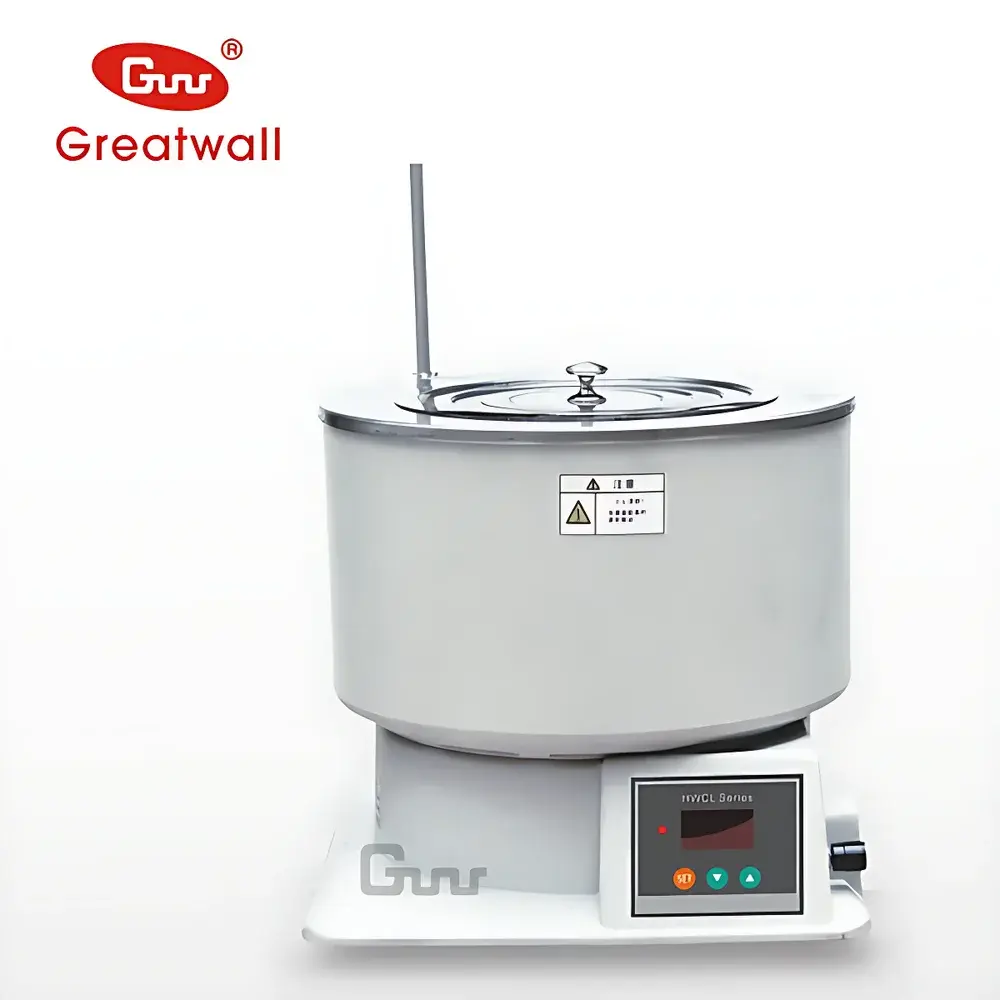
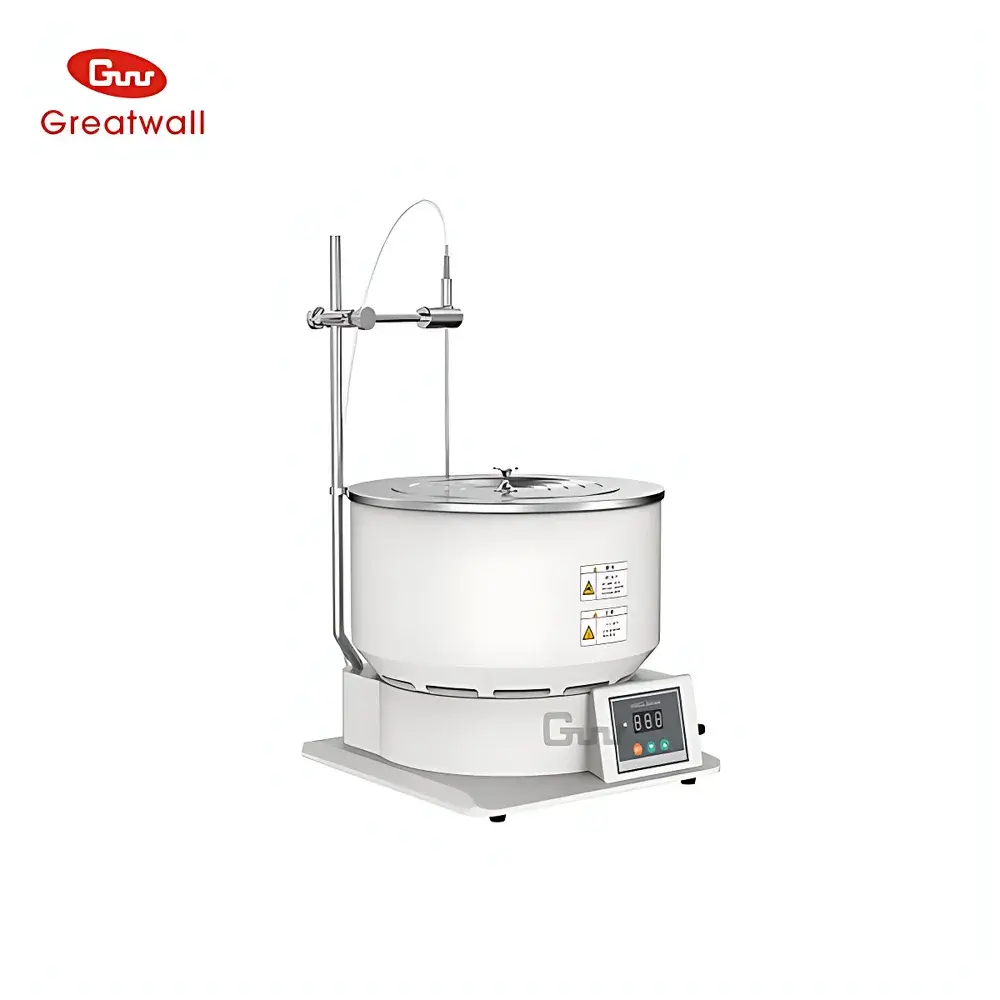
The Great Wall HWCL-5 Integrated Heating Magnetic Stirring Bath
| Brand | The Great Wall |
|---|---|
| Origin | Henan, China |
| Manufacturer Type | Direct Manufacturer |
| Instrument Type | Magnetic Stirrer |
| Max. Stirring Volume | 5000 mL |
| Speed Range | 0–2000 rpm |
| Temperature Control Range | Ambient +5°C to 200°C |
| Drive Motor | Brushless DC Motor |
| Magnet Type | High-Temperature Resistant Permanent Magnet |
| Control Method | PID Temperature Regulation |
| Display & Interface | Digital LED Display with Keypad Input |
| Dual-Sensor Capability | Yes (Bath Temperature or Vessel Internal Temperature) |
Overview
The Great Wall HWCL-5 Integrated Heating Magnetic Stirring Bath is an engineered laboratory platform designed for precise thermal control and homogeneous mixing in open-bath and vessel-based applications. Unlike conventional hotplates or standalone stirrers, the HWCL-5 integrates a thermostatically regulated heating bath with a high-torque magnetic stirring mechanism—enabling simultaneous temperature uniformity and mechanical agitation across large-volume samples. Its operational principle relies on a rotating magnetic field generated by a high-stability permanent magnet assembly, coupled with a brushless DC motor that ensures low-noise, maintenance-free rotation and consistent torque delivery up to 2000 rpm. The unit employs a dual-sensor architecture to support either bath-medium temperature monitoring or direct reaction-vessel internal temperature feedback—a critical capability for kinetic studies, solvent reflux, enzymatic reactions, and polymerization processes where thermal gradients must be minimized and process reproducibility maximized.
Key Features
- Integrated design combining heating, temperature regulation, and magnetic stirring in a single compact unit—eliminating inter-device alignment issues and thermal lag.
- Brushless DC motor drive delivering stable rotational output across the full 0–2000 rpm range, with no carbon brush wear or electromagnetic interference.
- High-temperature resistant permanent magnet system rated for continuous operation up to 200°C without demagnetization—ensuring long-term reliability under sustained thermal load.
- PID-based digital temperature controller with ±0.3°C typical stability (at setpoint) and fast thermal response time (<15 min to reach 150°C from ambient).
- Dual independent PT100 sensors: one embedded in the aluminum alloy bath block, the other configurable via external probe port for real-time vessel core temperature measurement.
- LED digital display with intuitive keypad interface—supporting setpoint entry, actual temperature readout, rpm setting, and status indicators for heating/stirring activation.
- Robust construction: anodized aluminum heating bath, stainless steel housing, and IP20-rated electrical enclosure compliant with IEC 61010-1 for laboratory use.
Sample Compatibility & Compliance
The HWCL-5 accommodates standard laboratory glassware including round-bottom flasks (up to 5 L), beakers, and jacketed reactors. Its 5000 mL maximum effective volume supports scalable synthesis, dissolution testing, and quality control workflows in pharmaceutical, chemical, and materials research labs. The unit meets general safety requirements per IEC 61010-1:2010 (Edition 3) for electrical equipment used in measurement, control, and laboratory use. While not certified to ISO/IEC 17025 or GLP-specific validation protocols out-of-the-box, its dual-sensor configuration and stable PID control facilitate user-defined IQ/OQ documentation aligned with internal SOPs or FDA 21 CFR Part 11-compliant data integrity frameworks when paired with validated logging software.
Software & Data Management
The HWCL-5 operates as a stand-alone instrument with local digital control; it does not include built-in data logging or PC connectivity. However, its analog voltage output (0–5 V or 4–20 mA, configurable via optional module) enables integration with third-party data acquisition systems (e.g., LabVIEW, MATLAB, or PLC-based SCADA platforms) for time-stamped temperature and speed recording. Users may implement audit-trail-capable logging through external hardware interfaces—supporting traceability requirements in regulated environments where temperature ramp profiles, dwell times, and stirring consistency must be documented per USP , ASTM E2500, or GMP Annex 11 guidelines.
Applications
- Controlled-temperature synthesis of organometallic compounds requiring inert-atmosphere reflux conditions.
- Dissolution rate testing per USP Apparatus II (paddle) calibration verification using standardized reference standards.
- Preparation of nanoparticle dispersions and colloidal suspensions where shear history and thermal homogeneity directly impact particle size distribution.
- Enzyme activity assays conducted at defined temperatures (e.g., 37°C, 60°C) with continuous mixing to prevent sedimentation or localized denaturation.
- Calibration of thermocouples, RTDs, and infrared pyrometers against NIST-traceable references in metrology laboratories.
- Material compatibility screening of elastomers, adhesives, and coatings under accelerated thermal aging protocols (e.g., ASTM D573).
FAQ
Does the HWCL-5 support external temperature probe input for reaction vessel monitoring?
Yes—the instrument includes a dedicated sensor port enabling connection of a PT100 or thermistor probe placed directly inside the reaction vessel. This allows real-time internal temperature feedback independent of bath fluid temperature.
What is the recommended maintenance interval for the magnetic stirring system?
No scheduled maintenance is required for the brushless DC motor or permanent magnet assembly. Routine cleaning of the bath surface and inspection of the Teflon-coated stir bar after each use are sufficient for long-term performance.
Can the HWCL-5 be used under inert gas or vacuum conditions?
The unit itself is not sealed for vacuum operation, but it is routinely employed beneath nitrogen or argon purge hoods. Users should ensure adequate venting of volatile solvents and avoid submerging electrical components during purging procedures.
Is RS-232 or USB communication available as a factory option?
No native serial or USB interface is included. Communication capability requires retrofitting with an optional analog output module and external DAQ hardware.
How is temperature uniformity verified across the bath volume?
Uniformity is characterized at ±0.5°C within the central 80% of the bath area (per ASTM E1137) when operating at steady state. Users may validate spatial consistency using a calibrated multi-point thermocouple array during qualification.



