
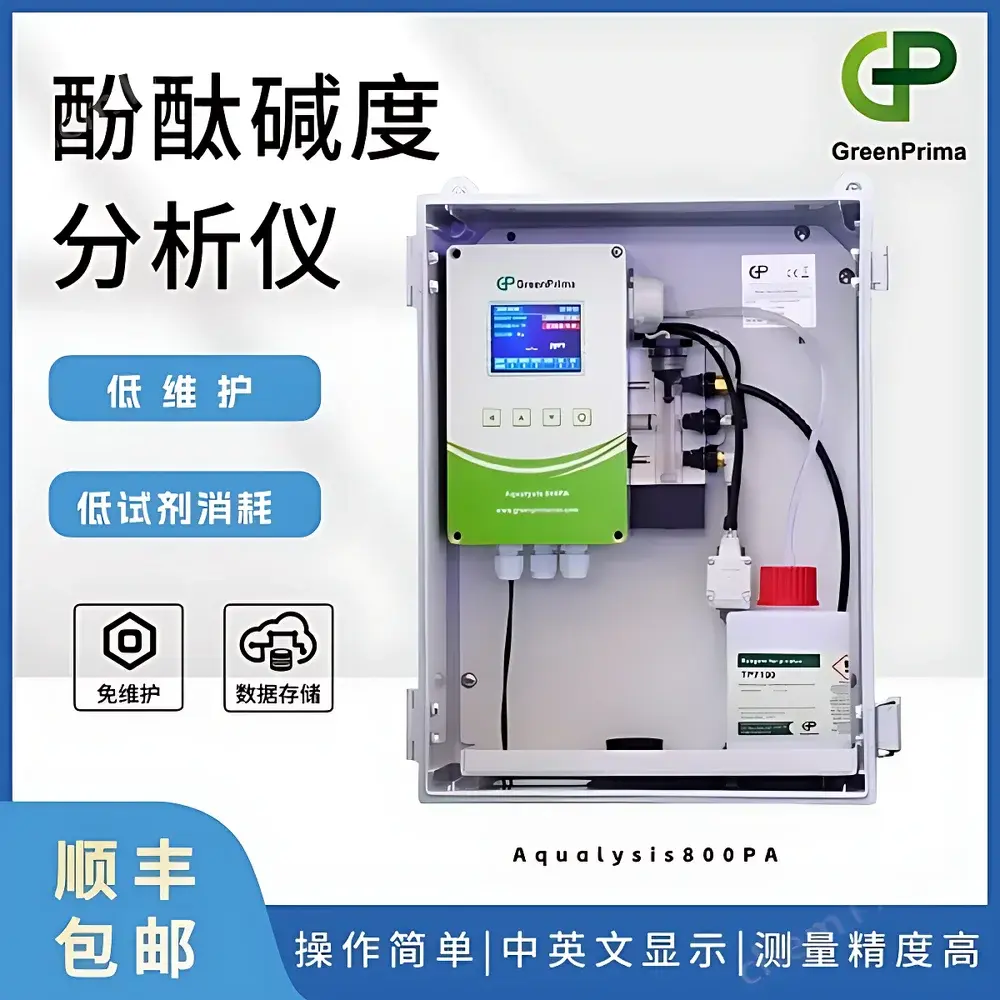
GreenPrima Aqualys is800PA Phenolphthalein Alkalinity Analyzer for Boiler Feedwater
| Brand | GreenPrima |
|---|---|
| Origin | United Kingdom |
| Manufacturer Type | Manufacturer |
| Origin Category | Imported |
| Model | Aqualys is800PA |
| Price | Upon Request |
Overview
The GreenPrima Aqualys is800PA Phenolphthalein Alkalinity Analyzer is a fully automated, benchtop-to-wall-mountable process analyzer engineered for continuous or interval-based monitoring of phenolphthalein alkalinity (P-alkalinity) in industrial water streams—particularly boiler feedwater, cooling tower makeup, blast furnace gas scrubber effluent, and turbid recirculating systems. It operates on the principle of potentiometrically guided acid–base titration coupled with photometric endpoint detection: a precise volume of standardized hydrochloric acid is delivered to the sample via peristaltic dosing; phenolphthalein indicator is then introduced, inducing a pH-dependent color shift from pink to colorless at approximately pH 8.3. The system measures absorbance change at 540 nm using a stable LED-light source and silicon photodiode detector, enabling quantification of P-alkalinity expressed as mg/L CaCO₃, mmol/L, °dH, or °f. Designed for unattended operation over extended periods, the is800PA integrates microprocessor-controlled fluidics, real-time self-diagnosis, and adaptive calibration logic to ensure long-term measurement integrity under variable inlet water quality.
Key Features
- Automated titration–photometry hybrid methodology compliant with ISO 9963-1 and ASTM D1067 for phenolphthalein alkalinity determination
- Touchscreen-enabled control unit with full-color LCD interface supporting both English and Chinese language modes
- Compact footprint (400 × 300 × 180 mm; 4 kg) and IP65-rated enclosure suitable for semi-outdoor or utility-room deployment
- Low-reagent consumption architecture: typical reagent usage 6 months of operation on standard 500-mL acid/indicator reservoirs
- Flexible measurement scheduling: user-defined intervals from 1 to 360 minutes, external trigger via dry-contact input (IN1/IN2), or flow-synchronized initiation
- Four programmable relay outputs (250 VAC / 4 A max) for alarm, pump control, or interlock signaling; two digital inputs for system integration
- Standard analog output (4–20 mA, load ≤750 Ω) and RS485 Modbus RTU interface for SCADA/HMI connectivity
- Onboard data logging (≥10,000 records) with timestamped event history including calibration events, fault codes, and maintenance alerts
Sample Compatibility & Compliance
The is800PA is validated for use with low-turbidity, non-oily aqueous samples meeting defined physicochemical constraints: pH 4–10, temperature 5–40 °C, pressure 0.2–5 bar (optimal 1–2 bar), and trace metal limits (Fe < 3 ppm, Cu < 0.2 ppm, Al < 0.1 ppm, Mn 50 mg/L or organic dyes require pre-filtration (5 µm nominal) to prevent optical interference or valve clogging. The analyzer complies with IEC 61326-1 (EMC for industrial environments), CE marking requirements, and supports audit-ready operation under GLP and GMP frameworks through configurable data retention, electronic signature-capable calibration logs, and optional 21 CFR Part 11–compatible software modules.
Software & Data Management
Embedded firmware enables automatic zero-point verification, multi-point standard calibration (up to 3 points), and drift compensation based on blank measurement stability. All configuration parameters—including titration slope, endpoint threshold, rinse duration (15–1800 s), and alarm thresholds—are stored in non-volatile memory. Data export is supported via USB mass storage or Modbus polling; historical trends can be visualized directly on-screen or exported as CSV. Remote diagnostics and parameter updates are possible via secure SSH or TLS-enabled web interface when integrated with GreenPrima’s AquaLink™ supervisory platform—designed for fleet-wide instrument health monitoring and predictive maintenance scheduling.
Applications
This analyzer serves critical water chemistry control functions across thermal power generation, steelmaking, petrochemical refining, and HVAC infrastructure. In boiler feedwater circuits, precise P-alkalinity monitoring prevents caustic embrittlement and carbonate scale formation by maintaining optimal NaOH/Na₃PO₄ dosing ratios. In gas scrubber systems, it ensures neutralization efficiency while minimizing acid overfeed and corrosion risk. For open-recirculating cooling towers, it supports blowdown optimization and cycles-of-concentration management. Its robustness against moderate iron and silica fouling makes it especially suited for metallurgical wastewater applications where conventional electrodes exhibit rapid drift.
FAQ
What is the difference between phenolphthalein alkalinity (P-alkalinity) and total alkalinity (M-alkalinity)?
Phenolphthalein alkalinity measures hydroxide and half the carbonate alkalinity (OH⁻ + ½CO₃²⁻) at pH ≈ 8.3, whereas total alkalinity includes all buffering species (OH⁻ + CO₃²⁻ + HCO₃⁻) titrated to pH ≈ 4.5.
Can the is800PA measure total alkalinity as well?
No—the is800PA is specifically configured for phenolphthalein endpoint detection. Total alkalinity requires methyl orange or mixed indicator titration to pH 4.5, which necessitates different reagent formulation and optical calibration.
Is field calibration required after installation?
Yes—a two-point calibration using certified standard solutions (e.g., 50 and 200 mg/L CaCO₃) is mandatory prior to commissioning; subsequent verification is recommended every 30 days or after reagent replacement.
Does the system support integration with PLC-based control networks?
Yes—via native Modbus RTU over RS485 or 4–20 mA analog signal; digital I/O lines allow hardwired coordination with dosing pumps, solenoid valves, or emergency shutdown circuits.
What maintenance intervals are recommended?
Quarterly inspection of tubing, valves, and optical window cleaning; annual replacement of peristaltic pump tubing and LED light source; biannual validation of metering accuracy using gravimetric dispensing checks.







