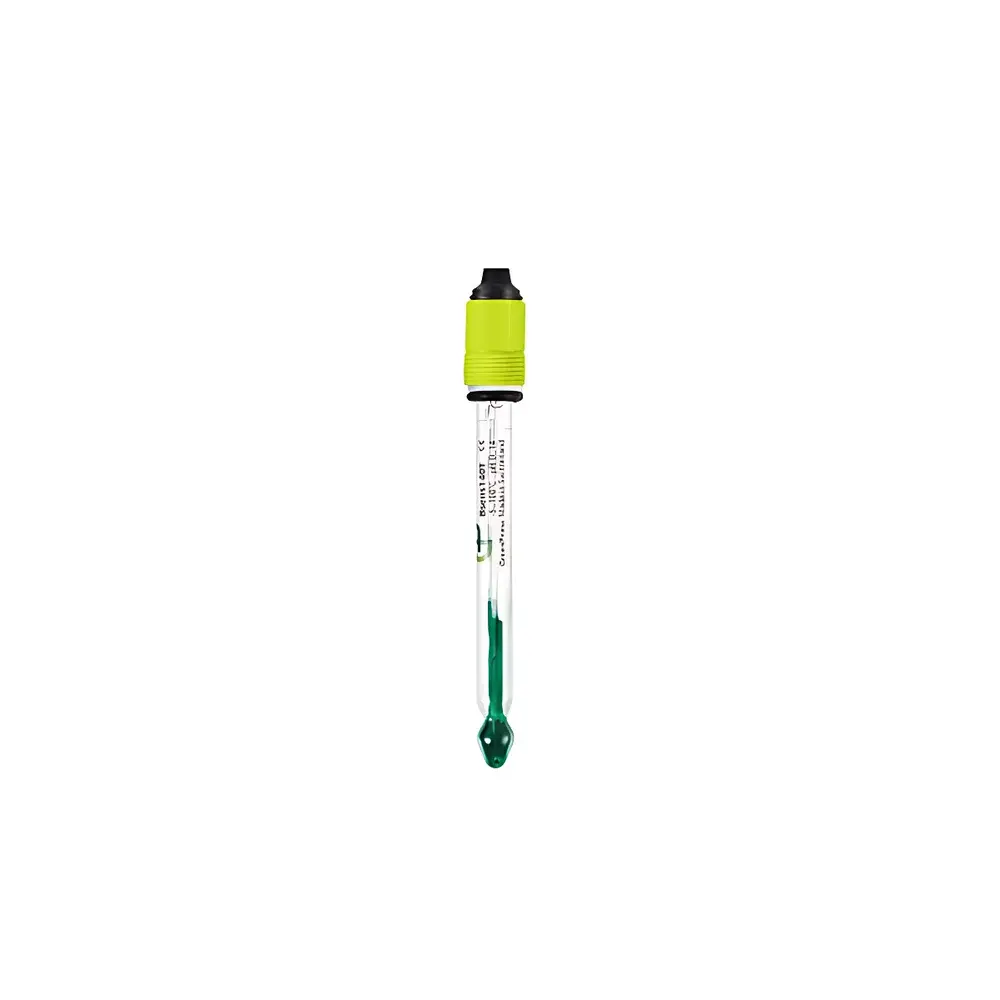
GreenPrima Bsens140T Ultra-Pure Water pH Sensor
| Brand | GreenPrima |
|---|---|
| Origin | Switzerland |
| Manufacturer Type | Original Equipment Manufacturer (OEM) |
| Product Category | Imported |
| Model | Bsens140T |
| Measuring Range | 0–14 pH |
| Operating Temperature | −5 to 100 °C |
| Reference Electrode | Ag/AgCl Cartridge |
| Temperature Sensor | PT1000 |
| Max. Process Pressure | 6 bar |
| Electrode Body Material | Glass |
| Electrolyte | Polymer-Gel |
| Junction | Triple Ceramic Porous Diaphragm |
| Glass Membrane | S-Type High-Resistance Glass |
| Minimum Immersion Depth | 20 mm |
| Zero Potential | ±20 mV |
| Sensitivity | 57–59 mV/pH at 25 °C |
| Minimum Sample Conductivity | 0.1 µS/cm |
| Response Time (pH 4–7) | <30 s |
| Process Connection | PG13.5 |
| Cable Length | 5 m |
Overview
The GreenPrima Bsens140T is a high-stability, low-conductivity pH sensor engineered specifically for continuous online monitoring of ultrapure water (UPW), deionized water (DIW), reverse osmosis (RO) permeate, and other low-ionic-strength aqueous streams. Unlike conventional pH electrodes, the Bsens140T employs an S-type high-resistance glass membrane combined with a triple ceramic junction and polymer-gel electrolyte—design features that minimize liquid junction potential drift and stabilize reference potential under conditions where sample conductivity falls below 1 µS/cm. Its measurement principle relies on the Nernstian response of hydrogen-ion activity across the hydrated glass membrane, calibrated against traceable buffer standards per ISO 8655 and ASTM D1293. The sensor is intended for integration into industrial process control systems where long-term stability, minimal maintenance, and reliable detection of subtle pH shifts (e.g., from CO₂ ingress or resin exhaustion) are critical.
Key Features
- S-type high-resistance glass membrane optimized for low-conductivity media (≥0.1 µS/cm), reducing asymmetric potential and improving zero-point stability
- Triple ceramic porous junction ensures consistent electrolyte outflow while resisting clogging in particle-free ultrapure water
- Polymer-gel electrolyte eliminates leakage risk and maintains stable internal reference potential over extended operation without refilling
- Integrated PT1000 temperature sensor enables automatic temperature compensation (ATC) compliant with IEC 60746-1
- Robust all-glass body with PG13.5 metric process thread for sanitary or pressurized line installations up to 6 bar
- Minimal immersion depth of 20 mm supports use in low-volume bypass cells and micro-loop applications
- Output compatibility with standard 4–20 mA transmitters and RS485 Modbus RTU interfaces for seamless integration into DCS/SCADA environments
Sample Compatibility & Compliance
The Bsens140T is validated for use in water systems meeting ASTM D5127 (Standard Guide for Ultrapure Water Used in the Electronics Industry), USP (Water for Pharmaceutical Use), and ISO 3696 (Grade 1 water). It is not suitable for wastewater, high-salinity brines, or organic solvents. The sensor complies with IP67-rated housing requirements when mounted with appropriate gland fittings. Its design supports GLP/GMP traceability: batch-specific calibration certificates (traceable to NIST SRM buffers) are provided, and the electrode’s zero point and slope are verifiable per EN ISO 17025-accredited procedures. For FDA-regulated pharmaceutical water systems, the sensor meets material biocompatibility requirements per USP and , and its gel electrolyte formulation avoids leachable contaminants.
Software & Data Management
When paired with the GreenPrima PM8200P controller, the Bsens140T supports audit-trail-enabled calibration logging, configurable alarm thresholds (pH deviation, temperature fault, signal loss), and real-time diagnostics including impedance monitoring and junction resistance estimation. All data—including timestamped calibration records, slope/offset history, and raw mV output—is exportable via Modbus TCP or CSV over USB. The controller firmware adheres to FDA 21 CFR Part 11 requirements for electronic records: user authentication, electronic signatures, and immutable event logs are enforced. Historical trends can be synchronized with LIMS or MES platforms using OPC UA or MQTT protocols.
Applications
- Real-time pH monitoring in semiconductor fab UPW distribution loops
- Final polishing loop verification in biopharmaceutical purified water (PW) and water-for-injection (WFI) systems
- RO and EDI system performance tracking in power plant boiler feedwater treatment
- Continuous quality assurance in laboratory-grade water purification systems (e.g., Milli-Q, ELGA)
- Leak detection in steam condensate return lines via pH depression caused by amine carryover or CO₂ absorption
- Validation of ion exchange column breakthrough in nuclear primary coolant purification circuits
FAQ
Why is a specialized electrode required for ultrapure water pH measurement?
Conventional pH electrodes exhibit unstable reference potentials and slow response in low-conductivity water due to high electrical resistance and liquid junction instability. The Bsens140T mitigates this via S-glass, triple junction geometry, and gel electrolyte—reducing measurement uncertainty to ≤±0.05 pH under controlled flow conditions.
Can the Bsens140T be used in hot process water above 80 °C?
Yes—the sensor is rated for continuous operation up to 100 °C; however, prolonged exposure above 85 °C may accelerate glass membrane hydration and require more frequent calibration verification per ASTM D1129.
What maintenance intervals are recommended for long-term deployment?
In clean UPW service, routine verification (zero/slope check) is advised every 7–14 days; physical cleaning is rarely needed unless silica scaling or organic fouling is observed. Electrode replacement is typically required after 12–18 months of continuous use.
Is the PG13.5 thread compatible with common sanitary fittings?
PG13.5 is a metric parallel thread widely adopted in European process instrumentation; adapters to Tri-Clamp® (DIN 11851) or NPT are available through GreenPrima’s accessory catalog.
Does the sensor support automatic temperature compensation?
Yes—the integrated PT1000 provides direct resistance measurement, enabling linear ATC per the NIST ITS-90 standard within the controller firmware.