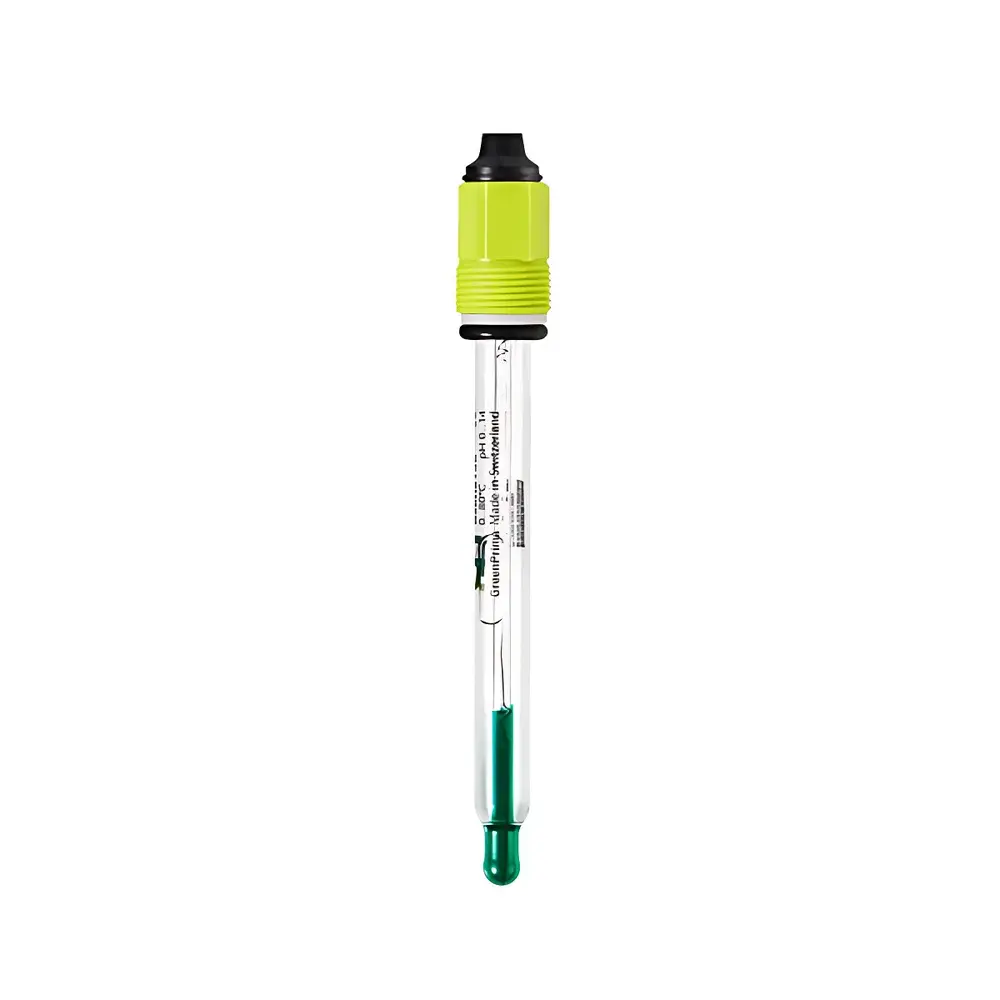
GreenPrima BSENS150T pH Sensor with HF-Resistant Glass Electrode
| Brand | GreenPrima |
|---|---|
| Origin | Switzerland |
| Manufacturer Type | OEM Producer |
| Origin Category | Imported |
| Model | BSENS150T |
| Electrode Body Material | HF-Resistant Glass |
| Reference System | Ag/AgCl Cartridge |
| Junction | Single Ceramic Porous Junction |
| Electrolyte | Polymer-Gel Filled |
| Connection | PG13.5 Threaded Process Connection |
| Max. Operating Pressure | 6 bar |
| Temp. Range | 0–80 °C |
| pH Range | 0–14 |
| Zero Point | ±20 mV |
| Sensitivity | 57–59 mV/pH at 25 °C |
| Impedance | ≤300 MΩ at 25 °C |
| Diameter | 12 mm |
| Length | 120 mm |
| Minimum Immersion Depth | 20 mm |
| Minimum Sample Conductivity | 50 μS/cm |
| Response Time (pH 4–7) | <30 s at 25 °C |
| HF Tolerance | Unrestricted up to 46 000 ppm F⁻ (i.e., ≥5 wt% HF) |
Overview
The GreenPrima BSENS150T is a high-integrity, process-grade pH sensor engineered specifically for continuous online monitoring in aggressive hydrofluoric acid (HF)-containing environments. Unlike conventional pH electrodes that rely on standard silicate-based glass membranes—rapidly degraded by fluoride ions—the BSENS150T employs a proprietary HF-resistant glass formulation developed and validated under controlled industrial conditions in Switzerland. Its measurement principle follows the Nernst equation, generating a stable, temperature-compensated millivolt signal proportional to hydrogen ion activity across the full aqueous pH range (0–14). Designed for permanent installation in chemical reactors, pickling lines, etching baths, and semiconductor wet benches, the sensor integrates a robust single-ceramic junction that eliminates clogging risks associated with multi-pore or sleeve-type reference systems. This architecture ensures long-term signal stability, reproducible calibration, and minimal maintenance intervals—even under sustained exposure to concentrated HF solutions exceeding 5 wt% (≥46 000 ppm F⁻).
Key Features
- HF-resistant glass membrane certified for unrestricted operation in hydrofluoric acid concentrations up to 46 000 ppm F⁻ (equivalent to ≥5 wt% HF), validated per internal GreenPrima corrosion testing protocol GPR-CT-021
- Single ceramic porous junction—mechanically stable, non-clogging, and optimized for low-conductivity media (≥50 μS/cm)
- Polymer-gel electrolyte system eliminating liquid electrolyte leakage, diffusion drift, and refilling requirements
- Integrated Ag/AgCl reference cartridge with sealed, replaceable design supporting field maintenance without sensor body replacement
- PG13.5 threaded process connection (DIN 40430) enabling direct insertion into pressurized pipelines or tank nozzles up to 6 bar
- Thermal compensation via integrated Pt1000 RTD (Class B, IEC 60751) ensuring accurate pH output across 0–80 °C operating range
- Low-impedance sensing element (<300 MΩ at 25 °C) compatible with standard industrial pH transmitters and PLC analog inputs
Sample Compatibility & Compliance
The BSENS150T is validated for use in highly corrosive aqueous process streams containing hydrofluoric acid, ammonium bifluoride, sodium fluoride, and mixed acid formulations common in metal surface treatment, photovoltaic wafer cleaning, and fluorochemical synthesis. It complies with material compatibility requirements outlined in ASTM D1129 (Standard Terminology Relating to Water) and supports GLP/GMP-aligned process validation when paired with compliant transmitter systems. While not intrinsically safe, its construction meets IP68 ingress protection when installed with appropriate gland seals. The sensor’s all-glass body and ceramic junction eliminate metallic leaching, making it suitable for ultrapure water applications where trace metal contamination must be avoided.
Software & Data Management
As a passive electrochemical transducer, the BSENS150T outputs a raw mV signal (Ecell) and Pt1000 resistance value. It requires integration with a calibrated pH transmitter—such as the GreenPrima GPT-300 series or third-party devices supporting NIST-traceable two-point calibration (e.g., Emerson DeltaV SIS, Endress+Hauser Liquiline CM44P). Transmitter firmware must support automatic temperature compensation (ATC) and slope/offset diagnostics. When connected to SCADA or MES platforms via 4–20 mA HART or Modbus RTU, the sensor enables audit-ready data logging—including calibration timestamps, slope drift history, and junction potential monitoring—supporting FDA 21 CFR Part 11 compliance where electronic records are governed by quality systems.
Applications
- Real-time pH control in stainless steel and aluminum pickling baths using HF/HNO₃ mixtures
- In-line monitoring of silicon wafer etch tanks in semiconductor fabs (e.g., SiO₂ removal with buffered oxide etch)
- Process analytics in fluoropolymer manufacturing (e.g., PTFE dispersion polymerization)
- Wastewater neutralization control in HF-containing effluent streams prior to CaF₂ precipitation
- Quality assurance during hydrofluoric acid regeneration in metal finishing recycling loops
FAQ
Can the BSENS150T be used in anhydrous HF or fuming HF?
No. The sensor is qualified only for aqueous-phase HF solutions. Anhydrous or fuming HF exceeds its thermal, chemical, and dielectric limits and will irreversibly damage the glass membrane and gel electrolyte.
What is the recommended calibration frequency in HF service?
For critical processes, daily two-point calibration (pH 4.01 and 7.00 buffers, traceable to NIST SRM) is advised. In stable, low-drift applications, calibration every 48–72 hours remains acceptable if slope remains >95% and asymmetry potential stays within ±20 mV.
Is the PG13.5 thread compatible with ISO 228-1 (G) or NPT piping?
PG13.5 is a metric parallel thread per DIN 40430. Adapters are required for direct integration with NPT or ISO 228-1 threaded connections.
Does the sensor require grounding or shielding in high-noise industrial environments?
Yes. A dedicated signal ground and twisted-pair shielded cable (e.g., Belden 8761) are mandatory to suppress common-mode noise, especially near VFDs or arc furnaces.
Can the Ag/AgCl reference cartridge be replaced in the field?
Yes. The cartridge is user-replaceable using GreenPrima’s GRC-150T tool kit (sold separately), requiring no recalibration after replacement if handled per GPR-OP-MAN-150T Rev. 3.
Related Products