
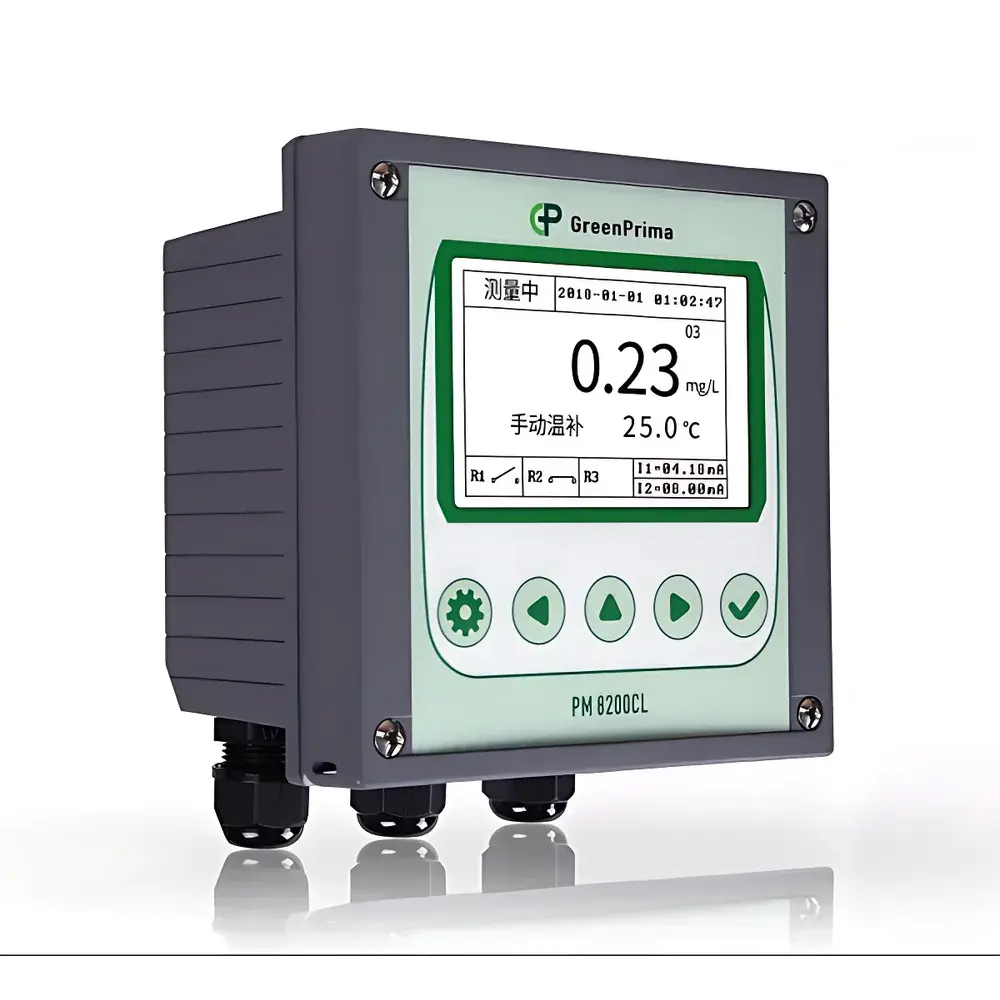
GreenPrima OM8200CL Online Electrochemical Residual Chlorine, Chlorine Dioxide & Ozone Analyzer
| Brand | GreenPrima |
|---|---|
| Origin | United Kingdom |
| Manufacturer | GreenPrima Ltd. |
| Type | Online Analyzer |
| Measurement Principle | Amperometric Electrochemical Sensor (Constant Potential Method) |
| Measured Parameters | Free Chlorine, Chlorine Dioxide, Ozone |
| Range | 0–2.000 ppm / 0–20.00 ppm |
| Accuracy | ±0.001 ppm / ±0.01 ppm |
| Repeatability | ±0.001 ppm / ±0.01 ppm |
| Resolution | 0.001 ppm / 0.01 ppm |
| LOD | 0.001 ppm / 0.01 ppm |
| Temperature Compensation | -10 to 130 °C (NTC10K or PT1000, manual/auto) |
| Operating Temp. | 0–70 °C |
| Storage Temp. | -20 to 70 °C |
| Display | Backlit dot-matrix LCD |
| Language | English / Chinese menu |
| Data Storage | 600,000 records |
| Power Supply | 90–260 VAC, 50/60 Hz or 24 VDC optional |
| Enclosure Rating | IP65 |
| Communications | RS485, MODBUS-RTU compliant |
| Analog Outputs | Dual isolated 4–20 mA (max. 500 Ω, 0.1% FS) |
| Cleaning Output | Adjustable interval (0.1–1000 h) and duration (1–1000 s) |
| Mounting Options | Wall-mount, pipe-mount, panel-mount |
| Dimensions | 144 × 144 × 106 mm |
| Panel Cutout | 138 × 138 mm |
| Weight | 0.86 kg |
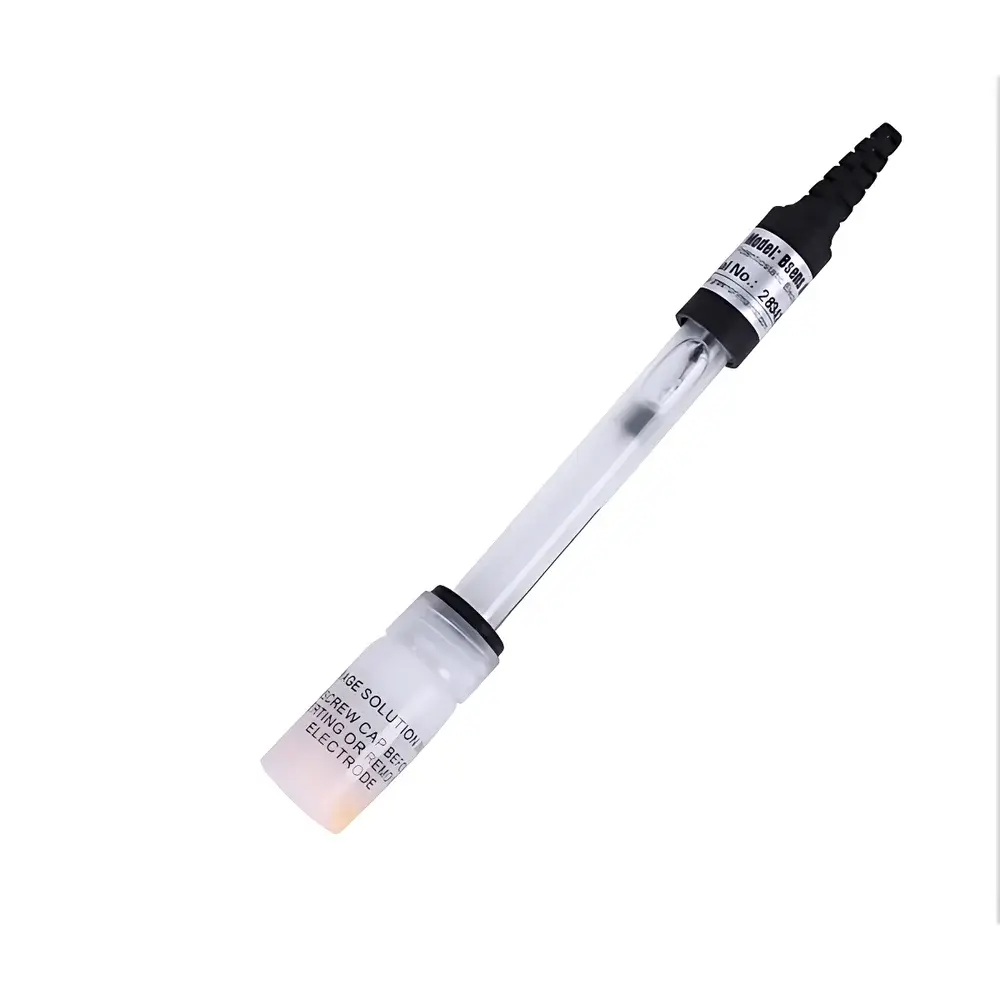
| Sensor Model | Bsens650 |
| Sensor Range | 0–2.000 / 0–20.00 ppm |
| Sensor Accuracy | ±2% FS |
| Electrode Material | Glass body with dual platinum ring working electrode |
| Max. Pressure Rating | 5 bar |
| Cable Length | 3 m |
| Connection | PG13.5 threaded fitting |
Overview
The GreenPrima OM8200CL is a high-precision, online electrochemical analyzer engineered for continuous monitoring of free chlorine, chlorine dioxide, and ozone in aqueous systems. It operates on the amperometric constant-potential (galvanic) principle: a stable polarization voltage is applied between a working electrode (dual platinum ring) and a reference electrode; target oxidants—Cl₂, ClO₂, and O₃—undergo selective reduction at this fixed potential, generating a current proportional to their concentration. This method eliminates reliance on colorimetric reagents, membrane replacement, or electrolyte refilling—reducing operational overhead while maintaining long-term baseline stability and low drift. Designed for integration into municipal water distribution networks, pharmaceutical water loops, swimming pool disinfection systems, and wastewater ozonation processes, the OM8200CL delivers real-time, maintenance-light measurement traceable to fundamental electrochemical response characteristics.
Key Features
- True amperometric sensing with constant-potential control ensures selectivity across Cl₂, ClO₂, and O₃ without cross-interference from common anions (e.g., NO₂⁻, Br⁻) under controlled pH and flow conditions.
- Dual isolated 4–20 mA analog outputs support redundant process control integration, each calibrated independently per parameter and range.
- RS485 interface compliant with MODBUS-RTU protocol enables seamless integration into SCADA, DCS, or PLC-based supervisory systems for centralized data acquisition and alarm management.
- Self-contained cleaning output allows programmable actuation of external solenoid valves or air-scour systems—critical for fouling-prone applications such as cooling tower make-up or secondary wastewater effluent.
- IP65-rated NEMA 4X enclosure permits direct installation in humid, non-hazardous industrial environments without additional weatherproof housing.
- Configurable temperature compensation using either NTC10K or PT1000 sensors supports accurate correction across wide thermal gradients—from chilled purified water (2–10 °C) to hot process return streams (up to 70 °C).
- No consumables required: sensor does not utilize gas-permeable membranes, liquid-filled reference chambers, or chemical reagents—minimizing total cost of ownership and calibration frequency.
Sample Compatibility & Compliance
The OM8200CL is validated for use in potable water, ultrapure water (UPW), pharmaceutical-grade purified water (PW/WFI), and tertiary-treated wastewater. Its Bsens650 sensor exhibits robust performance in turbidities up to 100 NTU and suspended solids concentrations ≤50 mg/L when installed with the BAF615 flow cell, which maintains laminar, bubble-free sample delivery at 150–300 mL/min. The analyzer complies with key regulatory frameworks governing water quality instrumentation: it supports audit-trail-enabled data logging aligned with FDA 21 CFR Part 11 requirements when paired with compliant software platforms; its measurement methodology conforms to ASTM D1253 (residual chlorine) and ISO 7393-2 (electrochemical determination of oxidants); and its construction adheres to IEC 61000-6-2 (immunity) and IEC 61000-6-4 (emissions) for industrial electromagnetic compatibility.
Software & Data Management
The OM8200CL embeds non-volatile flash memory capable of storing 600,000 timestamped measurement records—including raw current signals, compensated concentration values, temperature readings, and system diagnostics. Data export is supported via serial dump or MODBUS register polling, enabling ingestion into LIMS, MES, or cloud-based analytics platforms. Configuration is performed locally via intuitive English/Chinese bilingual menu navigation on the backlit LCD; no PC software is required for routine operation. For enterprise deployment, optional firmware upgrades introduce configurable alarm thresholds (high/low, rate-of-change), event-triggered data snapshots, and password-protected parameter lockdown—facilitating GLP/GMP-aligned operational discipline.
Applications
- Municipal drinking water treatment: real-time monitoring at chlorination contact tanks, clearwells, and distribution system endpoints per US EPA Guidance Manual for Disinfectants.
- Pharmaceutical water systems: continuous verification of residual oxidant levels in PW and WFI loops to meet USP , EP 2.2.43, and JP 17 requirements for microbial control.
- Recreational water facilities: closed-loop control of ClO₂ dosing in swimming pools and spas to maintain WHO-recommended disinfectant residuals while minimizing DBP formation.
- Ozonation process control: inline verification of dissolved ozone post-contact chamber in advanced oxidation processes (AOPs), supporting optimization of ozone mass transfer efficiency.
- Industrial cooling water: detection of carryover oxidants from upstream treatment stages to prevent corrosion acceleration in heat exchangers and condenser tubes.
- Wastewater reuse: compliance monitoring for indirect potable reuse (IPR) schemes where residual disinfectant must be verified prior to aquifer recharge or surface discharge.
FAQ
Does the OM8200CL require daily calibration?
No. The Bsens650 sensor demonstrates <1% drift over 30 days under stable operating conditions. A single two-point calibration (zero and span) is recommended every 7–14 days depending on matrix fouling risk and regulatory requirements.
Can the same sensor measure Cl₂, ClO₂, and O₃ simultaneously?
No. While the hardware platform supports all three analytes, measurement is sequential and parameter-specific. Users must configure the instrument for one target species per operational mode; switching requires recalibration and validation per ISO/IEC 17025 procedures.
Is the BAF615 flow cell compatible with high-pressure distribution mains?
Yes. Rated to 5 bar static pressure, the BAF615 permits direct T-piece sampling from pressurized pipelines without pressure-reduction stations—provided inlet flow is regulated to 150–300 mL/min via integrated needle valve.
How is temperature compensation implemented?
The system accepts input from either NTC10K or PT1000 probes mounted in the flow cell. Compensation algorithms apply polynomial correction per ASTM D1253 Annex A, ensuring accuracy across the full -10 °C to 130 °C range.
What maintenance intervals are recommended for unattended operation?
Sensor cleaning: every 24–72 hours in high-fouling applications; every 7 days in clean PW or drinking water. Flow cell inspection: quarterly. Electrical connections and sealing integrity: semi-annually per ISO 55001 asset management guidelines.
Related Products







