
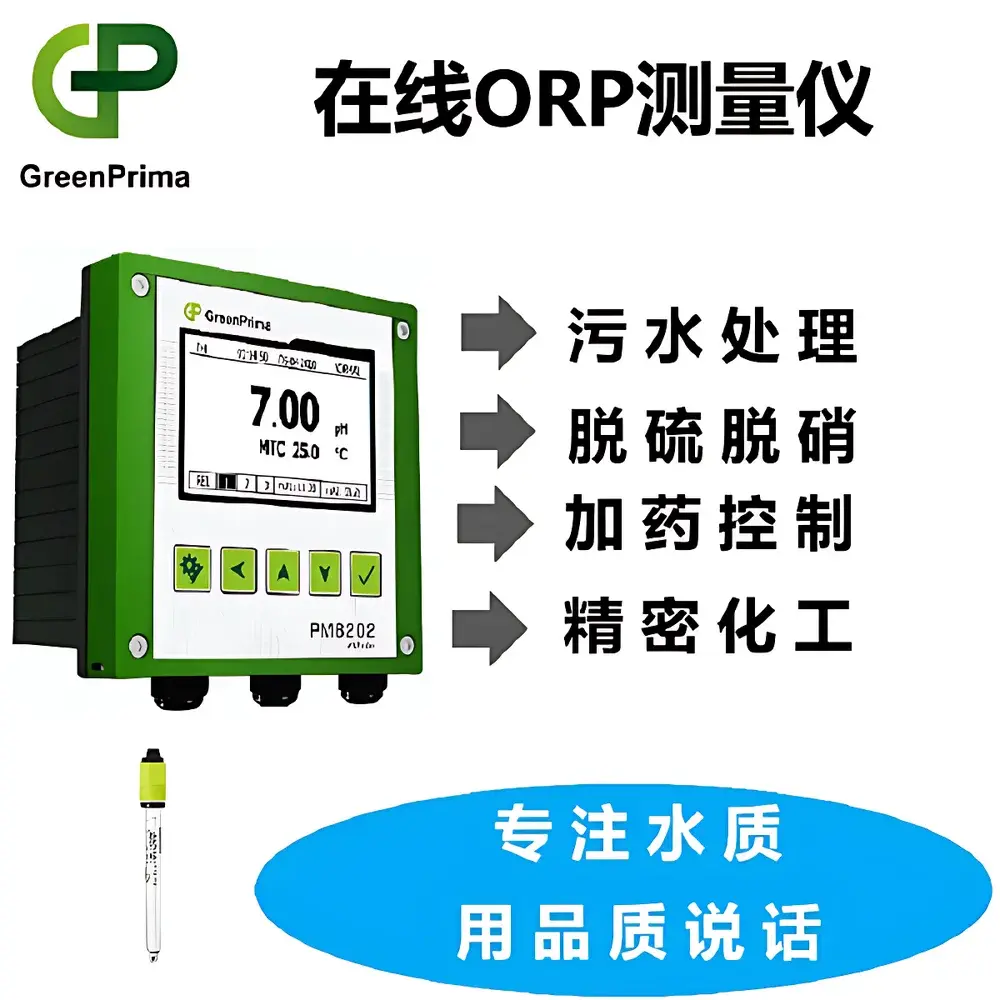
GreenPrima PM 820 2P Industrial Online ORP Analyzer
| Brand | GreenPrima |
|---|---|
| Origin | United Kingdom |
| Manufacturer Type | Original Equipment Manufacturer (OEM) |
| Product Category | Imported Industrial Online ORP Meter |
| Model | PM 820 2P |
| Instrument Type | Industrial Online ORP Analyzer |
| pH Range | -2.00 to 16.00 pH |
| ORP Range | -2000 to +2000 mV |
| Temperature Range | 0 to 130 °C |
| pH Resolution | 0.01 pH |
| ORP Resolution | 1 mV |
| Temperature Resolution | 0.1 °C |
| pH Accuracy | ±0.01 pH |
| ORP Accuracy | ±1 mV |
| Temp. Accuracy | ±0.1 °C |
| Temperature Compensation | -10 to 130 °C (NTC10K / PT1000, manual or auto) |
| Operating Temp. | -10 to 70.0 °C |
| Storage Temp. | -20 to 70.0 °C |
| Display | Backlit graphic LCD |
| Data Storage | 600,000 records |
| Power Supply | 90–260 VAC, 50/60 Hz or 24 VDC (optional) |
| Analog Outputs | 2 isolated 4–20 mA outputs (max. loop resistance 500 Ω, accuracy 0.1% FS) |
| Communication | RS485 Modbus RTU |
| Cleaning Output | Adjustable interval (0.1–1000 h), duration (1–1000 s) |
| Alarm Outputs | 2 independent Hi/Lo relays (5 A / 250 VAC / 30 VDC) |
| Enclosure Rating | IP65 |
| Mounting Options | Wall-mounted, pipe-mounted, panel-mounted |
| Dimensions (H×W×D) | 144 × 144 × 108 mm |
| Panel Cutout | 138 × 138 mm |
| Weight | 0.87 kg |
Overview
The GreenPrima PM 820 2P Industrial Online ORP Analyzer is an engineered solution for continuous, high-stability redox potential monitoring in demanding water and wastewater process environments. Based on potentiometric electrochemical measurement principles, the analyzer measures the open-circuit voltage difference between a noble-metal sensing electrode (typically platinum or gold) and a stable reference electrode (Ag/AgCl or calomel), expressed in millivolts (mV) relative to the Standard Hydrogen Electrode (SHE). This ORP value reflects the net oxidizing or reducing capacity of the aqueous matrix—critical for evaluating disinfection efficacy (e.g., chlorine, ozone, or peracetic acid residuals), redox-driven coagulation/flocculation control, biological treatment stability, and corrosion risk assessment. Designed for 24/7 operation in industrial utilities, municipal drinking water plants, effluent streams, and process cooling circuits, the PM 820 2P integrates seamlessly with GreenPrima’s Bsens series of rugged, field-replaceable pH/ORP sensors—including models optimized for fouling-prone, high-suspended-solid, or chemically aggressive media (e.g., Bsens120T, Bsens140T, Bsens180T).
Key Features
- True dual-channel capability: Simultaneous, independent measurement and output of pH and ORP—enabling correlated redox-pH process insight without external signal merging.
- High-precision analog architecture: 0.01 pH resolution and ±1 mV ORP accuracy supported by low-drift amplifier design and temperature-compensated signal conditioning.
- Intelligent sensor interface: Auto-detection and configuration of Bsens-series sensors via embedded ID chip; supports NTC10K and PT1000 temperature elements for accurate thermal compensation across -10 to 130 °C.
- Configurable cleaning logic: Programmable relay-driven cleaning cycles with independently adjustable interval (0.1–1000 hours) and duration (1–1000 seconds)—essential for maintaining electrode integrity in sludge-laden or scaling-prone applications.
- Dual isolated 4–20 mA outputs: Fully assignable to pH, ORP, temperature, or derived parameters (e.g., deviation from setpoint); each calibrated to 0.1% full-scale accuracy with 500 Ω max loop load.
- Robust industrial enclosure: IP65-rated polycarbonate housing rated for wall, pipe, or panel mounting; operating ambient range of -10 to +70 °C ensures reliability in unconditioned equipment rooms and outdoor kiosks.
Sample Compatibility & Compliance
The PM 820 2P is validated for use with aqueous matrices ranging from potable water (pH 6.5–8.5, ORP > +650 mV post-chlorination) to highly variable industrial effluents (pH -2 to 16, ORP -2000 to +2000 mV). Its compatibility extends to chlorinated, ozonated, UV-treated, and membrane-filtered streams. Sensor selection (e.g., Bsens130 for high-temperature boiler feedwater, Bsens150T for abrasive slurry applications) directly governs chemical resistance, response time, and long-term drift performance. The analyzer complies with electromagnetic compatibility standards IEC 61326-1 (industrial environment) and meets functional safety requirements aligned with IEC 61508 SIL 2 for basic process control tasks. While not certified for intrinsic safety, it is routinely deployed in Zone 2 classified areas when installed with appropriate barrier systems. Data logging and alarm event records support adherence to ISO 9001, ISO 14001, and regulatory frameworks requiring demonstrable process consistency—such as EPA Clean Water Act reporting or EU Drinking Water Directive (2020/2184) operational monitoring.
Software & Data Management
Data acquisition and configuration are managed via the front-panel graphical LCD interface with multilingual (English/Chinese) support and intuitive menu navigation. All critical parameters—including calibration history, sensor diagnostics (impedance, asymmetry potential), alarm timestamps, and cleaning logs—are stored locally in non-volatile memory (600,000 entries, timestamped to the second). Historical data export is enabled via Modbus RTU over RS485, allowing integration into SCADA, DCS, or cloud-based IIoT platforms (e.g., Siemens Desigo, Honeywell Experion, or Azure IoT Edge). The system supports audit-trail-ready operations: all configuration changes and manual calibrations are automatically logged with user ID (if configured via external authentication), timestamp, and pre-/post-value deltas—meeting foundational expectations of FDA 21 CFR Part 11 for electronic records in regulated utilities and pharmaceutical water systems.
Applications
- Drinking water disinfection control: Real-time ORP feedback for dynamic chlorine dosing, ensuring residual compliance while minimizing DBP formation.
- Wastewater tertiary treatment: Monitoring ORP during denitrification (target: -50 to -150 mV) and sulfur removal processes.
- Industrial cooling tower management: Tracking biocide efficacy and early-stage microbiologically influenced corrosion (MIC) onset.
- Food & beverage process water: Verifying sanitization cycle endpoints (e.g., ≥ +750 mV for peracetic acid) prior to equipment rinse.
- Pharmaceutical purified water (PW) and water-for-injection (WFI) loops: Supporting redox-based validation of sanitization and routine monitoring per USP and Annex 1 guidelines.
- Chemical dosing optimization: Closed-loop control of coagulant (e.g., FeCl₃) addition based on ORP inflection points observed during jar testing correlation.
FAQ
What reference electrode types are compatible with the PM 820 2P?
The analyzer supports Ag/AgCl (3 M KCl gel-filled) and double-junction reference electrodes with integrated temperature sensing. It does not support traditional calomel electrodes due to mercury content restrictions.
Can the PM 820 2P perform automatic pH and ORP calibration?
No—it requires manual two-point pH calibration (using NIST-traceable buffers) and single-point ORP verification (e.g., with Zobell’s or Light’s solution). Auto-calibration is not implemented to preserve metrological traceability in regulated environments.
Is the 4–20 mA output intrinsically safe?
No—the outputs are non-IS but can be connected to IS barriers (e.g., Pepperl+Fuchs KFD2-ST2-Ex2) for hazardous area deployment. Consult local ATEX/IECEx certification documentation for approved barrier pairings.
How frequently should the Bsens sensor be cleaned or recalibrated?
Cleaning frequency depends on fouling rate; typical intervals range from 24 h (activated sludge) to 168 h (clarified surface water). Calibration is recommended before each critical batch or at least weekly in continuous operation—per ASTM D1293 and ISO 7888 protocols.
Does the PM 820 2P support HART communication?
No—only RS485 Modbus RTU is supported. HART-capable variants (e.g., PM 820 HART) are available upon request but require separate ordering and configuration.





