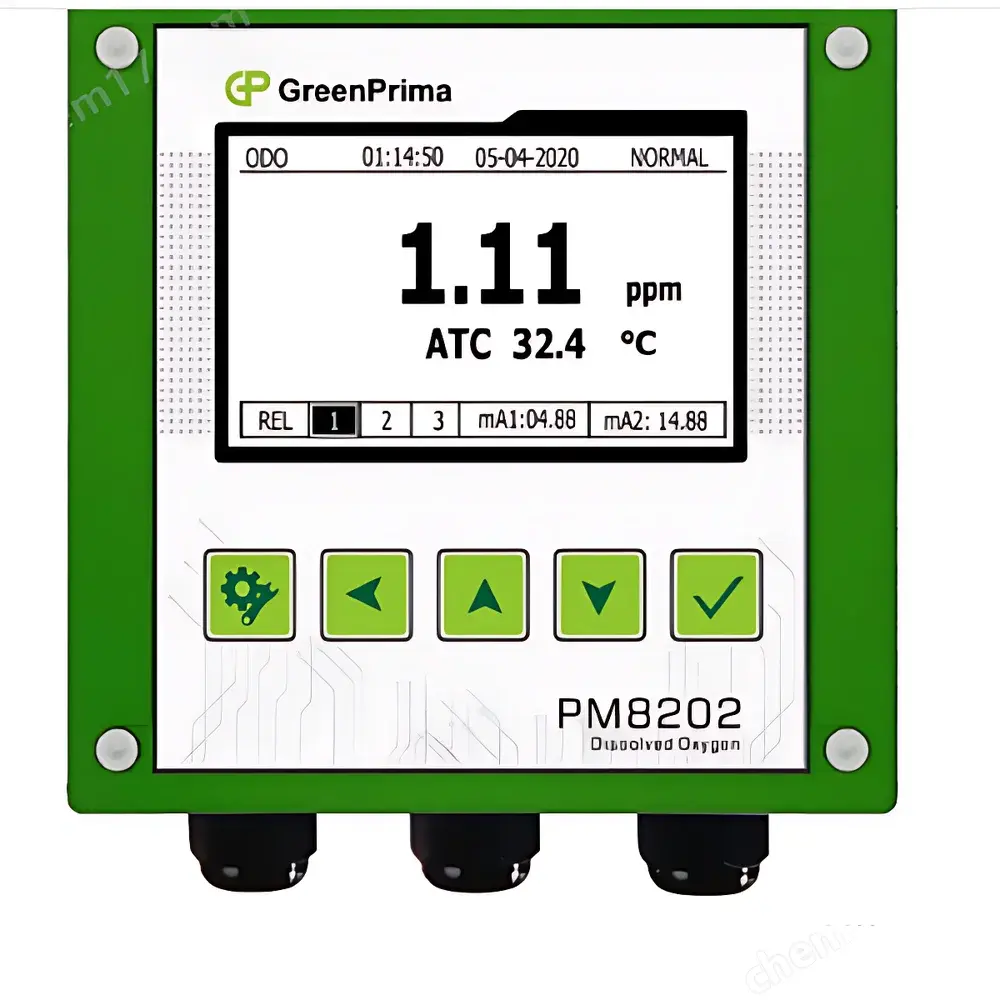
GreenPrima PM 8202O Online Dissolved Oxygen Analyzer
| Brand | GreenPrima |
|---|---|
| Origin | United Kingdom |
| Manufacturer Type | Original Equipment Manufacturer (OEM) |
| Product Category | Imported Industrial Process Instrument |
| Model | PM 8202O |
| Measurement Range | 0.00–20.00 ppm |
| Resolution | 0.01 ppm |
| Dimensions | 144 × 144 × 108 mm |
| Temperature Compensation Range | −10 to +130 °C (NTC30K or PT1000 selectable) |
| Operating Temperature | −10 to +70.0 °C |
| Storage Temperature | −20 to +70.0 °C |
| Display | Backlit Graphic LCD |
| Data Storage Capacity | 600,000 records |
| Power Supply | 90–260 VAC, 50/60 Hz or optional 24 VDC |
| Output | Dual isolated 4–20 mA (max. 500 Ω, accuracy ±0.1 % FS) |
| Cleaning Output | Adjustable interval (0.1–1000 h) and duration (1–1000 s) |
| Alarm Outputs | Two independent Hi/Lo relay outputs (5 A / 250 VAC / 30 VDC) |
| Enclosure Rating | IP65 |
| Mounting Options | Wall-mounted, pipe-mounted, panel-mounted |
| Electrode Material | 316L stainless steel |
| Optional Feature | Air-driven self-cleaning system |
| Password Protection | Yes |
Overview
The GreenPrima PM 8202O Online Dissolved Oxygen Analyzer is an industrial-grade, fluorescence-based dissolved oxygen (DO) measurement system engineered for continuous, high-reliability monitoring in demanding aqueous process environments. Unlike traditional electrochemical Clark-type sensors, the PM 8202O employs optical luminescence quenching technology—where molecular oxygen modulates the lifetime and intensity of fluorescent emission from a proprietary ruthenium-based sensing layer. This principle eliminates oxygen consumption during measurement, removes dependence on sample flow velocity or diffusion kinetics, and ensures stable baseline performance across low-circulation or stagnant conditions. The analyzer integrates a dedicated controller with the Bsens410 optical DO sensor, delivering true real-time concentration data without drift-induced calibration drift. Its design conforms to fundamental requirements of continuous process validation under ISO 9001 and IEC 61511 frameworks, supporting long-term unattended operation in wastewater treatment plants, aquaculture recirculation systems, surface water quality networks, and pharmaceutical water-for-injection (WFI) distribution loops.
Key Features
- Fluorescence-based sensing principle—zero oxygen consumption, no membrane replacement, no electrolyte refills
- Stable signal output with negligible long-term drift; factory-calibrated for extended operational intervals between verification checks
- Dual isolated 4–20 mA analog outputs configurable for DO concentration and temperature, each with full-scale accuracy of ±0.1 % FS
- RS485 interface compliant with Modbus RTU protocol for seamless integration into SCADA, DCS, or PLC-based control architectures
- Backlit high-contrast graphic LCD with intuitive bilingual (English/Chinese) menu navigation and real-time trend visualization
- Robust 316L stainless steel sensor housing rated for prolonged exposure to aggressive municipal and industrial effluents
- Configurable air-pulse self-cleaning option to mitigate biofouling in high-solids or algal-rich applications
- Comprehensive local data logging—600,000 timestamped records with automatic rollover and non-volatile memory retention
- IP65-rated enclosure suitable for indoor panel mounting or outdoor wall installation in non-hazardous zones
- User-accessible password protection to prevent unauthorized configuration changes or alarm reset actions
Sample Compatibility & Compliance
The PM 8202O is validated for use in liquid-phase applications where dissolved oxygen concentration is a critical process parameter—including activated sludge basins, anaerobic digesters, fish hatchery circulation tanks, drinking water reservoirs, and cooling tower make-up streams. It meets material compatibility standards per ASTM F2129 for metallic sensor components in contact with potable water and complies with EN 50178 (Equipment for power electronic converters) for electrical safety in industrial settings. While not intrinsically safe, its 24 VDC auxiliary power option supports integration into hazardous area barrier systems when deployed alongside certified isolators. The instrument’s firmware architecture supports audit-trail-ready operation when configured per FDA 21 CFR Part 11 guidelines via external supervisory software.
Software & Data Management
Data acquisition and system diagnostics are managed through embedded firmware with dual-layer configuration access—standard user mode and engineer-level mode secured by multi-digit password authentication. All configuration changes, calibration events (if performed), alarm triggers, and cleaning cycles are time-stamped and stored locally. Export of logged data is supported via USB mass storage emulation (when equipped with optional USB module) or periodic polling over Modbus. No proprietary software is required for basic commissioning; however, GreenPrima provides a free Windows-based configuration utility (PM ConfigTool v3.x) enabling advanced setup of alarm hysteresis, temperature compensation curves, and output scaling parameters. Firmware updates are delivered as signed binary packages to ensure integrity and traceability.
Applications
- Municipal and industrial wastewater treatment—real-time DO optimization in aerobic zones to reduce energy consumption of blowers
- Recirculating aquaculture systems (RAS)—continuous monitoring to maintain species-specific oxygen thresholds and prevent hypoxia stress
- Surface water quality surveillance networks—deployment in rivers, lakes, and estuaries for environmental compliance reporting
- Pharmaceutical purified water (PW) and water-for-injection (WFI) distribution—verification of low-oxygen conditions per USP and EP 2.2.48
- Food and beverage process water lines—monitoring for microbial growth risk mitigation in sugar syrup or CIP rinse loops
- Power plant condensate polishing—detection of air ingress or deaerator inefficiency via sub-ppb level trending (with appropriate sensor variant)
FAQ
Does the PM 8202O require routine calibration?
While factory-calibrated for immediate deployment, periodic verification against a certified Winkler titration standard or saturated air/water reference is recommended every 3–6 months depending on application severity. Zero-point checks using nitrogen-sparged water may be performed onsite.
Can the sensor operate in low-flow or static water conditions?
Yes. The optical fluorescence method is inherently independent of convective mass transfer, making it suitable for immersion in low-circulation tanks, sedimentation basins, or buried monitoring wells.
Is temperature compensation automatic?
Yes. The integrated NTC30K or PT1000 temperature sensor enables real-time compensation across −10 to +130 °C. Both manual offset adjustment and auto-compensation modes are configurable.
What maintenance is required beyond cleaning?
No consumables—no membranes, no electrolytes, no cathode polishing. Routine inspection of the optical window for fouling and scheduled air-pulse cleaning (if enabled) constitute the full preventive maintenance scope.
How is sensor health monitored?
The controller continuously evaluates signal-to-noise ratio, photodiode response stability, and LED drive current consistency. Diagnostic flags appear on-screen and are reportable via Modbus register mapping.
Related Products