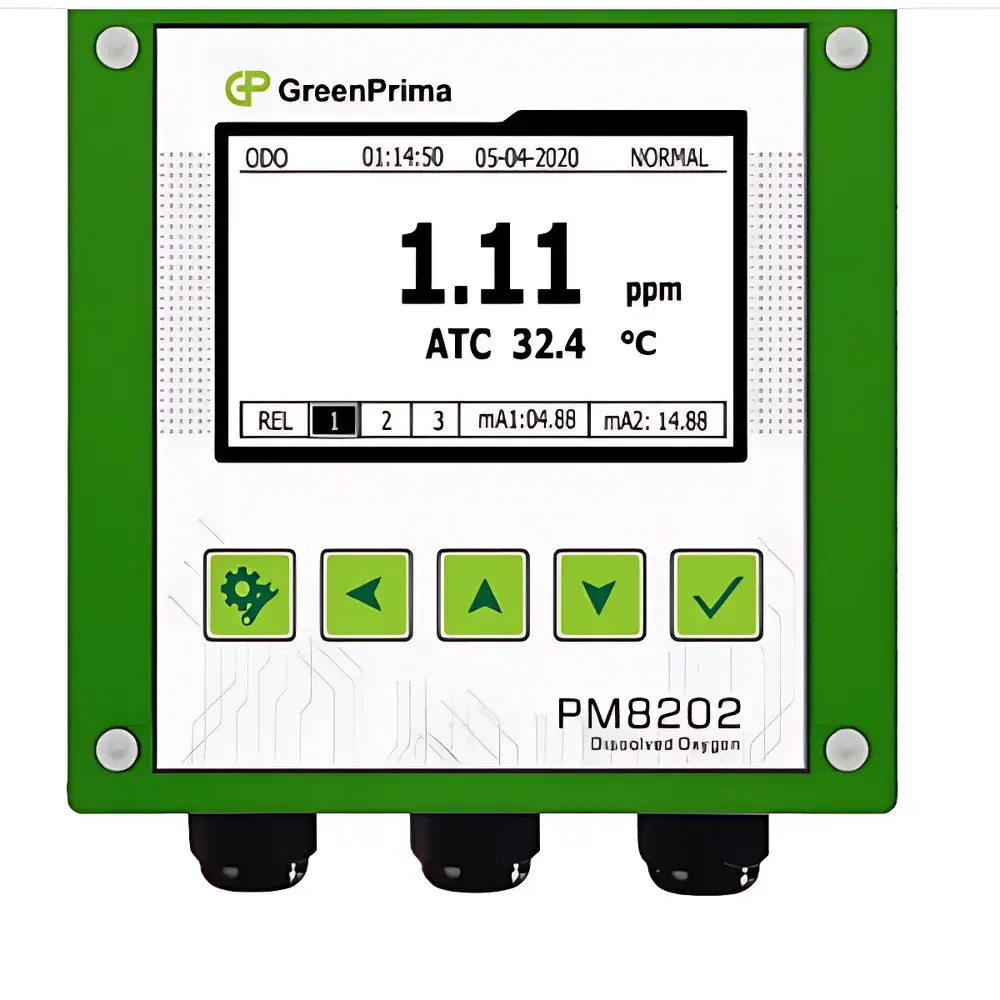
GreenPrima PM8202D Polarographic Dissolved Oxygen Analyzer
| Brand | GreenPrima |
|---|---|
| Origin | United Kingdom |
| Manufacturer Type | Original Equipment Manufacturer (OEM) |
| Product Category | Imported Industrial Online DO Analyzer |
| Model | PM8202D |
| Measurement Range | 0.00–20.00 ppm / 0.00–200.00 ppb |
| Resolution | 0.001 ppm / 0.01 ppb |
| Accuracy | ±0.02 ppm / ±0.02 ppb |
| Temperature Compensation | –10 to +130 °C (manual or automatic, NTC10K or PT1000 sensor support) |
| Operating Temperature | –10 to +70.0 °C |
| Storage Temperature | –20 to +70.0 °C |
| Display | Backlit dot-matrix LCD with DO, temperature, time, and relay status |
| Data Storage | 600,000 records |
| Power Supply | 90–260 VAC, 50/60 Hz or optional 24 VDC |
| Output | Two isolated 4–20 mA outputs (max. loop resistance 500 Ω, accuracy 0.1% FS, configurable for DO or temperature) |
| Communication | RS485 Modbus RTU |
| Cleaning Cycle Control | Interval 0.1–1000 h, duration 1–1000 s |
| Alarm Outputs | Two independent Hi/Lo relays (5 A / 250 VAC / 30 VDC, programmable hysteresis) |
| Enclosure Rating | IP65 |
| Dimensions | 144 × 144 × 108 mm |
| Panel Cutout | 138 × 138 mm |
| Weight | 0.87 kg |
| Mounting Options | Wall-mount, pipe-mount, panel-mount |
| Electrode Compatibility | Bsens420, Bsens430, Bsens440 polarographic sensors |
| Membrane Type | Clark-type oxygen-permeable membrane |
| Maintenance Requirement | Periodic electrolyte replenishment |
Overview
The GreenPrima PM8202D Polarographic Dissolved Oxygen Analyzer is an industrial-grade online measurement system engineered for continuous, high-stability monitoring of dissolved oxygen (DO) concentration in aqueous process streams. It operates on the classical Clark polarographic principle: molecular oxygen diffuses through a gas-permeable membrane into an electrolyte-filled electrochemical cell, where it undergoes reduction at a cathode (typically gold or platinum) under a fixed polarizing voltage (–0.6 to –0.8 V vs. Ag/AgCl). The resulting diffusion-limited current is linearly proportional to the partial pressure of dissolved O₂, enabling precise quantification in ppm or ppb units. Designed for integration into demanding water and wastewater treatment plants, pharmaceutical bioreactors, fermentation vessels, power plant condensate systems, and aquaculture facilities, the PM8202D delivers trace-level sensitivity (down to 0.01 ppb), long-term baseline stability, and robust performance across wide temperature gradients (–10 to +130 °C with integrated NTC10K or PT1000 compensation).
Key Features
- True polarographic architecture with replaceable Clark-type electrodes (compatible with Bsens420, Bsens430, and Bsens440 sensor variants for optimized response in low-conductivity, high-fouling, or high-temperature applications)
- IP65-rated sealed enclosure with corrosion-resistant housing—certified for deployment in humid, dusty, or splash-prone industrial environments
- High-resolution backlit dot-matrix LCD displaying real-time DO value (ppm/ppb), compensated temperature (°C), system time, and dual relay operational status
- Dual isolated 4–20 mA analog outputs—configurable independently for DO concentration and/or temperature signal transmission to DCS, PLC, or SCADA systems
- RS485 Modbus RTU interface for bidirectional communication, enabling remote configuration, calibration logging, and diagnostic interrogation per industry-standard protocol
- Programmable cleaning control logic—user-defined cleaning intervals (0.1–1000 hours) and durations (1–1000 seconds) to mitigate biofilm or particulate fouling on the sensing membrane
- Two fully configurable Hi/Lo alarm relays with adjustable hysteresis—rated for 5 A at 250 VAC or 30 VDC, supporting fail-safe interlock integration
- Password-protected parameter access—prevents unauthorized calibration or configuration changes in shared or unattended installations
- Flexible mounting options: front-panel insertion (138 × 138 mm cutout), wall bracket, or direct pipe-mount adapter kits—facilitating retrofit into existing infrastructure
Sample Compatibility & Compliance
The PM8202D is validated for use in conductive aqueous media ranging from deionized water (≥5 µS/cm) to saline or wastewater matrices. Its polarographic design inherently tolerates moderate levels of suspended solids, organic films, and redox-active interferents—especially when paired with the Bsens440 high-fouling electrode variant. Temperature compensation employs either factory-calibrated NTC10K thermistors or user-supplied PT1000 sensors, ensuring compliance with ISO 5814:2012 (water quality — determination of dissolved oxygen — electrochemical probe method) and ASTM D888-22 (standard test methods for dissolved oxygen in water). While not intrinsically safe, the analyzer meets CE, RoHS, and EMC Directive 2014/30/EU requirements. For regulated GMP or GLP environments, audit-trail-capable data export (via Modbus register polling) supports alignment with FDA 21 CFR Part 11 principles when implemented with validated data acquisition software.
Software & Data Management
The PM8202D embeds non-volatile memory capable of storing up to 600,000 timestamped measurement records—including DO, temperature, relay states, and calibration events—without external logging hardware. Data retrieval occurs via Modbus function codes (e.g., Read Holding Registers 40001–40100), enabling seamless ingestion into third-party historian platforms (e.g., Ignition, Siemens Desigo, or custom Python-based dashboards). No proprietary PC software is required; configuration is performed locally via intuitive menu navigation or remotely using standard Modbus master tools. All critical parameters—including zero/span calibration coefficients, alarm thresholds, and cleaning schedules—are stored with write-protection logic and change timestamps. Firmware updates are supported via serial bootloader mode using standard UART-to-USB adapters.
Applications
- Wastewater treatment: Aeration basin optimization, effluent DO compliance monitoring per EPA 40 CFR Part 136
- Drinking water distribution: Residual oxygen verification post-chlorination/dechlorination, corrosion control in cast iron mains
- Pharmaceutical manufacturing: Sterile bioreactor DO control during mammalian cell culture (USP water quality guidance)
- Fermentation processes: Real-time O₂ feedback for aerobic yeast or bacterial cultivations (e.g., ethanol, antibiotics, enzymes)
- Power generation: Condensate and feedwater deaerator performance validation (ASME PTC 19.11)
- Aquaculture and recirculating aquaculture systems (RAS): Hypoxia prevention in high-density fish tanks and hatcheries
- Chemical process cooling water: Corrosion inhibitor efficacy assessment via dissolved oxygen profiling
FAQ
What electrode types are compatible with the PM8202D controller?
The PM8202D supports GreenPrima’s Bsens420 (general-purpose), Bsens430 (low-temperature/high-sensitivity), and Bsens440 (fouling-resistant) polarographic DO sensors—all featuring replaceable Teflon membranes and standardized BNC or DIN connectors.
Does the analyzer require daily maintenance?
No daily intervention is needed. Electrolyte replenishment is typically required every 3–6 months depending on operating temperature and sample matrix; membrane replacement is recommended annually or after mechanical damage.
Can the PM8202D operate in high-purity water (e.g., UPW) below 1 µS/cm conductivity?
Yes—when used with the Bsens430 sensor and enabled low-conductivity compensation algorithm, the system maintains metrological integrity down to 0.1 µS/cm, meeting semiconductor-grade UPW monitoring requirements per SEMI F63.
Is automatic temperature compensation mandatory?
No—both manual and automatic modes are supported. Automatic mode requires connection of an NTC10K or PT1000 sensor; manual entry is permitted for fixed-temperature applications or legacy sensor integration.
How is calibration performed?
Zero calibration uses nitrogen-purged water or sodium sulfite solution; span calibration uses air-saturated water at known barometric pressure and temperature. Both procedures are guided by on-screen prompts and store calibration metadata (date, operator ID, reference values) in internal memory.
Related Products