
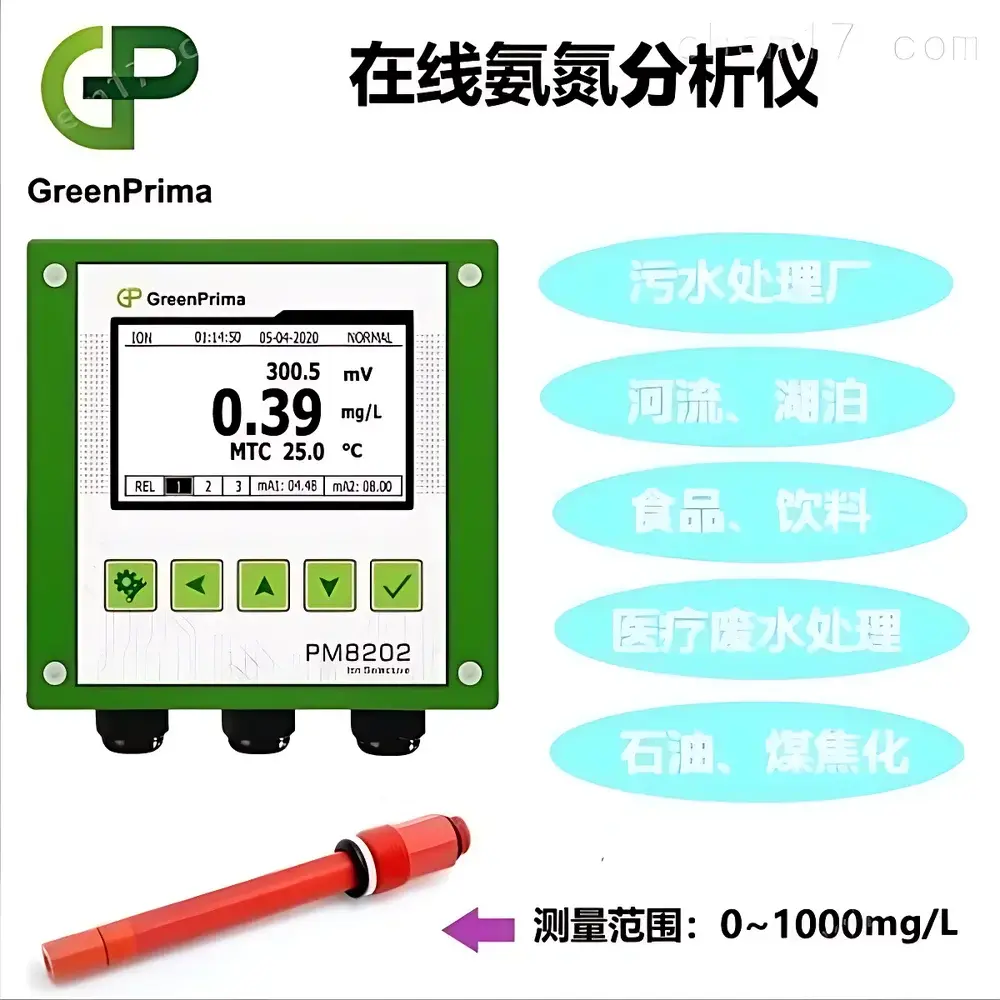
GreenPrima PM8202I Online Ammonia Nitrogen Analyzer (ISE-Based)
| Brand | GreenPrima |
|---|---|
| Origin | United Kingdom |
| Manufacturer Type | Manufacturer |
| Origin Category | Imported |
| Model | PM8202I |
| Instrument Type | Online |
| Measurement Principle | Ion-Selective Electrode (ISE) Method |
| Measurement Range | 0.00–20,000 ppm NH₃-N |
| Accuracy | ±0.01 ppm, ±0.1 ppm, or ±1 ppm (depending on range selection) |
| Resolution | 0.01 / 0.1 / 1 ppm |
| Temperature Compensation | -10 to 130 °C (manual/automatic |
| Operating Temperature | -10 to 70.0 °C |
| Storage Temperature | -20 to 70.0 °C |
| Display | Backlit large-dot-matrix LCD |
| Language Support | English & Chinese |
| Data Storage Capacity | 600,000 records |
| Power Supply | 90–260 VAC, 50/60 Hz or optional 24 VDC |
| Analog Outputs | Two isolated 4–20 mA outputs (max. loop resistance 500 Ω, accuracy ±0.1 % FS) |
| Communication | RS485 Modbus RTU |
| Cleaning Control Output | Adjustable interval (0.1–1000 h) and duration (1–1000 s) |
| Alarm Outputs | Two independent Hi/Lo relay outputs (5 A / 250 VAC / 30 VDC) |
| Enclosure Rating | IP65 |
| Mounting Options | Wall-mounted, pipe-mounted, panel-mounted |
| Dimensions (H×W×D) | 144 × 144 × 108 mm |
| Cutout Size | 138 × 138 mm |
| Weight | 0.87 kg |
Overview
The GreenPrima PM8202I Online Ammonia Nitrogen Analyzer is an industrial-grade, continuous-monitoring instrument engineered for reliable quantification of total ammonia nitrogen (NH₃-N) in aqueous matrices using the ion-selective electrode (ISE) principle. Unlike optical or colorimetric methods, this analyzer employs a potentiometric measurement technique based on the Nernst equation, where the Bsens730 ammonia-selective electrode generates a millivolt signal proportional to the logarithmic activity of ammonium ions (NH₄⁺) in solution—adjusted for pH and temperature to reflect total NH₃-N concentration. The system integrates seamlessly into water treatment process control loops, enabling real-time feedback for dosing optimization, regulatory compliance verification, and early detection of nitrification failure or influent upsets.
Key Features
- Robust IP65-rated enclosure with full waterproof and gas-tight sealing, suitable for harsh indoor and outdoor installation environments including pump stations, clarifiers, and chemical feed rooms.
- Intuitive dual-language (English/Chinese) interface with backlit dot-matrix LCD display showing real-time NH₃-N concentration, measured temperature, system timestamp, relay status, and diagnostic indicators.
- Configurable resolution and accuracy modes (0.01 ppm, 0.1 ppm, or 1 ppm), supporting both low-level monitoring (e.g., drinking water distribution) and high-range effluent tracking (up to 20,000 ppm).
- Integrated temperature compensation via user-selectable NTC30K or PT1000 sensors, ensuring stable readings across wide operational thermal ranges (−10 to 130 °C).
- Two isolated 4–20 mA analog outputs assignable to NH₃-N concentration and/or temperature—each calibrated to ±0.1 % full scale with load capability up to 500 Ω.
- RS485 Modbus RTU communication protocol for integration with SCADA, DCS, or PLC systems; supports standard register mapping for remote configuration, data polling, and firmware updates.
- Programmable cleaning cycle with adjustable frequency (0.1–1000 hours) and duration (1–1000 seconds), minimizing biofouling and drift without manual intervention.
- Dual independent relay outputs with programmable high/low setpoints, hysteresis control, and dry-contact ratings of 5 A / 250 VAC / 30 VDC for alarm annunciation or actuator triggering.
Sample Compatibility & Compliance
The PM8202I is validated for use in municipal drinking water, wastewater influent/effluent, industrial cooling water, aquaculture recirculation systems, and bioreactor sidestreams. It operates within pH 4–12 and tolerates suspended solids ≤500 mg/L when paired with appropriate flow conditioning (e.g., laminar flow cell or bypass filtration). While not a certified reference method per ISO 5667-3 or ASTM D1426, its ISE-based output correlates strongly with standardized laboratory procedures under controlled conditions and meets functional requirements for process trending and alarm-level decision support in accordance with EU Urban Wastewater Treatment Directive (91/271/EEC) and U.S. EPA NPDES permit monitoring guidelines. All firmware and data handling comply with GLP-aligned audit trail principles, including timestamped calibration logs and event-driven storage of operator actions.
Software & Data Management
Data logging is performed autonomously onboard the controller with non-volatile memory retaining up to 600,000 timestamped records—including NH₃-N value, temperature, electrode mV potential, calibration status, and relay events. No external software is required for basic operation; however, optional configuration utilities enable advanced parameter tuning (e.g., slope validation thresholds, auto-zero suppression, and adaptive cleaning logic) via USB-to-RS485 adapter. All stored data are exportable as CSV files through serial dump or Modbus register reads. The system supports password-protected access levels (operator, technician, administrator) to prevent unauthorized modification of critical settings, satisfying baseline cybersecurity expectations for industrial IoT endpoints.
Applications
- Real-time monitoring of ammonia breakthrough in granular activated carbon (GAC) or ion exchange beds.
- Feedback control of chloramination dosage in drinking water distribution networks.
- Trend analysis of nitrification efficiency in activated sludge and MBR systems.
- Early warning of ammonia accumulation in anaerobic digesters or landfill leachate collection ponds.
- Compliance reporting for discharge permits requiring continuous NH₃-N surveillance (e.g., 40 CFR Part 136, EN 25667-2).
- Process optimization in semiconductor ultrapure water (UPW) polishing loops where sub-ppb sensitivity is not required but robustness is essential.
FAQ
What calibration standards are recommended for the Bsens730 ammonia electrode?
Standard solutions traceable to NIST-certified NH₄Cl references (e.g., 1, 10, 100, and 1000 ppm NH₃-N) prepared in background electrolyte matching sample ionic strength (typically 0.1 M NaCl or KNO₃). Calibration frequency depends on application severity—daily for high-fouling wastewater, weekly for clean drinking water.
Does the analyzer require reagent addition or consumables beyond the electrode?
No. The ISE method is reagent-free. Only periodic electrode membrane replacement (every 6–12 months depending on usage) and electrolyte refilling (if applicable to electrode model) are necessary maintenance items.
Can the PM8202I be used in seawater or high-salinity brines?
Yes—with caution. High ionic strength causes activity coefficient deviation; therefore, calibration must be performed in matrix-matched standards. Use of a double-junction reference electrode is advised to minimize liquid junction potential errors.
Is the device compliant with FDA 21 CFR Part 11 for electronic records?
The PM8202I does not include electronic signature functionality or audit-trail encryption required by Part 11; however, its time-stamped, immutable data log satisfies ALCOA+ principles for raw data integrity in non-GxP environments.
How is temperature compensation implemented?
Automatic compensation uses either built-in NTC30K thermistor or external PT1000 sensor input; algorithm applies the modified Nernst equation incorporating temperature-dependent slope and intercept coefficients derived during factory characterization.







