
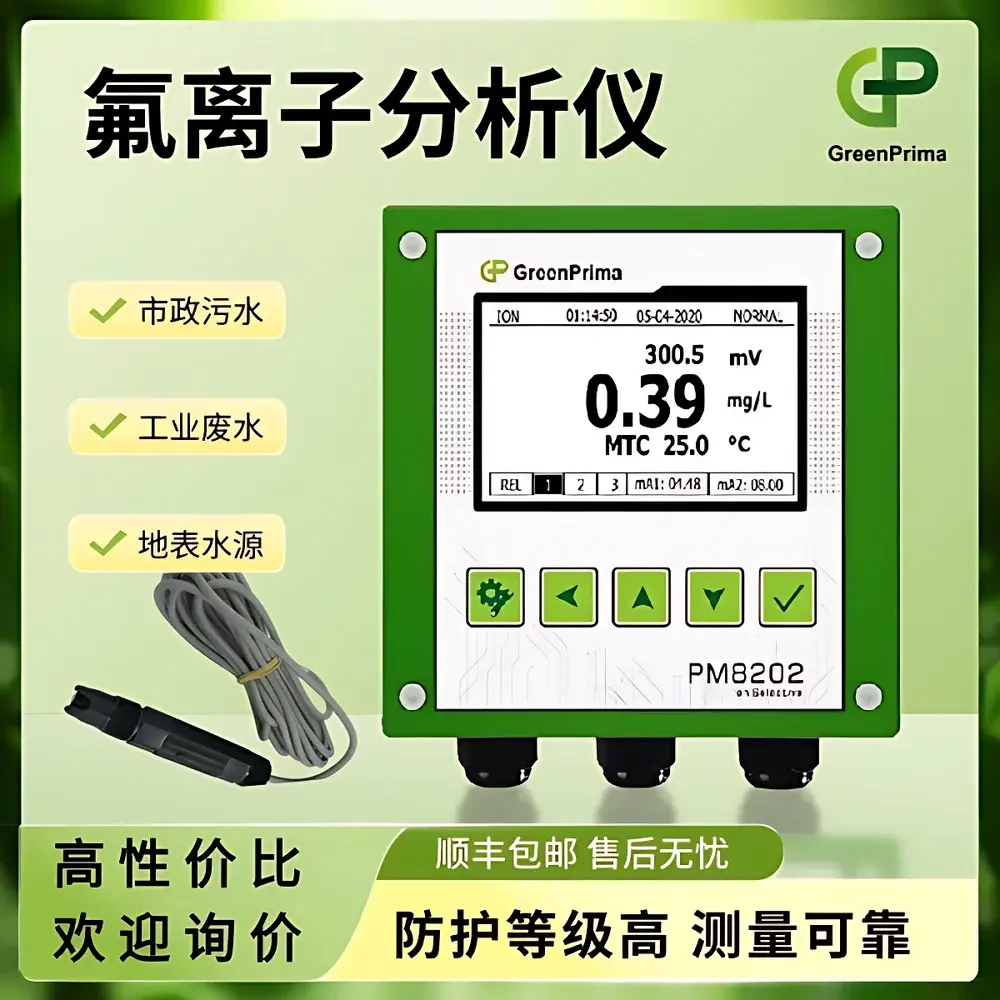
GreenPrima PM8202I Online Fluoride Ion Analyzer
| Brand | GreenPrima |
|---|---|
| Origin | United Kingdom |
| Manufacturer Type | Original Equipment Manufacturer (OEM) |
| Product Category | Imported Instrument |
| Model | PM8202I |
| Pricing | Available Upon Request |
| Measurement Range | 0.00–20,000 ppm F⁻ |
| Resolution | 0.01 / 0.1 / 1 ppm (user-selectable) |
| Accuracy | ±0.01 / ±0.1 / ±1 ppm (depending on range) |
| Temperature Compensation | –10 to 130 °C (manual or automatic |
| Operating Temperature | –10 to 70.0 °C |
| Storage Temperature | –20 to 70.0 °C |
| Display | Backlit high-contrast dot-matrix LCD |
| Languages | English & Chinese interface |
| Data Storage | 600,000 records |
| Power Supply | 90–260 VAC, 50/60 Hz or optional 24 VDC |
| Output Signals | Two isolated 4–20 mA analog outputs (max. loop resistance 500 Ω, accuracy ±0.1% FS) |
| Enclosure Rating | IP66/IP67 (fully sealed, dust-tight and water-resistant) |
| Electrode Compatibility | BSens710 (F⁻), BSens720 (Cl⁻), BSens730 (NH₃-N) |
| Calibration | Manual or scheduled automatic calibration support |
| Security | Password-protected configuration and operation |
Overview
The GreenPrima PM8202I Online Fluoride Ion Analyzer is a multi-parameter, electrochemical process analyzer engineered for continuous, real-time monitoring of fluoride (F⁻), chloride (Cl⁻), and ammoniacal nitrogen (NH₃-N) concentrations in aqueous environments. Built upon potentiometric ion-selective electrode (ISE) technology, the system delivers stable, reproducible measurements by detecting the thermodynamic activity of target ions in solution via Nernstian response. The instrument integrates a rugged controller with interchangeable, field-replaceable ISE modules—BSens710 for fluoride, BSens720 for chloride, and BSens730 for ammonia—enabling flexible deployment across diverse water matrices without hardware modification. Designed for unattended operation in demanding industrial and municipal settings, the PM8202I complies with fundamental principles outlined in ISO 10523 (water quality — determination of pH), ASTM D6919 (standard test method for determination of dissolved alkali and alkaline earth cations and ammonium ions by ion chromatography), and supports traceability requirements aligned with ISO/IEC 17025–compliant QA/QC workflows.
Key Features
- IP66/IP67-rated enclosure with fully sealed, corrosion-resistant housing—suitable for outdoor mounting, wet utility trenches, and chemical exposure zones
- Intuitive dual-language (English/Chinese) graphical user interface with backlit dot-matrix LCD, displaying real-time ion concentration, temperature, timestamp, relay status, and diagnostic flags
- User-selectable resolution (0.01 / 0.1 / 1 ppm) and accuracy tiers calibrated per ISE performance envelope—optimized for regulatory reporting thresholds (e.g., WHO guideline value of 1.5 mg/L F⁻ for drinking water)
- Dual isolated 4–20 mA analog outputs configurable for primary measurement and temperature signal—each compliant with IEC 61000-6-2/6-4 immunity and emission standards
- RS485 Modbus RTU serial interface enabling seamless integration into SCADA, DCS, and PLC-based automation infrastructures
- Built-in data logger storing up to 600,000 timestamped records with cyclic overwrite protection—supports CSV export via USB or remote retrieval via Modbus register mapping
- Password-protected access levels (operator, technician, administrator) ensuring configuration integrity and audit readiness per GLP/GMP operational frameworks
Sample Compatibility & Compliance
The PM8202I is validated for use in raw surface water, treated potable water, wastewater effluent, cooling tower recirculation loops, and industrial process streams containing low-to-moderate turbidity (<100 NTU) and suspended solids (<50 mg/L). It operates reliably across pH 4–10 and total dissolved solids (TDS) ≤ 5,000 mg/L. Fluoride measurement employs a lanthanum fluoride crystal membrane electrode (BSens710), inherently selective against common interferents including OH⁻, Cl⁻, SO₄²⁻, and NO₃⁻ under controlled ionic strength conditions. All electrode modules meet RoHS Directive 2011/65/EU and are CE-marked per EMC Directive 2014/30/EU and Low Voltage Directive 2014/35/EU. The system architecture supports traceable calibration documentation required under EPA Method 300.0 and ISO 15304 (water quality — determination of fluoride by ion-selective electrode).
Software & Data Management
No proprietary PC software is required for basic operation; all setup, calibration, and diagnostics occur locally via the front-panel interface. For centralized monitoring, the embedded Modbus RTU protocol allows direct register-level access to live values (e.g., holding register 40001 = F⁻ concentration in ppm), calibration history timestamps, sensor health status, and temperature-compensated mV readings. Logged data adheres to ISO 8601 timestamp formatting and includes checksum-verified records to ensure data integrity during transmission. Optional firmware updates are delivered via signed binary files over USB, with SHA-256 hash verification—supporting cybersecurity best practices defined in ISA/IEC 62443-3-3.
Applications
- Municipal drinking water treatment plants: continuous compliance monitoring of fluoridation dosing systems against national limits (e.g., US EPA MCL of 4.0 mg/L, EU Drinking Water Directive 2020/2184 limit of 1.5 mg/L)
- Wastewater treatment facilities: tracking fluoride release from semiconductor, aluminum, or phosphate fertilizer manufacturing discharges
- Power generation: monitoring for fluoride-induced stress corrosion cracking in steam cycle condensate and boiler feedwater
- Pharmaceutical and biotech clean utilities: verifying low-fluoride rinse water specifications (≤0.1 ppm) in sterile processing lines
- Environmental monitoring networks: long-term trend analysis of fluoride leaching from geological formations or landfill leachate plumes
FAQ
What ion-selective electrodes are supported, and how often must they be calibrated?
The PM8202I supports BSens710 (fluoride), BSens720 (chloride), and BSens730 (ammonia) electrodes. Calibration frequency depends on application stability and regulatory requirements—typically every 24–168 hours for critical potable water applications, with automated calibration reminders configurable in the device menu.
Does the analyzer compensate for temperature variations during measurement?
Yes—automatic temperature compensation is enabled using either integrated NTC30K or external PT1000 sensors, covering –10 to 130 °C. The system applies the full Nernst equation correction, not fixed-offset linear adjustment.
Can the 4–20 mA outputs be assigned to different parameters simultaneously?
Yes—Output 1 may be assigned to fluoride concentration (ppm), while Output 2 can be configured for temperature (°C) or a secondary ion channel, with independent zero/span and damping settings.
Is the data logger compatible with third-party historian systems?
Yes—via Modbus RTU, historical registers (40101–40600) expose timestamped values for automated polling by PI System, Ignition SCADA, or custom Python/Node-RED integrations.
What maintenance is required beyond electrode replacement?
Beyond routine ISE membrane cleaning (using 0.1 M HNO₃ for fluoride electrodes) and reference junction inspection, no moving parts or consumables require servicing—the solid-state electronics design ensures >10-year operational life under specified environmental conditions.
Related Products







