
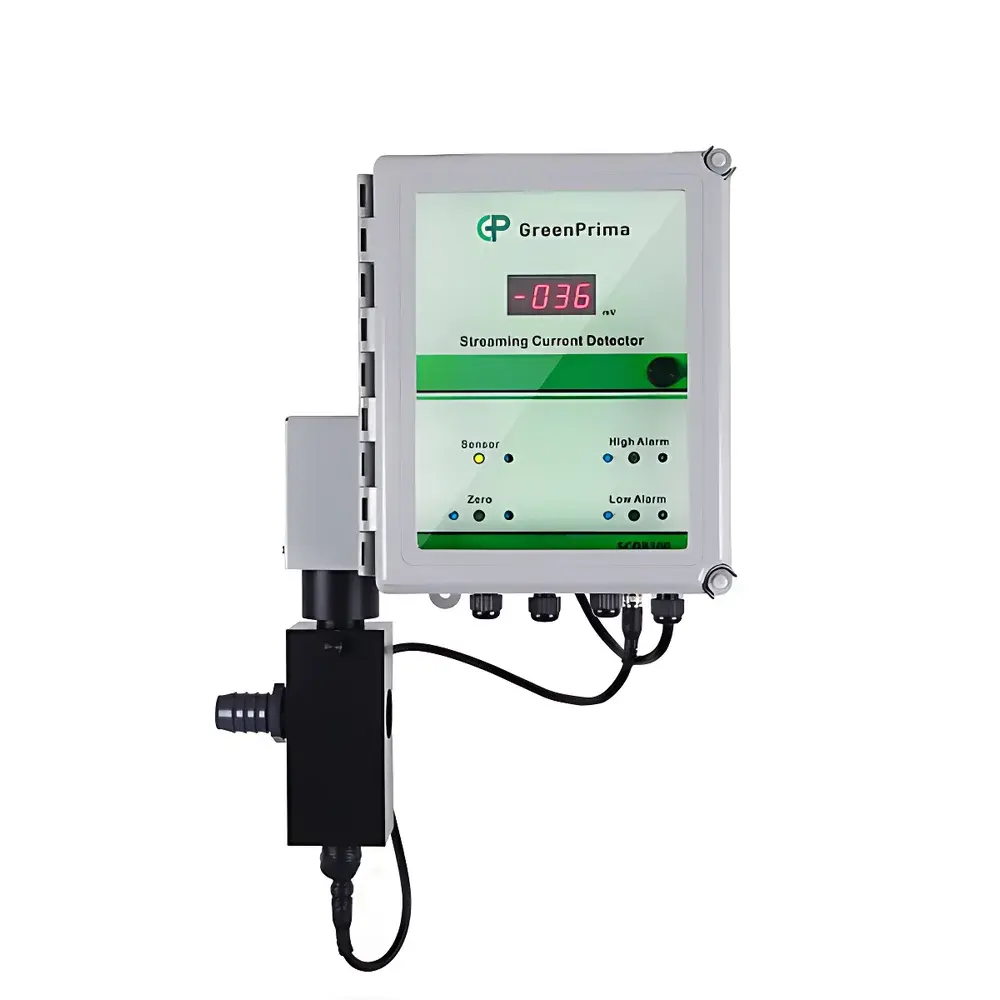
GreenPrima SCD8200 Streaming Current Detector
| Brand | GreenPrima |
|---|---|
| Origin | USA |
| Manufacturer Type | Manufacturer |
| Origin Category | Imported |
| Model | SCD8200 |
| Power Supply | 230 VAC |
| Measurement Range | −1000 to +1000 mV |
| Accuracy | ±0.1% of full scale |
| Response Time | 1 s |
| Flow Rate | 1 US gal/min (3.785 L/min) |
| Inlet Connection | 1/2" barbed |
| Outlet Connection | 3/4" barbed |
| Output Signals | 4–20 mA, −10 to +10 V, 0–10 V |
| Communication | Modbus RTU (optional) |
| Alarm Outputs | Hi/Lo relay contacts |
| Enclosure Rating | NEMA 4X, IP65 |
| Display | LED |
| Sensor Diagnostics | Integrated LED indicator |
| Weight | 9 kg |
| Dimensions | 11" × 6" × 6" (279 × 152 × 152 mm) |
Overview
The GreenPrima SCD8200 Streaming Current Detector is an industrial-grade, continuous online analyzer engineered for real-time measurement of streaming current—a direct electrokinetic indicator of colloidal and ionic charge stability in aqueous systems. Based on the principle of controlled shear-induced charge displacement, the SCD8200 employs a motor-driven piston within a precision-machined cylindrical sensor chamber to generate reproducible laminar flow across a fixed electrode pair. As water passes through the chamber under regulated flow (1 US gal/min), hydrodynamic shear forces disrupt the Stern layer surrounding suspended colloids, releasing counter-ions into bulk solution. Their directional migration under the applied electric field gradient generates a measurable alternating current—termed streaming current—proportional to net surface charge density. This signal, expressed in millivolts (mV), serves as a highly sensitive, process-relevant proxy for coagulant demand and floc formation kinetics. Unlike offline zeta potential measurements or turbidity-based control, the SCD8200 delivers dynamic, feed-forward-compatible feedback ideal for closed-loop dosing of cationic polymers, ferric salts, or aluminum-based coagulants in potable water, wastewater, and membrane pretreatment applications.
Key Features
- Real-time streaming current measurement with 1-second response time and ±0.1% full-scale accuracy
- Dual-mode analog output (4–20 mA and ±10 V or 0–10 V) for seamless integration into DCS, PLC, or SCADA systems
- Optional Modbus RTU (RS-485) digital communication for remote configuration, data logging, and alarm event reporting
- NEMA 4X/IP65 non-metallic enclosure with latching cover—rated for outdoor, washdown, and corrosive environments
- Self-diagnostic sensor status indication via integrated LED; zero-point and gain calibration accessible via front-panel controls
- High-torque brushless motor ensures long-term reliability and consistent shear profile across variable inlet pressures
- Quick-connect barbed fittings (1/2″ inlet, 3/4″ outlet) simplify retrofitting into existing sample loops without welding or threading
Sample Compatibility & Compliance
The SCD8200 operates reliably across a broad range of water matrices, including raw surface water, clarified effluent, filtered process streams, and low-TDS RO feedwater. It tolerates suspended solids up to 100 mg/L and is compatible with pH 4–10 and temperatures from 5°C to 45°C. No reagents, consumables, or reference electrodes are required—eliminating drift associated with liquid junction potentials. The instrument meets UL 61010-1 and IEC 61326-1 for electromagnetic compatibility and safety in industrial measurement environments. Its analog outputs and relay alarms support compliance with EPA guidance for coagulant optimization (e.g., EPA 815-R-00-001) and align with ISO 5667-3 sampling principles for representative online monitoring. While not certified for SIL-rated safety functions, its deterministic signal path and hardware watchdog make it suitable for GMP-aligned water system monitoring per USP and EU Annex 1 requirements when deployed in validated control strategies.
Software & Data Management
The SCD8200 operates as a stand-alone transmitter with no embedded firmware requiring periodic updates. All configuration—including zero offset, span calibration, alarm thresholds, and output scaling—is performed locally via tactile push-button interface and LED display. For centralized data aggregation, the optional Modbus RTU interface enables readout of primary streaming current value, sensor status flag, temperature-compensated diagnostic code, and relay state registers. When integrated with historian platforms (e.g., Ignition, Siemens Desigo CC, or OSIsoft PI), streaming current trends can be correlated with coagulant feed rate, turbidity, pH, and UV254 to build multivariate control models. Audit trails for calibration events and alarm acknowledgments are maintained externally by the host system—supporting FDA 21 CFR Part 11 compliance where electronic records are governed by procedural controls.
Applications
- Optimization of coagulant dosing in drinking water treatment plants to minimize chemical consumption while maintaining turbidity removal efficiency
- Dynamic control of polymer addition in municipal and industrial wastewater clarification, reducing sludge volume and dewatering energy
- Early detection of breakthrough events in dual-media or granular activated carbon filters
- Protection of reverse osmosis membranes by preventing colloidal fouling through proactive coagulant adjustment
- Process validation and routine monitoring in pharmaceutical water systems (PW, WFI) where particle charge stability affects filter integrity
- Research and pilot-scale studies evaluating novel coagulants, flocculants, or hybrid coagulation-flocculation processes
FAQ
How does streaming current differ from zeta potential?
Streaming current measures bulk charge mobility under controlled shear and reflects the net ionic environment influencing coagulation; zeta potential estimates particle surface potential via electrophoretic mobility and requires dilution or specialized cells—not suitable for continuous online use.
Can the SCD8200 be installed directly in a pressurized main line?
No—it requires a side-stream sample loop with pressure regulation (typically 0–30 psi); a dedicated sample pump or pressure-reducing valve must be used upstream of the inlet.
Is temperature compensation automatic?
The SCD8200 includes a built-in NTC thermistor for passive temperature monitoring; however, streaming current itself exhibits minimal intrinsic thermal drift below 45°C, so active compensation is not implemented.
What maintenance is required?
Annual inspection of piston seals and electrode cleanliness; no routine electrolyte refills or membrane replacements—sensor cleaning is performed via citric acid flush or ultrasonic bath if fouling occurs.
Does the instrument support HART protocol?
No—only 4–20 mA analog output with digital Modbus RTU as an optional add-on; HART is not supported due to hardware architecture constraints.
Related Products







