
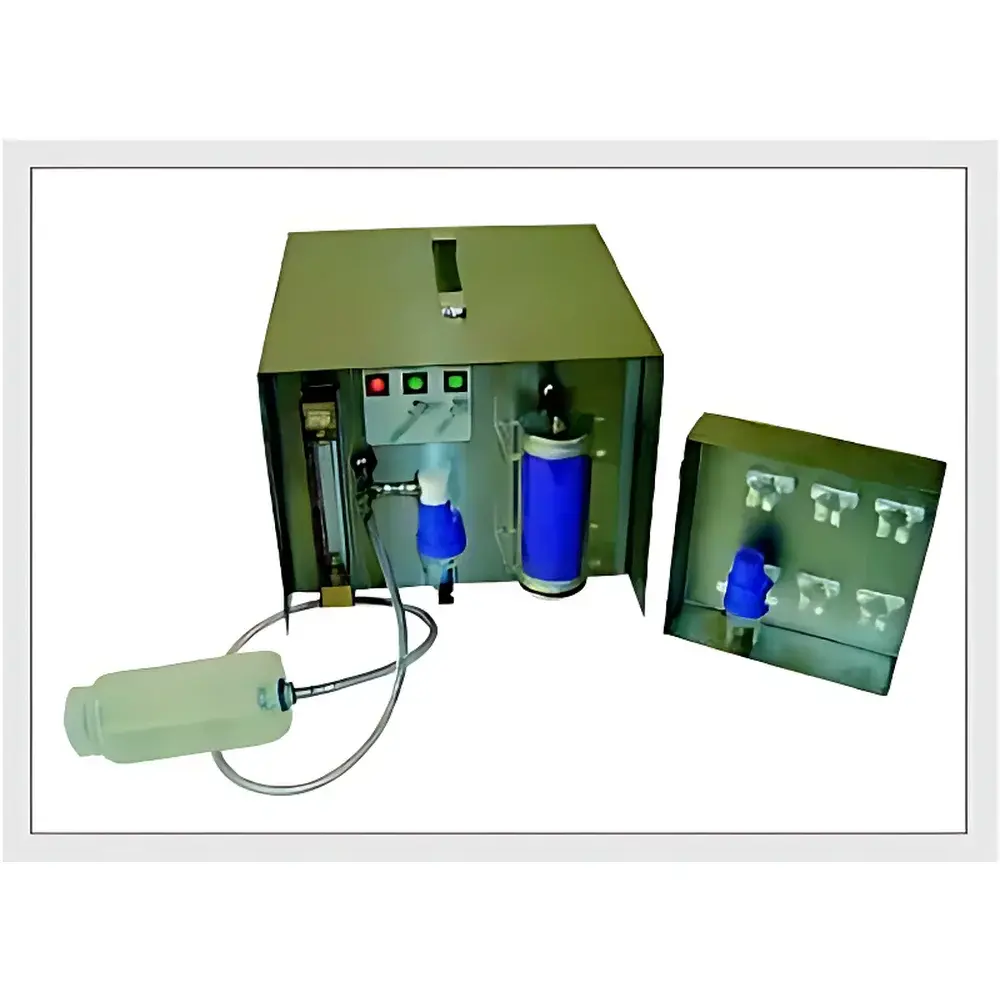
GRIMM 7811 Universal Aerosol Generator
| Brand | GRIMM |
|---|---|
| Origin | Germany |
| Model | 7811 |
| Power Supply | AC 100–240 V, 50–60 Hz, max. 1.7 A |
| Protection Class | IEC Class 1 (grounded) |
| Fuse | 2.0 A, T-type, 5 × 20 mm, 250 VAC |
| Operating Temperature | 0–40 °C |
| Storage/Transport Temperature | −20–50 °C |
| Relative Humidity (operating) | ≤90 % RH, non-condensing (instrument temperature ≥ ambient & aerosol temperature) |
| Max. Altitude | 2000 m |
| Dimensions (D×W×H) | 325 × 310 × 280 mm |
| Weight | 11.0 kg |
| Aerosol Output Pressure | Ambient pressure only — direct connection to downstream instruments prohibited |
| Aerosol Materials | Aqueous NaCl, PSL suspensions, DEHS, DOP (with dedicated nozzle), PAO, Emery 2003 |
| Nozzle Count | Up to 6 interchangeable nozzles |
| Primary Aerosol Flow Rate | ~2.5–7.0 L/min |
| Dry Air Flow Rate | ~7.5–17.0 L/min (customizable) |
| Nozzle Liquid Capacity | 3–10 mL per nozzle |
| Particle Concentration | >10⁷ #/cm³ (DEHS), >10⁵ #/cm³ (NaCl, ~0.025 mg/cm³) |
| Particle Size Range | DEHS: ~80–350 nm |
| NaCl | ~10–200 nm |
| PSL | ~50–5000 nm |
| Sample Compatibility | Monodisperse and polydisperse aerosols |
| Compliance | Designed for ISO 14644-3, ISO 21501-4, ASTM F51, USP <788>, EN 1822 test protocols |
| Software Interface | Analog output (0–10 V) for real-time flow monitoring |
Overview
The GRIMM 7811 Universal Aerosol Generator is an engineered laboratory-grade instrument designed for the precise, reproducible generation of monodisperse and polydisperse test aerosols under controlled environmental conditions. It operates on the principle of pneumatic nebulization combined with inline desiccation—utilizing two independently regulated diaphragm pumps: one to drive liquid feed through calibrated capillary nozzles, and a second to supply metered dry air for dilution and moisture removal. The aerosol stream passes through a replaceable silica gel dryer cartridge mounted on the front panel, ensuring consistent particle morphology and minimizing hygroscopic growth during downstream sampling. Its dual-flow architecture enables fine-tuned control over aerosol concentration, size distribution, and stability—critical parameters in filter testing, sensor calibration, inhalation toxicology studies, and cleanroom validation workflows.
Key Features
- Dual independent mass flow control: Separate adjustment of primary aerosol flow (2.5–7.0 L/min) and dry air flow (7.5–17.0 L/min) via front-panel precision knobs
- Modular nozzle configuration: Supports up to six interchangeable nozzles, each optimized for specific aerosol materials (e.g., NaCl, PSL, DEHS, DOP, PAO, Emery 2003)
- Integrated desiccation system: Front-access silica gel dryer cartridge with visual saturation indicator; removable for regeneration or replacement
- Real-time process monitoring: Built-in dry air flowmeter with analog output (0–10 V) compatible with external data loggers or SCADA systems
- Robust electrical safety architecture: IEC Class 1 grounding, T-rated fuse protection, and universal 100–240 V AC input for global deployment
- Ambient-pressure output design: Eliminates backpressure-induced particle coagulation; mandates use of T-connectors or passive equalization paths when interfacing with counters or spectrometers
Sample Compatibility & Compliance
The GRIMM 7811 accommodates a broad spectrum of aerosol precursors—including aqueous sodium chloride, polystyrene latex (PSL) suspensions, di-2-ethylhexyl sebacate (DEHS), di-2-ethylhexyl phthalate (DOP), poly-alpha olefin (PAO), and Emery 2003 abrasive particles. Each material requires appropriate nozzle selection and operational validation per application-specific protocols. The generator meets foundational requirements for ISO 14644-3 (cleanroom testing), ISO 21501-4 (light-scattering particle sizing calibration), ASTM F51 (filter efficiency testing), USP (subvisible particle analysis), and EN 1822 (HEPA/ULPA filter classification). While not inherently compliant with FDA 21 CFR Part 11, its analog outputs and mechanical repeatability support integration into GLP/GMP environments when paired with validated data acquisition systems featuring audit trail and electronic signature capabilities.
Software & Data Management
The GRIMM 7811 operates as a standalone hardware platform without embedded firmware or touchscreen interface. All operational parameters are manually set via analog controls, ensuring deterministic behavior and eliminating software-related drift or versioning dependencies. Dry air flow is continuously monitored via a calibrated rotameter and relayed as a 0–10 V analog signal—enabling synchronization with third-party DAQ systems (e.g., LabVIEW, MATLAB, or industrial PLCs) for time-stamped correlation with particle counter readings or environmental sensor data. Optional RS-232 or RS-485 serial modules (subject to firmware revision) may be installed to support remote status polling and basic command triggering—though full automation requires external logic layer implementation and protocol documentation review prior to integration.
Applications
- Filter integrity and penetration testing per ISO 14644-3 and EN 1822 standards
- Calibration and challenge testing of optical particle counters (OPCs), condensation particle counters (CPCs), and scanning mobility particle sizers (SMPS)
- Development and validation of respiratory protective equipment (RPE) and inhaler delivery systems
- Environmental chamber exposure studies requiring stable, traceable aerosol concentrations
- Reference aerosol generation for gravimetric and photometric filter testing (e.g., MERV, HEPA, ULPA classifications)
- Research into particle deposition dynamics, coagulation kinetics, and hygroscopic growth behavior
FAQ
Can the GRIMM 7811 generate truly monodisperse aerosols?
Yes—when operated with narrow-distribution PSL suspensions and matched nozzle geometry, it achieves size distributions with geometric standard deviations (σg) < 1.1 under optimized flow ratios. Monodispersity is further enhanced by post-generation classification using differential mobility analyzers (DMA).
Is DOP generation supported without modification?
DOP requires a dedicated corrosion-resistant nozzle due to its chemical compatibility profile. Standard nozzles supplied with the unit are rated for DEHS and NaCl only; DOP-capable nozzles must be ordered separately and installed prior to use.
Why must the aerosol outlet never be directly connected to downstream instrumentation?
Direct coupling introduces backpressure that disrupts nebulization stability, promotes nozzle clogging, and induces unintended particle coagulation. A minimum 30 cm free-path section or T-connector with vented bypass is mandatory to ensure pressure equilibrium and laminar flow development before measurement.
What maintenance intervals are recommended for the silica gel dryer?
Visual inspection before each use is required. Replacement or thermal regeneration (120 °C for 4 hours) is necessary when the blue indicator crystals turn pink—typically after 20–40 hours of continuous DEHS operation or 5–10 hours with high-humidity NaCl solutions.
Does the 7811 meet explosion-proof requirements for hazardous area use?
No. The GRIMM 7811 is certified for indoor laboratory use only (IEC Class 1, non-explosion-proof enclosure). It must not be deployed in Zone 0, 1, or 2 classified environments without additional third-party ATEX/IECEx certification and physical isolation measures.
Related Products







