
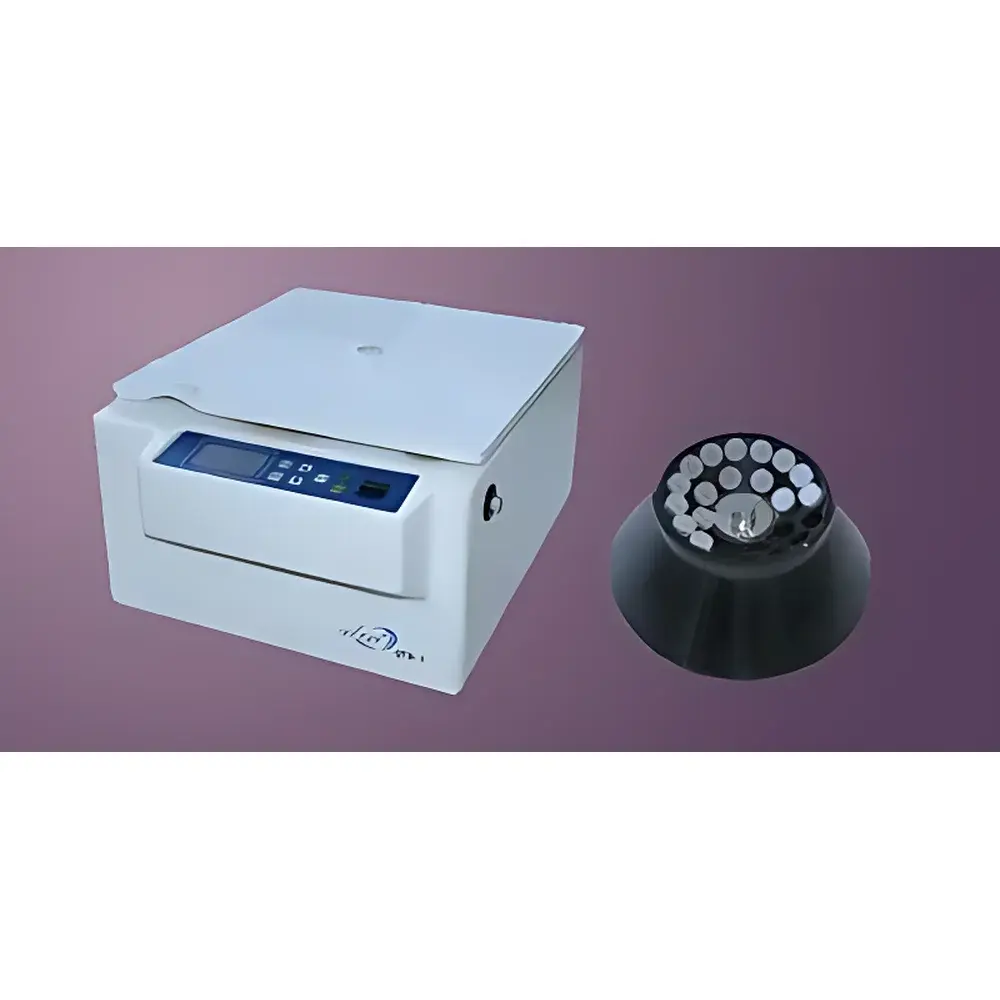
GT10-1 / GT10-2 High-Speed Benchtop Centrifuge
| Origin | Beijing, China |
|---|---|
| Manufacturer Type | Authorized Distributor |
| Origin Category | Domestic (PRC) |
| Model | GT10-1 / GT10-2 (Formerly LG10-2.4A) |
| Max Speed | 10,000 rpm |
| Max RCF | 11,000 × g |
| Timer Range | 0–999 min |
| Power Supply | AC 220 V, 50 Hz, 8 A |
| Dimensions (W×D×H) | 51 × 41 × 31 cm |
| Weight | 36 kg |
| Rotor Configurations | 6 × 50 mL angular rotor (standard) |
| optional | 24 × 10 mL angular rotor, 4 × (100/10/5) mL multi-volume buckets |
Overview
The GT10-1 and GT10-2 high-speed benchtop centrifuges are engineered for precision sedimentation and phase separation in routine laboratory workflows across clinical diagnostics, food safety testing, environmental analysis, and academic research. These instruments operate on the principle of radial acceleration—generating controlled centrifugal force to separate particles or immiscible phases based on density, size, and shape differences. With a maximum rotational speed of 10,000 rpm and an achievable relative centrifugal force (RCF) of up to 11,000 × g, they support rapid pelleting of mammalian cells, bacterial cultures, subcellular organelles, precipitated nucleic acids, and protein aggregates. Designed for continuous operation under demanding QC/QA protocols, both models comply with IEC 61010-1 safety standards for laboratory electrical equipment and incorporate mechanical and electronic safeguards aligned with GLP-compliant operational requirements.
Key Features
- Brushless DC motor architecture ensures maintenance-free operation, eliminating carbon brush wear and associated particulate contamination—critical for sterile and cleanroom environments.
- Microprocessor-based fuzzy logic control system enables precise, repeatable setpoint execution for speed, time, and RCF; real-time monitoring is displayed via high-contrast LCD with full-touch interface.
- Modular rotor mounting system supports rapid interchange between standardized angular rotors without tools, minimizing cross-contamination risk and downtime.
- Integrated safety suite includes automatic rotor recognition (via mechanical coding), imbalance detection (>5 g mass differential), lid interlock with dual-sensor verification, over-speed protection, and thermal cutoff at 55 °C.
- Acoustically optimized housing and vibration-damping base reduce operational noise to ≤62 dB(A) at 1 m distance, supporting extended use in shared lab spaces.
- Wide-input power regulation (±15% voltage tolerance) accommodates fluctuations common in regional utility grids, ensuring stable performance without external stabilizers.
Sample Compatibility & Compliance
The GT10-1 and GT10-2 accommodate a range of sample formats through interchangeable rotor configurations: standard 6 × 50 mL conical tubes (15° angular rotor), optional 24 × 10 mL round-bottom tubes, and multi-bucket carriers for mixed-volume processing (4 × 5/10/100 mL). All rotors are certified to ISO 15751:2017 for mechanical integrity and fatigue resistance. Tube compatibility extends to polypropylene, polycarbonate, and borosilicate glass vessels rated for ≥11,000 × g. The centrifuge meets electromagnetic compatibility (EMC) requirements per IEC 61326-1 and is suitable for use in laboratories adhering to ISO/IEC 17025, CLIA, and FDA-regulated environments where audit-ready documentation of calibration and preventive maintenance is required.
Software & Data Management
While these models operate as standalone instruments, their programmable parameters—including speed ramp profiles, deceleration braking modes (soft stop vs. fast brake), and auto-restart after power interruption—are fully configurable and retain settings across power cycles. Event logs record timestamped entries for lid open/close, error triggers, and run completion. For laboratories implementing 21 CFR Part 11 compliance, optional RS-232 or USB-to-serial interfaces enable integration with LIMS platforms for traceable method storage, user access logging, and electronic signature support when paired with validated third-party middleware.
Applications
- Clinical microbiology: Pelleting of blood-derived pathogens, isolation of extracellular vesicles from serum/plasma.
- Food quality control: Separation of fat globules in dairy emulsions, sediment analysis in beverage suspensions.
- Environmental testing: Concentration of microplastics or heavy metal-bound colloids from aqueous samples prior to ICP-MS analysis.
- Academic life sciences: Crude subcellular fractionation (e.g., mitochondrial isolation from tissue homogenates), nucleic acid precipitation recovery.
- Industrial R&D: Clarification of fermentation broths, catalyst recovery in biocatalytic reactions.
FAQ
What rotor configurations are included by default with the GT10-1 and GT10-2?
The GT10-1 ships with a 6 × 50 mL angular rotor; the GT10-2 includes the same plus a 24 × 10 mL angular rotor. All other rotors—including multi-bucket assemblies—are available as optional accessories.
Is rotor calibration required before first use?
No factory calibration is needed—the rotors are pre-balanced and mechanically coded for automatic recognition. However, users must verify tube balance manually prior to each run per ISO 20931-1 guidelines.
Can these centrifuges be used in cold rooms?
They are rated for ambient operation between 10–32 °C and 30–80% non-condensing humidity. Operation below 10 °C is not recommended due to potential lubricant viscosity changes and LCD response delay.
Does the instrument support GMP-compliant audit trails?
Native audit trail functionality is not embedded, but event logs and external interface options allow integration into validated data management systems meeting ALCOA+ principles when configured per organizational SOPs.
What is the mean time between failures (MTBF) under typical usage conditions?
Based on field reliability data from distributor service records, MTBF exceeds 12,000 hours for the motor assembly and 8,500 hours for the control board, assuming scheduled cleaning and rotor inspection every 6 months.



