
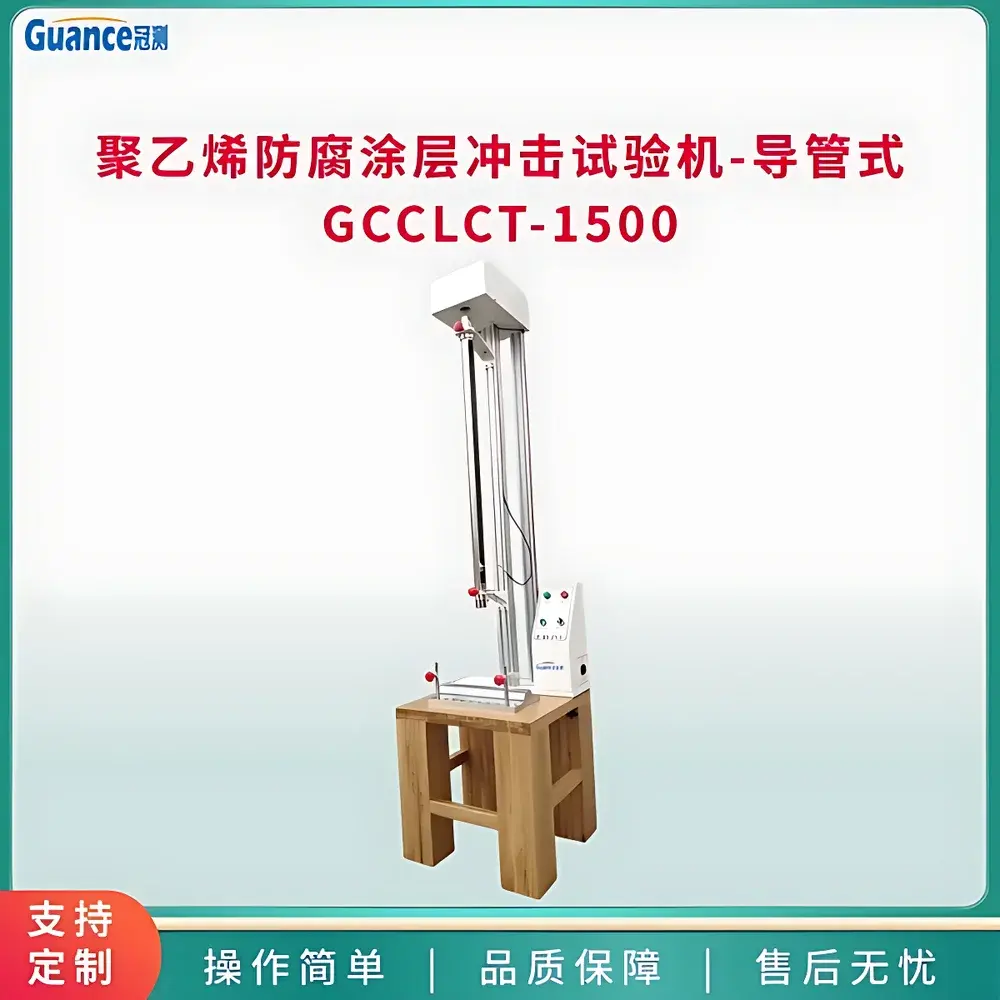
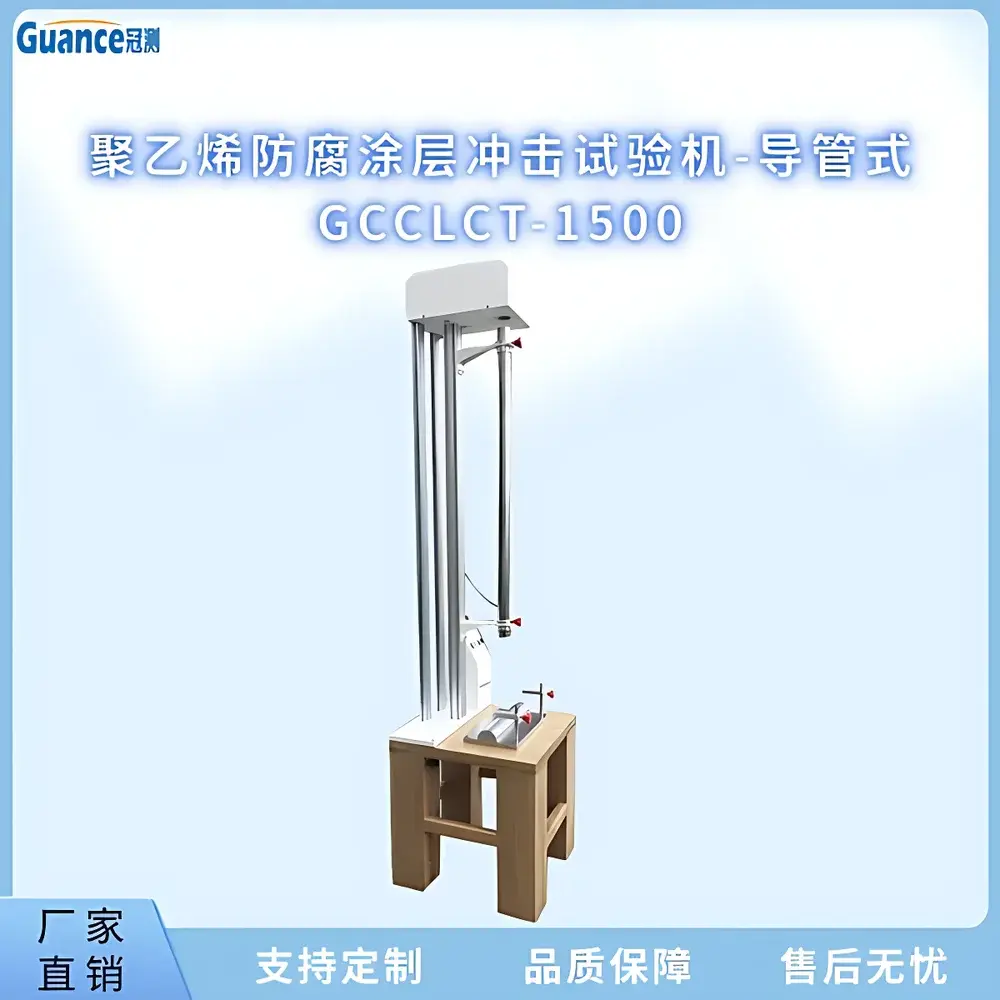
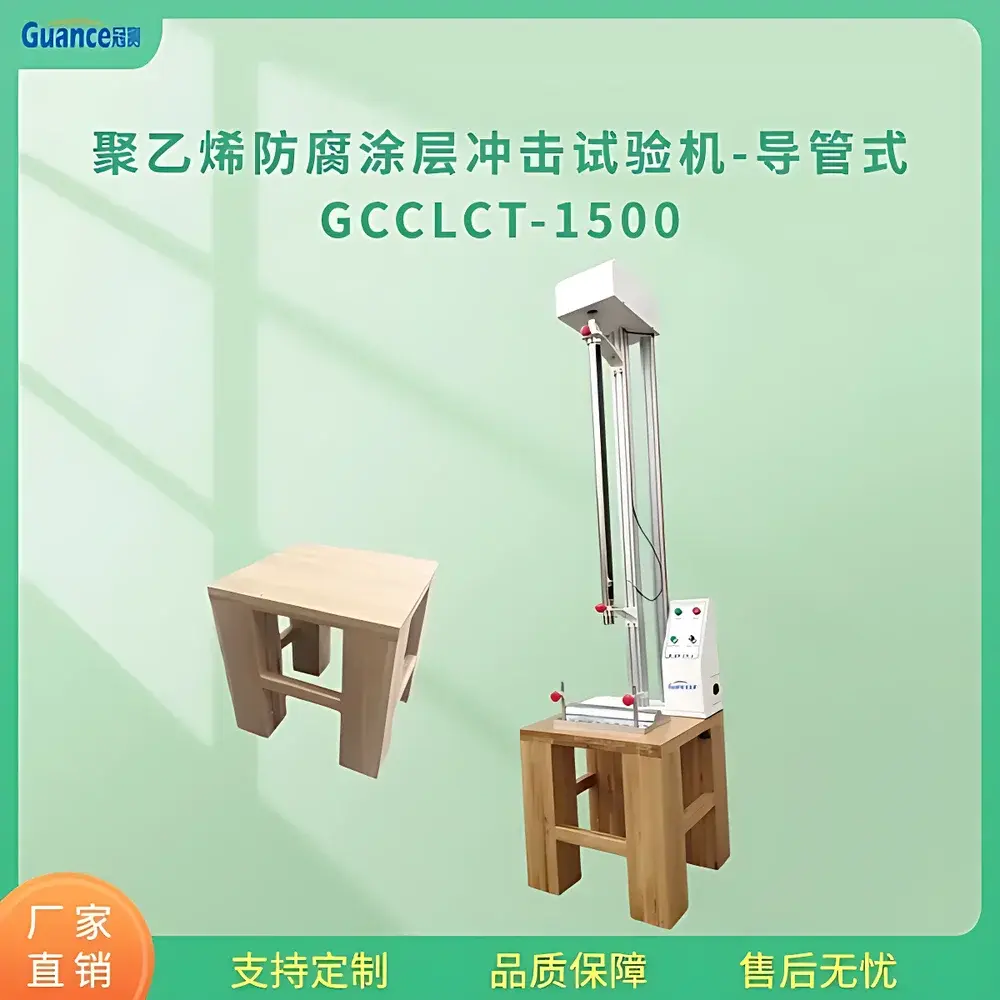
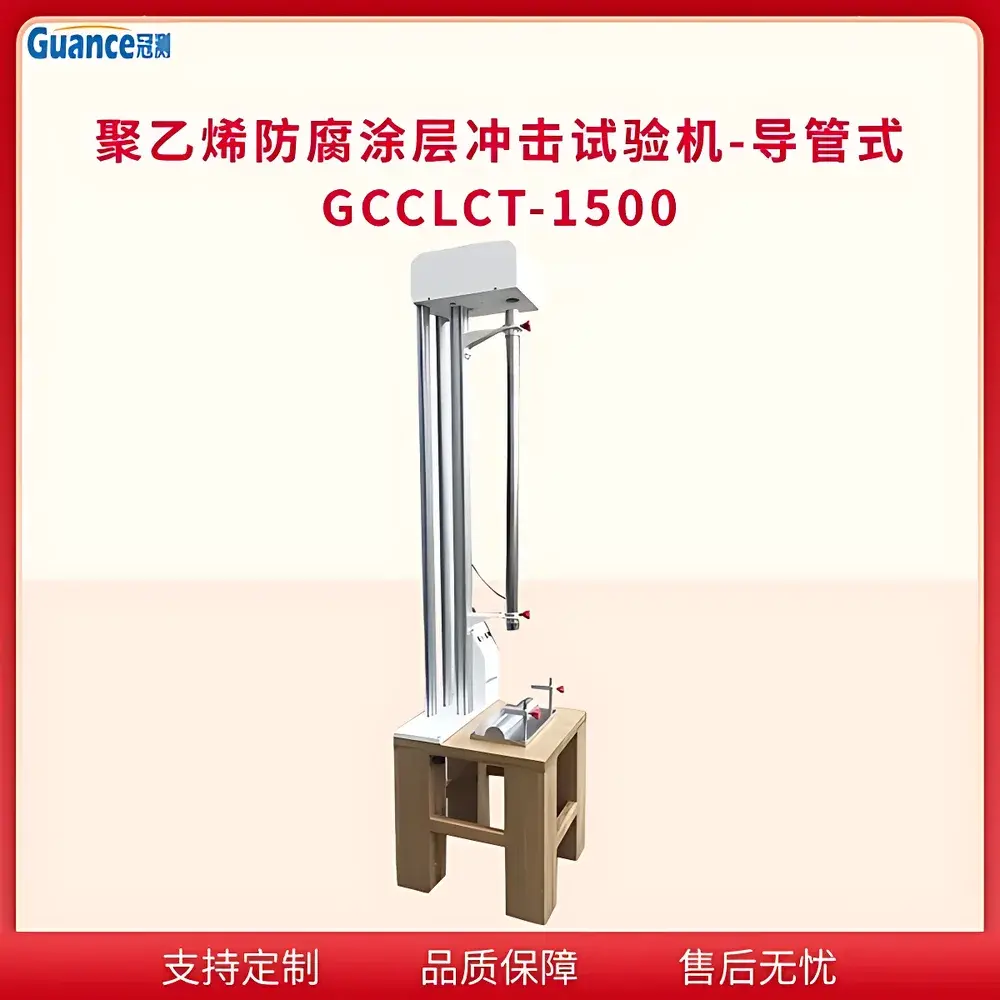
GuanCe GCCLCT-1500 Polyethylene Coating Impact Tester
| Brand | GuanCe |
|---|---|
| Origin | Beijing, China |
| Model | GCCLCT-1500 |
| Impact Energy | 155 J |
| Impact Velocity | 198 cm/s |
| Pendulum Torque (Impact Constant) | 16 N·m |
| Load Cell Range | 12–17 kN |
| Maximum Lift Height | 1500 mm |
| Hammer Mass Options | 1 kg / 2 kg / 3 kg |
| Hammer Tip Diameter | Φ16 mm / Φ25 mm |
| Guide Tube ID | 48 mm, Length: 1200 mm |
| Anvil Radius (Curved) | 40 mm, Hardness: 55 HRC ±5 HRC |
| Flat & V-Groove Anvils | 55 HRC ±5 HRC |
| Specimen Fixing | Mechanical clamping for flat, curved, and tubular specimens (DN50–DN150, L=300 mm) |
| Compliance | SY/T 0315–2013 Annex D, GB/T 23257–2009 Annex L |
Overview
The GuanCe GCCLCT-1500 Polyethylene Coating Impact Tester is a precision-engineered mechanical impact testing system designed specifically for evaluating the resistance of polyethylene (PE) and fusion-bonded epoxy (FBE) anticorrosion coatings applied to steel pipelines. It operates on the principle of controlled free-fall impact, where a calibrated hammer—lifted to a defined height—is released under electromagnetic control to strike a coated specimen mounted on standardized anvils. The test quantifies coating integrity by assessing visible damage (e.g., cracking, delamination, or substrate exposure) after impact, directly correlating with field performance under mechanical stress during pipeline handling, backfilling, or third-party interference. This instrument fulfills the physical verification requirements of SY/T 0315–2013 (Annex D) for FBE coatings and GB/T 23257–2009 (Annex L) for PE extruded and coextruded coatings—key standards referenced in Chinese oil & gas infrastructure procurement specifications and widely adopted across APAC pipeline projects.
Key Features
- Motorized, remote-controlled hammer lifting mechanism with precise 5-mm graduated scale and upper-limit safety switch, enabling repeatable impact height adjustment up to 1500 mm.
- Electromagnetic hammer release system operated via dual redundant remote keys—ensuring operator safety and eliminating manual trigger variability.
- Interchangeable hardened steel hammers (1 kg, 2 kg, 3 kg) with two tip diameters (Φ16 mm and Φ25 mm) to accommodate varying coating thicknesses and industry-specified energy densities.
- Dual-anvil configuration: Curved anvil (R = 40 mm, 55 HRC ±5) simulates pipe curvature; flat anvil (55 HRC ±5) supports plate specimens; V-groove anvil (55 HRC ±5) secures tubular samples (DN50–DN150, 300 mm length) with axial alignment.
- Robust guide tube (ID 48 mm, L 1200 mm) with polished internal surface ensures consistent vertical trajectory and minimizes lateral deviation (<0.5°), critical for ASTM E23-compliant repeatability.
- Modular clamping system engineered for rapid, tool-free fixation of diverse specimen geometries—including strip (200 × 25 × 6–45 mm), square/rectangular plates (100 × 100 mm to 350 × 170 mm), and curved segments—without slippage or deformation during impact.
Sample Compatibility & Compliance
The GCCLCT-1500 accommodates standard specimen formats mandated by national and industry standards for pipeline coating qualification. Strip specimens (200 mm × 25 mm × 6–45 mm) are secured using side-locking jaws; flat plates (100 × 100 mm to 350 × 170 mm, thickness 6–45 mm) rest on the flat anvil with perimeter clamps; tubular sections (DN50–DN150, 300 mm long) are centered in the V-groove anvil and axially restrained. All anvils meet hardness certification per GB/T 230.1 (Rockwell C scale) and are traceable to national metrology institutes. The system satisfies the mechanical test requirements of SY/T 0315–2013 (Annex D) for FBE coatings and GB/T 23257–2009 (Annex L) for PE systems—standards aligned with ISO 21809-2 and EN 10292 for external pipeline protection. While not inherently GLP/GMP-certified, its mechanical design supports audit-ready documentation when integrated into QA/QC workflows compliant with ISO/IEC 17025.
Software & Data Management
The GCCLCT-1500 is a manually operated mechanical tester with no embedded microprocessor or digital data logging. All test parameters—including hammer mass, drop height, anvil type, specimen geometry, and post-test evaluation—are recorded manually in laboratory notebooks or LIMS-integrated spreadsheets. Its design prioritizes mechanical reliability and regulatory transparency: no firmware updates, no calibration drift from software dependencies, and full traceability of physical settings (e.g., height scale graduation, anvil hardness certificates, hammer mass calibration reports). Users may integrate results into electronic quality records (eQMS) compliant with FDA 21 CFR Part 11 via external documentation protocols—leveraging the instrument’s deterministic mechanical behavior as a foundation for ALCOA+ data integrity principles.
Applications
- Qualification testing of extruded and coextruded polyethylene (PE) anticorrosion coatings for buried steel pipelines per GB/T 23257–2009.
- Evaluation of fusion-bonded epoxy (FBE) coating adhesion and toughness under mechanical shock per SY/T 0315–2013 Annex D.
- R&D validation of novel polymer blends, filler-modified PE formulations, or adhesive interlayers intended for enhanced impact resistance.
- Third-party inspection and factory acceptance testing (FAT) for pipeline coating contractors supplying to CNPC, Sinopec, or CNOOC projects.
- Comparative assessment of coating performance across batch variations, curing conditions, or surface preparation methods (e.g., blast profile, anchor pattern).
FAQ
What standards does the GCCLCT-1500 explicitly support?
It is configured and validated for SY/T 0315–2013 (Annex D) and GB/T 23257–2009 (Annex L), including specified hammer masses, drop heights, anvil geometries, and specimen dimensions.
Is calibration certification provided with the instrument?
Yes—hammer mass calibration certificates (traceable to NIM, Beijing), anvil hardness verification reports, and guide tube dimensional inspection records are included in the delivery package.
Can the system be used for non-pipeline coating applications?
While optimized for PE/FBE on steel substrates, it may be adapted for other rigid-coated metallic or composite substrates, provided specimen geometry and anvil compatibility are verified per ISO 6603-2 guidelines.
Does the tester include data acquisition hardware?
No—the GCCLCT-1500 is a purely mechanical impact tester. Force-time profiles or energy absorption curves require external high-speed load cells and oscilloscopes, which are not part of the standard configuration.
What maintenance is required for long-term accuracy?
Biannual verification of hammer mass, anvil hardness, guide tube bore smoothness, and electromagnetic release timing consistency is recommended; all procedures are documented in the user manual per ISO 17025 clause 6.4.



