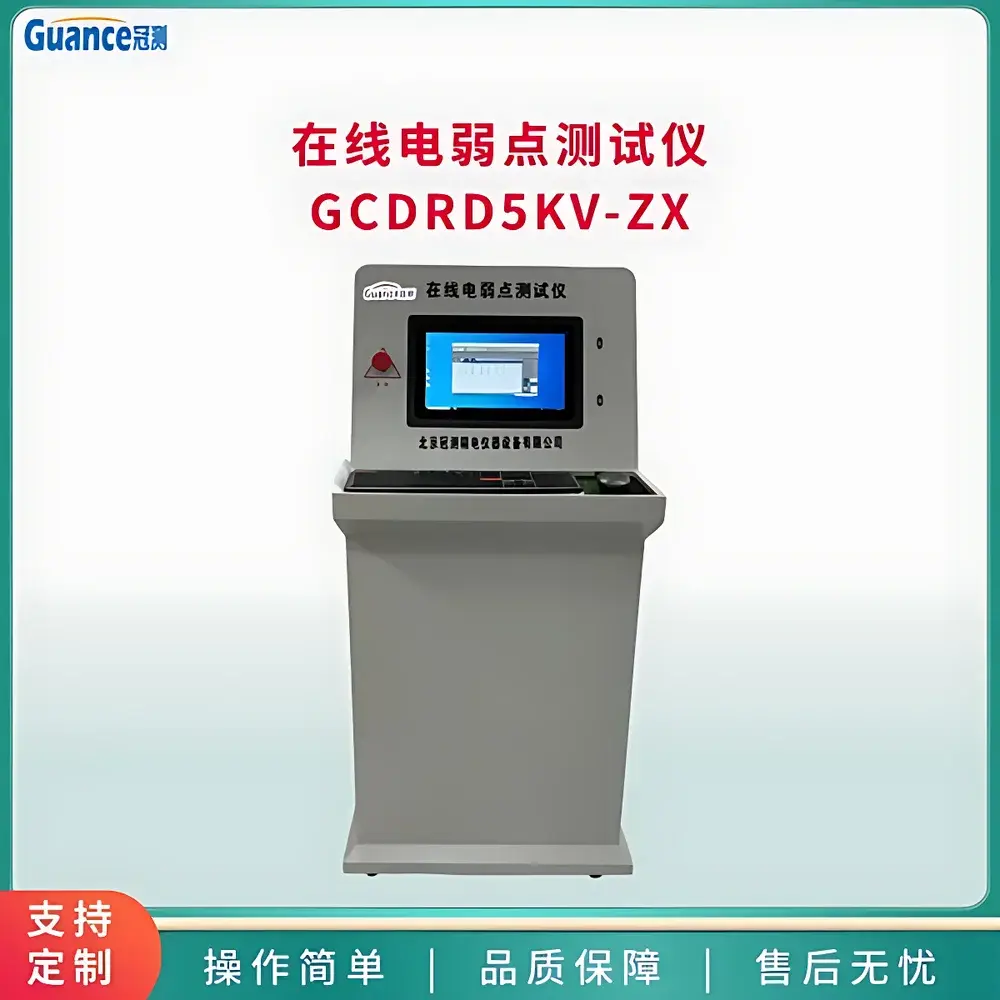
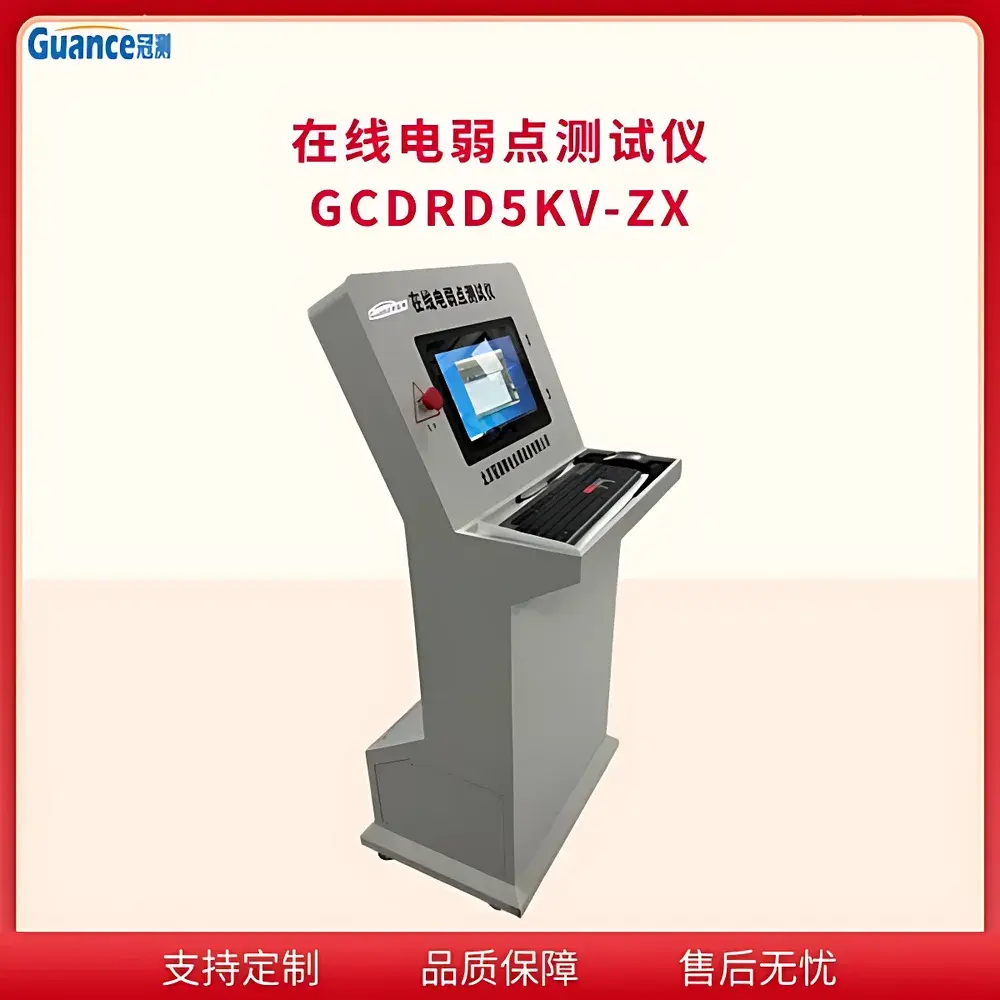
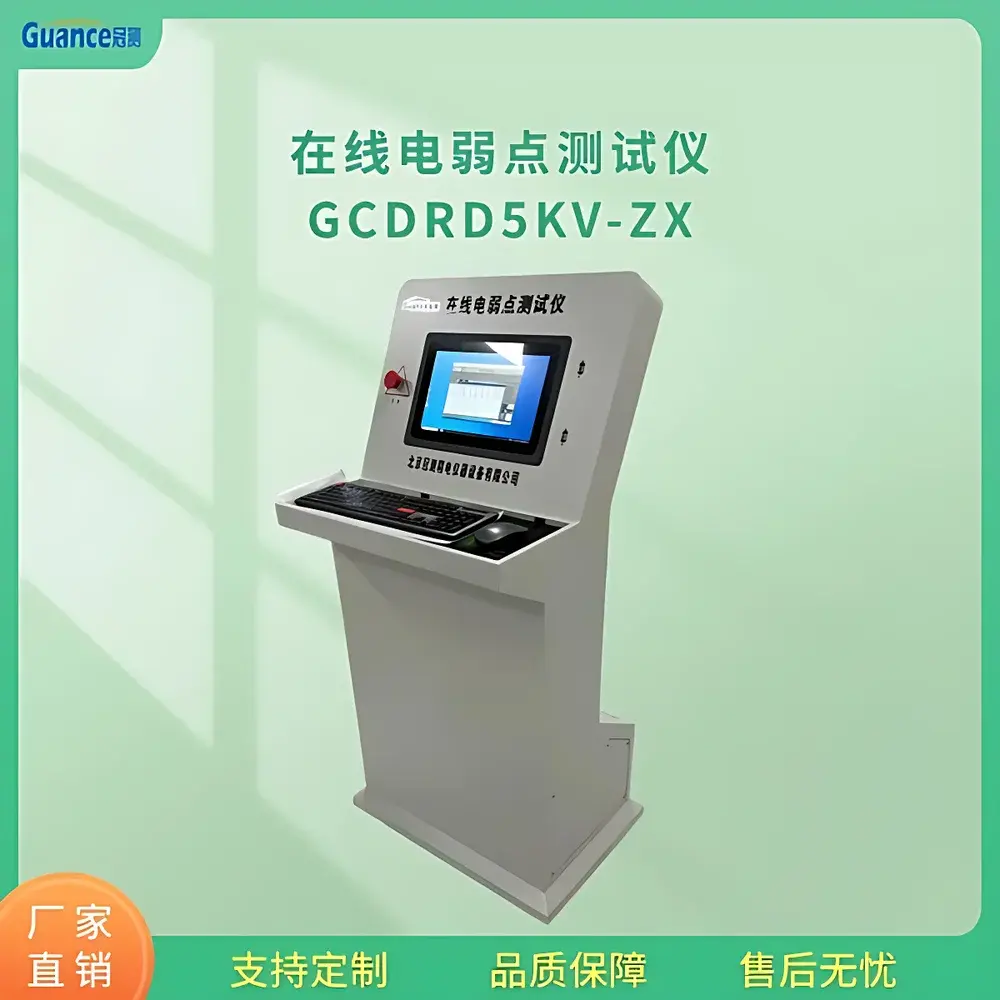
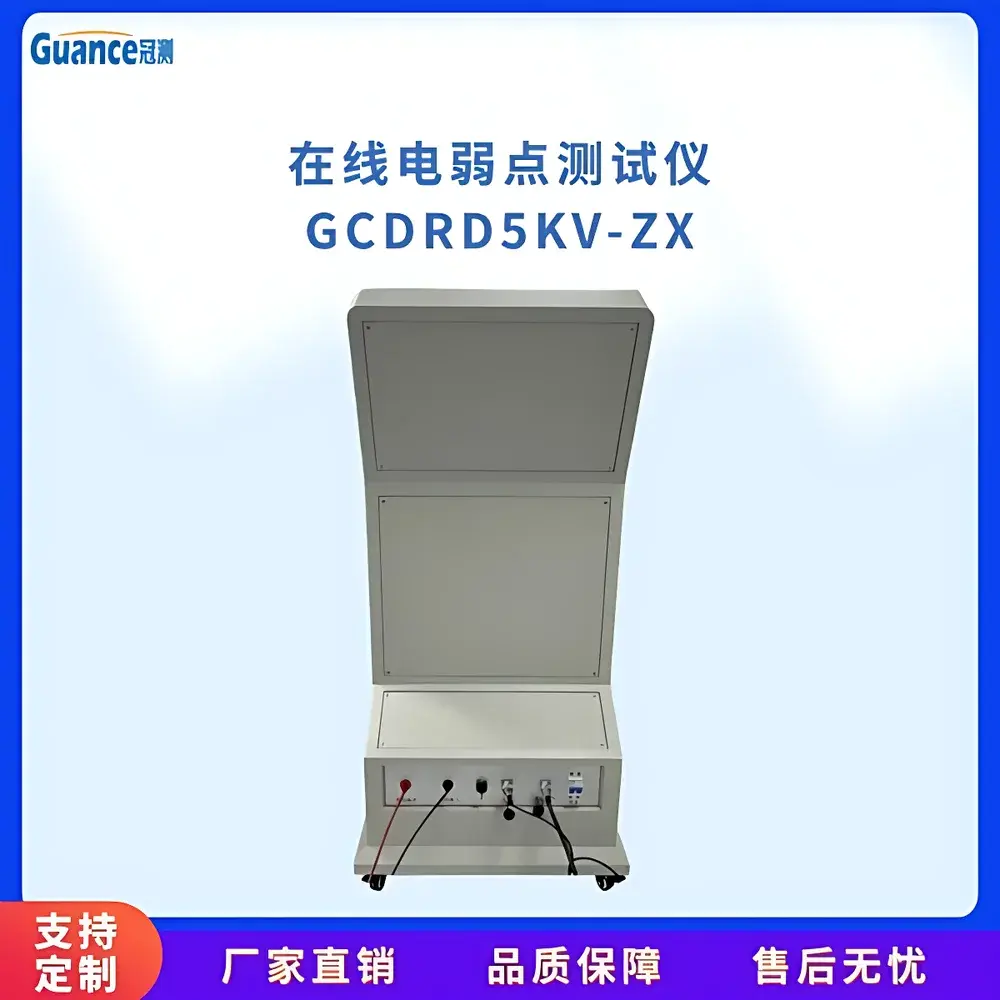
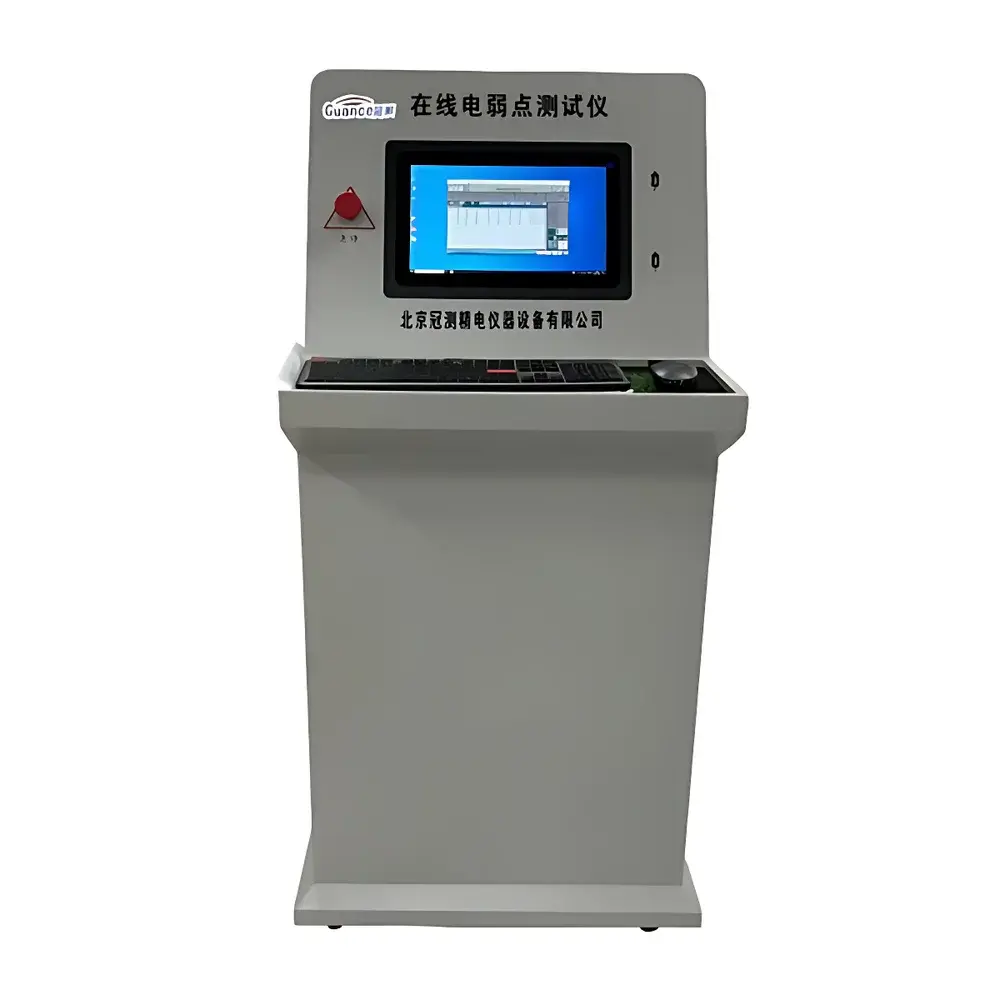
Guance GCDRD5KV-ZX Online Electrical Weak Point Tester
| Brand | Guance Instruments |
|---|---|
| Origin | Beijing, China |
| Manufacturer Type | Authorized Distributor |
| Country of Origin | China |
| Model | GCDRD5KV-ZX |
| Price | USD 1,850 (FOB Beijing) |
| Test Voltage Range | 0–10 kV DC (±1% stability) |
| Voltage Ramp Rate | Programmable |
| Film Traverse Speed | 2–5 m/min |
| Electrode Configuration | Copper roller (lower), conductive rubber roller (upper) |
| Data Output | Real-time voltage/current logging, weak-point coordinate mapping, areal density calculation (points/m²), linear spacing analysis (m/point), auto-zeroing post-test |
| Compliance | GB/T 13542.2–2009, IEC 60674-2:1988 |
| Software | Windows-based control & analysis suite with audit trail, CSV export, and GLP-compliant metadata tagging |
Overview
The Guance GCDRD5KV-ZX Online Electrical Weak Point Tester is an industrial-grade, microprocessor-controlled system engineered for continuous in-line quality assurance of polymeric dielectric films—specifically polyurethane, polypropylene, polyester, and other flexible insulating substrates used in capacitors, transformers, and high-reliability electronics. It operates on the principle of controlled DC voltage ramping across a moving film sample under defined mechanical tension and electrode geometry. Unlike static dielectric strength testers, the GCDRD5KV-ZX performs real-time detection of localized insulation failures (electrical weak points) as the film traverses between two parallel electrodes at precisely regulated speed and pressure. Upon dielectric breakdown, the instrument suppresses arcing within ≤100 ms, restores the test voltage to its pre-breakdown setpoint, and logs spatial coordinates relative to film length—enabling quantitative assessment of defect distribution per unit area (points/m²) or linear density (points/m). Its design conforms to the fundamental measurement paradigm specified in IEC 60674-2 and GB/T 13542.2, where electrical weakness is evaluated not as bulk breakdown voltage, but as statistical frequency of localized conduction events under standardized stress conditions.
Key Features
- Programmable DC voltage ramp (0–10 kV) with ±1% output stability and automatic recovery to setpoint within 100 ms post-breakdown
- Motor-driven film transport system with adjustable traverse speed (2–5 m/min) and independent tension control for unwind/re-wind stations
- Dual-electrode configuration: precision-ground copper roller (grounded cathode) and compliant conductive rubber roller (anode), ensuring uniform field distribution and minimal edge effects
- Real-time oscillographic display of voltage, leakage current, and breakdown transients during testing
- Automated spatial registration: each weak point is timestamped and mapped to absolute film position, enabling downstream correlation with extrusion or coating process parameters
- Multi-mode operation: selectable test termination criteria—target area (m²), cumulative length (m), or elapsed time (min)
- Integrated data processing engine computes areal weak-point density, inter-defect spacing statistics, and cumulative failure histograms without post-processing
- Self-calibrating sensor interface with isolated analog-to-digital conversion (16-bit resolution) for leakage current (nA–µA range) and voltage monitoring
Sample Compatibility & Compliance
The GCDRD5KV-ZX is validated for use with roll-form dielectric films having thicknesses from 6 µm to 250 µm and widths up to 600 mm. Compatible substrates include biaxially oriented polypropylene (BOPP), metallized polyester (MPET), polyimide (PI), and solvent-cast polyurethane (PU) films. Electrode contact integrity is maintained via pneumatic expansion shafts (standard air supply: 0.4–0.6 MPa), eliminating slippage during high-speed traversal. All measurement protocols adhere strictly to Clause 5.3 (“Electrical Weak Point Test”) of GB/T 13542.2–2009 and its harmonized international counterpart IEC 60674-2:1988. The system supports traceable calibration using NIST-traceable HV dividers and current shunts; full calibration records—including date, technician ID, and equipment IDs—are embedded in exported datasets.
Software & Data Management
The embedded Windows 10 IoT application provides role-based access control, configurable test templates, and automated report generation in PDF and CSV formats. Each test session generates a structured metadata file containing operator ID, ambient temperature/humidity (optional external sensor input), film batch number, tension setpoints, voltage ramp profile, and raw time-series acquisition (1 kHz sampling). Audit trails comply with FDA 21 CFR Part 11 requirements: all parameter changes, test starts/stops, and data exports are digitally signed and immutable. Data retention policies support both local SSD storage (≥2 TB) and network-attached storage (NAS) via SMB protocol. Exported datasets include georeferenced weak-point coordinates (length in meters), instantaneous voltage/current values at breakdown, and calculated metrics (e.g., weak points per 100 m², median inter-defect distance).
Applications
- Capacitor film manufacturers performing 100% in-line screening of BOPP and metallized PET prior to slitting and winding
- Quality assurance labs verifying compliance with customer-specified weak-point limits (e.g., ≤3 points/m² for Class X1 safety capacitors)
- R&D facilities correlating extrusion die settings, quench rates, or additive dispersion homogeneity with electrical defect density
- Third-party certification bodies conducting witnessed conformity testing per IEC/EN 60384-14 for AC motor run capacitors
- Process engineers deploying statistical process control (SPC) charts using real-time weak-point rate trends to trigger preventive maintenance on casting lines
FAQ
What standards does the GCDRD5KV-ZX directly support?
It implements the test methodology and acceptance criteria defined in GB/T 13542.2–2009 and IEC 60674-2:1988, including electrode geometry, voltage ramp rate tolerances, and breakdown recovery timing.
Can the system integrate with factory MES or SCADA platforms?
Yes—via OPC UA server mode (included) or Modbus TCP, enabling real-time streaming of weak-point counts, average breakdown voltage, and line stoppage triggers.
Is film width adjustment manual or motorized?
Width alignment is achieved through mechanical side guides with vernier scales; no motorized width adaptation is provided, as the system assumes fixed-width production rolls.
How is electrode wear monitored and compensated?
Conductive rubber rollers include integrated resistivity sensors; degradation beyond ±15% from baseline triggers a maintenance alert in the software dashboard.
Does the instrument provide uncertainty budgets for reported weak-point densities?
Yes—uncertainty propagation accounts for film speed drift (±0.1%), length encoder resolution (±0.5 mm), and voltage calibration uncertainty (±0.8%), all documented in the generated test certificate.