
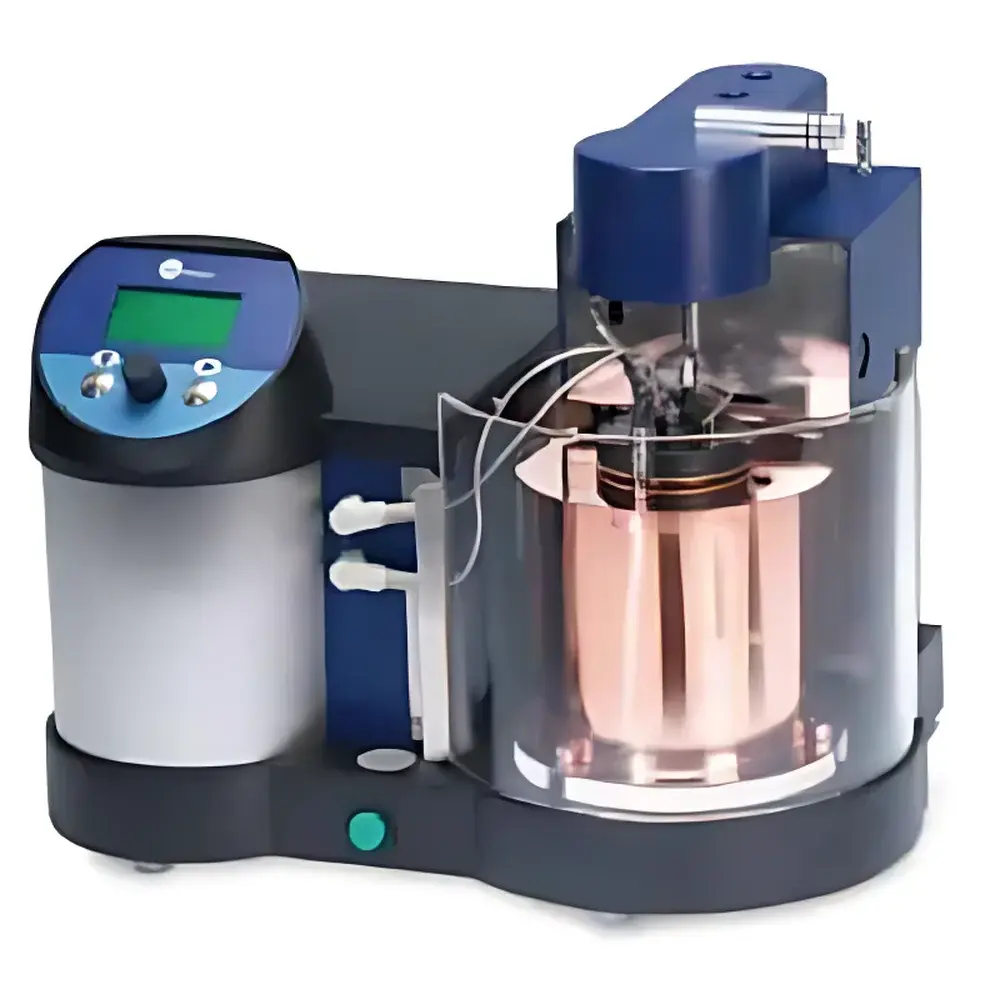
SETA 34200-0 Automated Multi-Method Abel Closed-Cup Flash Point Tester
| Brand | SETA |
|---|---|
| Origin | United Kingdom |
| Model | 34200-0 |
| Test Method | Abel Equilibrium Cup Method |
| Temperature Range | Ambient to 93°C |
| Heating System | Electric heating plate |
| Cooling Options | Fan-cooled (45 min) or optional recirculating liquid cooling (3 min) |
| Ignition Sources | Selectable electronic or gas ignition |
| Temperature Sensor | Platinum resistance thermometer (Pt100) |
| Flash Detection | Ionization ring |
| Stirring Speed | 30 rpm |
| Power Supply | 110/120 V or 220/240 V, 50/60 Hz |
| Power Consumption | 600 W |
| Dimensions | 47 × 45 × 34 cm |
| Weight | 13 kg |
| Atmospheric Pressure Correction | Automatic |
| Compliance Standards | IP 170, IP 304 (obs) Part 2, IP 492, BS 2000-170, BS 3900-A8/A9, BS 6664-1&2, EN ISO 13736, ISO 1523 |
Overview
The SETA 34200-0 Automated Multi-Method Abel Closed-Cup Flash Point Tester is a precision-engineered instrument designed for reliable, repeatable flash point determination of petroleum products, solvents, and other flammable liquids using the standardized Abel equilibrium cup method. Based on the modular SETA MULTIFLASH platform, this unit integrates the Abel-specific test module onto a universal base unit—enabling rapid reconfiguration for alternative methods including Pensky-Martens, Tag, Cleveland Open Cup, and Small-Scale Equilibrium techniques. The instrument operates on the fundamental principle that flash point is the lowest temperature at which vapors above a sample ignite momentarily when exposed to an ignition source under controlled closed-cup conditions. Its design adheres strictly to internationally recognized test protocols, ensuring regulatory alignment with statutory safety and quality assurance frameworks across refining, petrochemical, transportation, and laboratory accreditation environments.
Key Features
- Modular architecture allows seamless interchange of test modules without hardware modification or recalibration—reducing downtime and maximizing lab flexibility.
- Full automation of heating ramp control, ignition timing, vapor detection, and endpoint recognition eliminates operator variability and enhances inter-laboratory reproducibility.
- Dual ignition options: user-selectable electronic spark or gas flame ignition—supporting method-specific requirements and operational preferences.
- Pt100 platinum resistance thermometer ensures high-accuracy temperature measurement across the full operating range (ambient to 93°C), traceable to national standards.
- Ionization ring detection system provides rapid, unambiguous flash confirmation by monitoring transient current changes in the vapor space—minimizing false positives and improving detection sensitivity.
- Integrated atmospheric pressure sensor enables real-time correction of flash point values per ASTM D93 and ISO 1523 algorithms—critical for labs operating at non-standard elevations.
- Robust safety features include automatic shut-off upon flash detection, sealed vapor containment, and fail-safe ignition sequencing compliant with IEC 61010-1.
- Electric heating plate delivers uniform thermal distribution; optional recirculating liquid cooling reduces cycle time from 45 minutes (fan-only) to under 3 minutes—increasing throughput in high-volume QC settings.
Sample Compatibility & Compliance
The SETA 34200-0 is validated for use with transparent and opaque petroleum distillates, lubricating oils, biodiesel blends, paint solvents, and industrial cleaning agents. It supports sample volumes of 5–7 mL per test and accommodates viscosity ranges up to 100 mm²/s at 40°C without preheating. All operational parameters—including heating rate, stir speed (30 rpm), dwell time, and ignition frequency—are programmable to match exact clause requirements of referenced standards. The instrument meets essential conformity criteria for ISO/IEC 17025-accredited laboratories and supports audit-ready documentation for GLP and GMP environments. Its firmware and calibration routines are structured to facilitate FDA 21 CFR Part 11 compliance when deployed with validated LIMS integration.
Software & Data Management
The embedded control interface provides intuitive touchscreen navigation, multi-language support (English, German, French, Spanish), and password-protected method configuration. Up to five recent test results—including raw temperature/time profiles, corrected flash point, atmospheric pressure, and pass/fail status—are stored locally with timestamp and operator ID. Data export is supported via USB drive in CSV format for traceability and statistical process control (SPC) analysis. Optional PC connectivity enables remote monitoring, centralized data archiving, and integration with enterprise QA systems. Audit trail functionality records all parameter changes, calibration events, and result modifications—meeting ALCOA+ principles for data integrity.
Applications
- Quality control of gasoline, diesel, kerosene, and jet fuels in refinery off-gas and blending operations.
- Regulatory compliance testing for transport classification (UN TDG, ADR/RID, IMDG Code) and SDS preparation (GHS Category 2/3 flammables).
- Stability assessment of biofuels and synthetic hydrocarbons during oxidation aging studies.
- Batch release testing of solvent-based coatings, adhesives, and cleaning formulations per ISO 3679 and ISO 3678.
- Research applications involving low-volatility base oils, transformer fluids, and hydraulic fluids requiring precise closed-cup characterization.
FAQ
What standards does the SETA 34200-0 specifically support for Abel method testing?
It complies fully with IP 170, IP 304 (obs) Part 2, IP 492, BS 2000-170, BS 3900-A8/A9, BS 6664-1&2, EN ISO 13736, and ISO 1523.
Can the instrument be upgraded to support other flash point methods?
Yes—the MULTIFLASH base unit accepts certified modules for Pensky-Martens, Tag, Cleveland, and Small-Scale Equilibrium testing without replacement of core electronics or software.
Is atmospheric pressure correction performed automatically during testing?
Yes—integrated barometric sensing applies real-time correction using the standard Clausius–Clapeyron-derived algorithm specified in ISO 1523 and ASTM D93 Annex A1.
What safety certifications apply to the instrument’s electrical and mechanical design?
It conforms to IEC 61010-1 (Safety Requirements for Electrical Equipment for Measurement, Control, and Laboratory Use) and carries CE marking for EMC and Low Voltage Directive compliance.
How is calibration verified and maintained?
Calibration is performed using NIST-traceable reference standards (e.g., n-decane, n-dodecane); built-in diagnostics validate temperature sensor linearity, ignition energy, and ionization response prior to each test sequence.






