
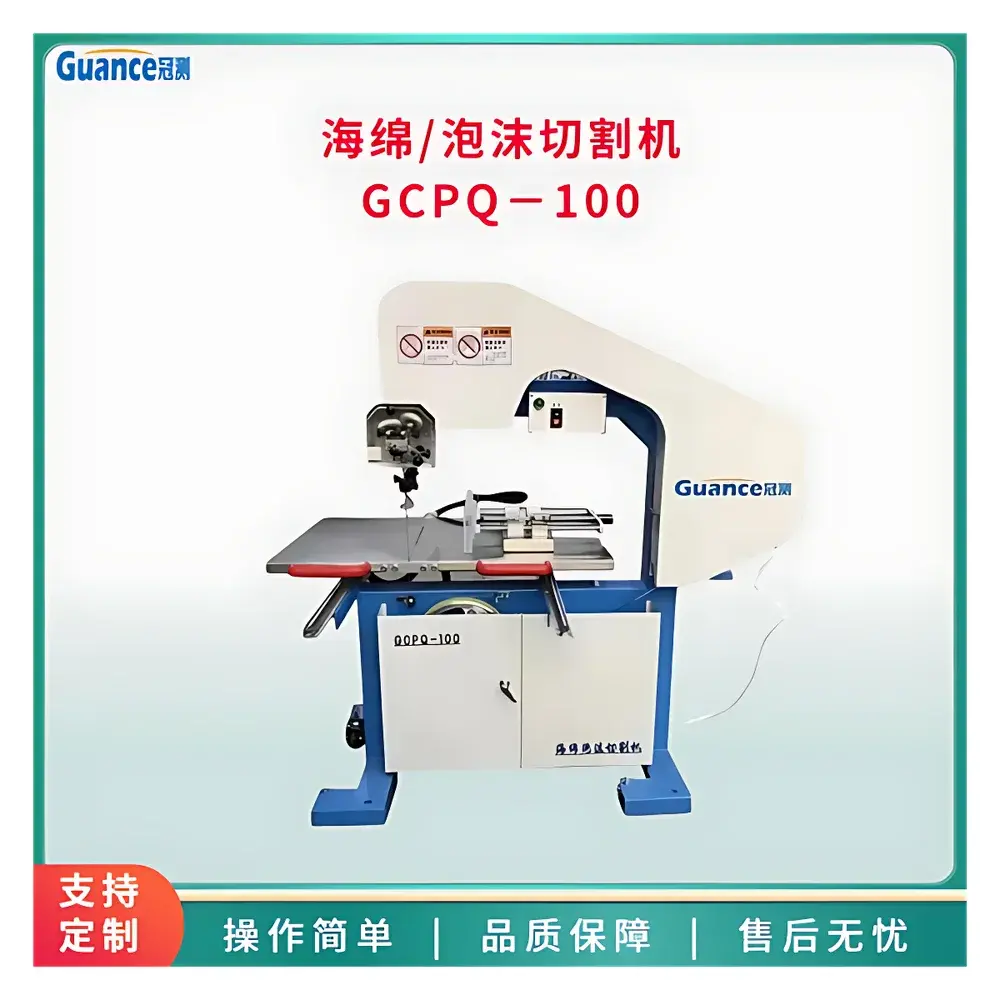
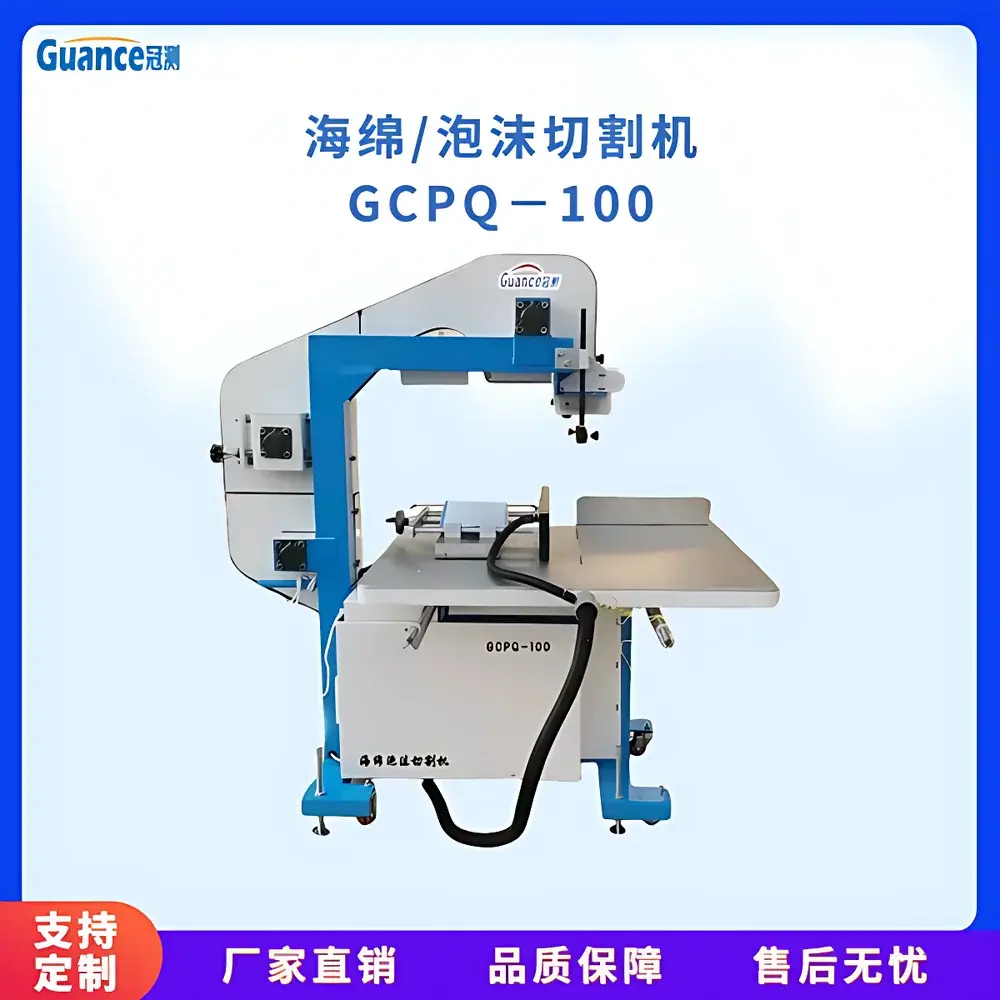
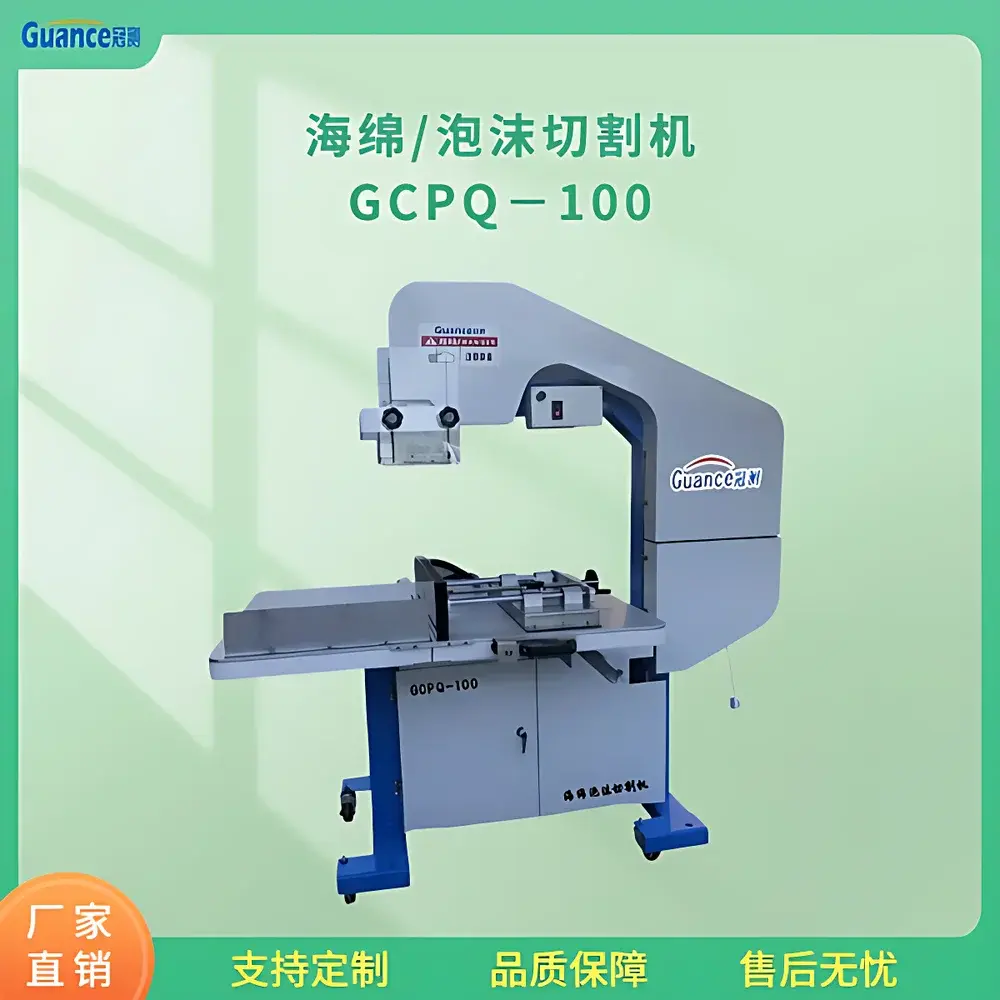
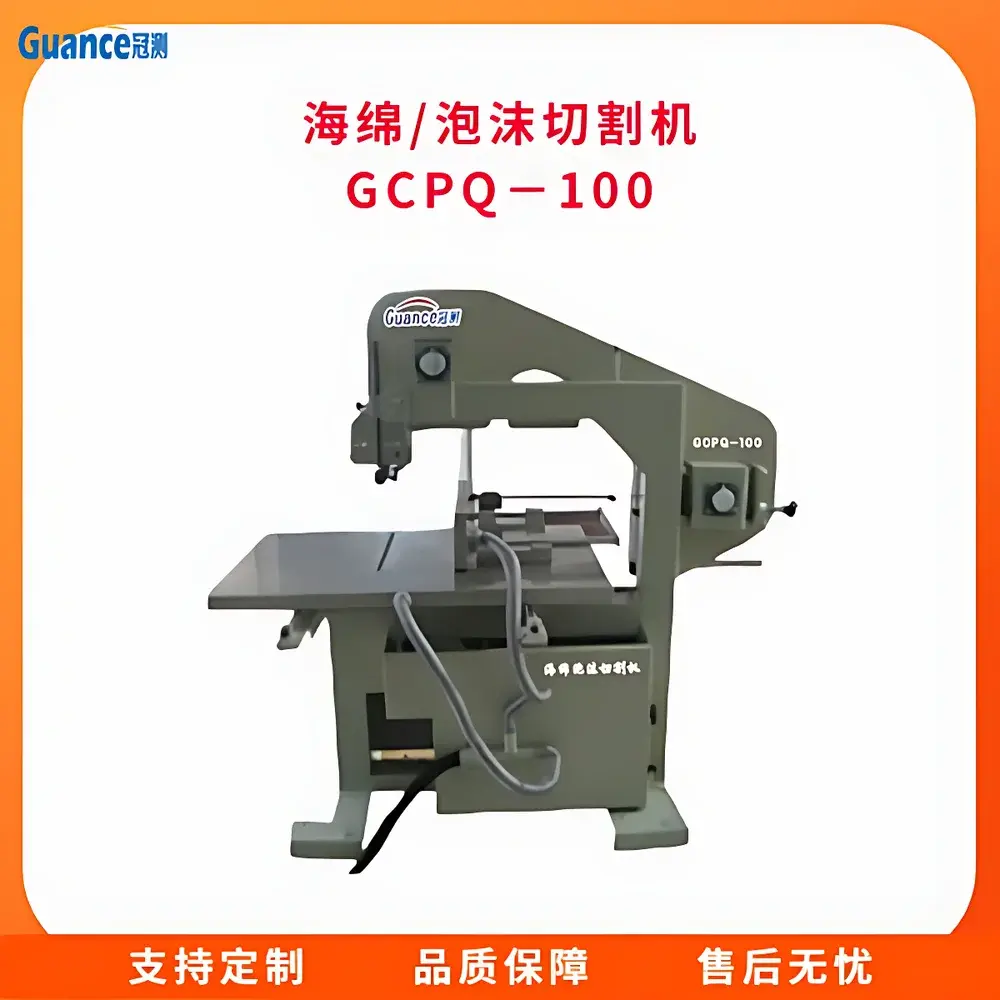
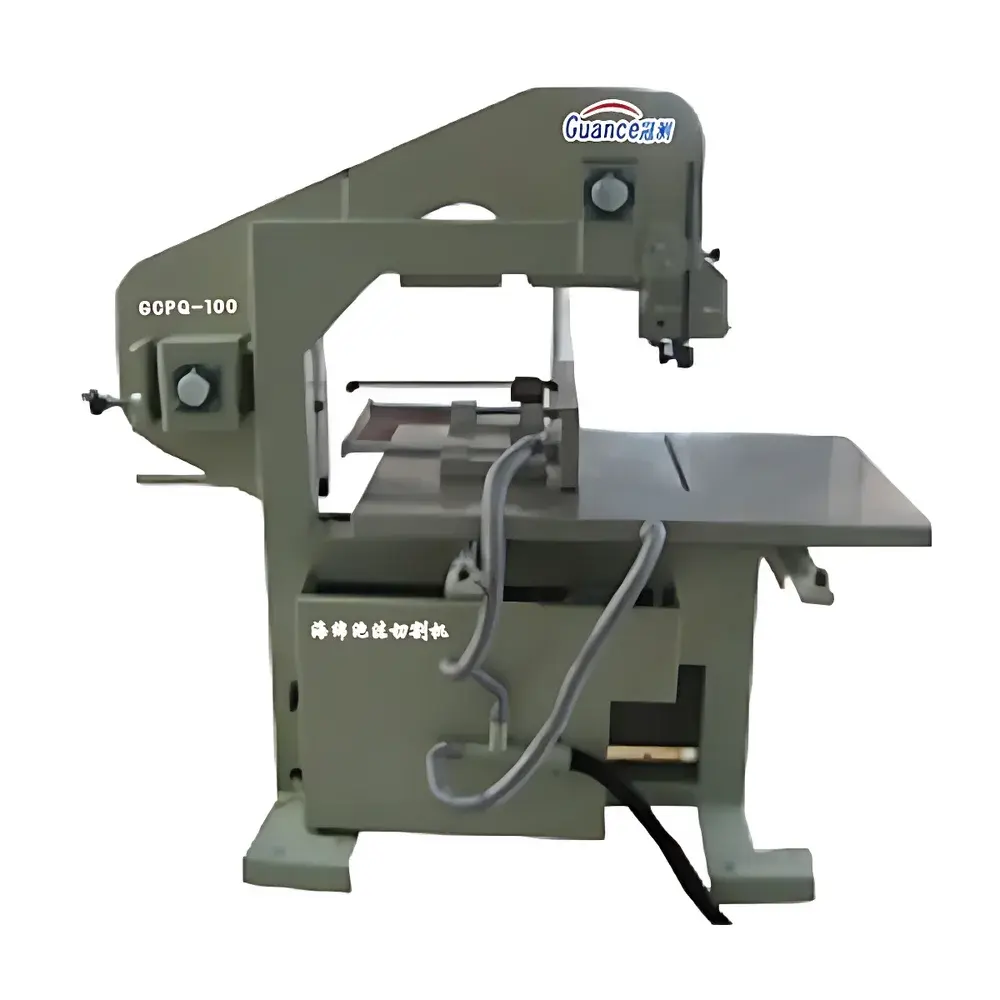
GuanCe GCPQ-100 Precision Foam & Sponge Cutting Machine
| Brand | GuanCe Instruments |
|---|---|
| Origin | Beijing, China |
| Manufacturer Type | Authorized Distributor |
| Country of Origin | China |
| Model | GCPQ-100 |
| Instrument Type | Precision Cutting Machine |
| Digital Caliper Resolution | 0.01 mm |
| Cutting Accuracy | ±1 mm (material-dependent) |
| Worktable Dimensions | 1000 × 700 mm (customizable) |
| Worktable Material | Anodized Aluminum |
| Guard Material | Acrylic |
| Effective Travel Stroke | 500 mm |
| Maximum Cutting Cross-section | 25 × 25 × 10 mm |
| Maximum Electric Cutting Thickness | 400 mm |
| Vacuum Dust Extraction Voltage | 220 V / 50 Hz |
| Rated Power | 1 kW |
| Blade Belt Circumference | 3920 mm |
Overview
The GuanCe GCPQ-100 Precision Foam & Sponge Cutting Machine is an engineered solution for reproducible, dimensionally accurate sectioning of low-density polymeric cellular materials—including flexible and rigid polyurethane foams, ethylene-vinyl acetate (EVA), expanded polystyrene (EPS), polyethylene (PE) foam, and sponge rubber—within laboratory, quality control, and R&D environments. Unlike abrasive or thermal cutting methods that induce melting, compression deformation, or edge charring, the GCPQ-100 employs a continuous-loop heated wire blade system operating under controlled tension and linear motion. This principle—based on resistive thermal softening followed by clean mechanical separation—ensures minimal thermal distortion and high surface fidelity in cut specimens. The machine’s core architecture integrates a precision-ground anodized aluminum worktable with vacuum-assisted fixation, enabling stable positioning of compliant substrates during translation. Its design conforms to fundamental metrological requirements for sample preparation in physical testing standards such as ASTM D3574 (flexible cellular materials), ISO 1856 (foam compression behavior), and GB/T 6342 (cellular plastics dimensional measurement), where specimen geometry directly influences test validity.
Key Features
- High-flatness anodized aluminum worktable (1000 × 700 mm standard; customizable) with integrated vacuum suction ports for secure, non-mechanical fixation of low-modulus foam specimens
- Digitally calibrated linear scale with 0.01 mm resolution, enabling real-time positional feedback during manual or jog-mode operation
- Adjustable acrylic safety guards and multi-stage physical barriers to minimize operator exposure during active cutting cycles
- Heated wire blade system with constant-tension drive mechanism and replaceable tungsten-alloy filament, optimized for consistent thermal penetration across variable foam densities
- On-machine blade sharpening capability—no disassembly required—maintaining cutting edge geometry without recalibration
- Low-noise operation achieved via elastomeric vibration dampers at all rotating contact points and noise-absorbing blade support rollers
- Jog-mode control interface allowing precise incremental movement (±0.1 mm steps) for iterative alignment prior to full-stroke cuts
- Integrated 1 kW dust extraction module (220 V / 50 Hz) compliant with IEC 60335-1 general safety requirements for electrical appliances
Sample Compatibility & Compliance
The GCPQ-100 accommodates specimens ranging from soft, open-cell memory foams (density: 15–30 kg/m³) to semi-rigid closed-cell elastomeric sponges (density: 80–120 kg/m³). It supports standardized specimen geometries required by international test protocols—including cubes (25 × 25 × 25 mm), rectangular prisms (e.g., 100 × 100 × 25 mm per ASTM D3574), and thin sheets (minimum thickness: 10 mm; maximum thickness: 400 mm). All structural components meet RoHS Directive 2011/65/EU restrictions on hazardous substances. The vacuum holding system complies with ISO 14155:2020 Annex C guidelines for non-invasive sample immobilization in preclinical material characterization workflows. While not certified to GLP or FDA 21 CFR Part 11, the device supports traceable sample preparation when used with external documentation systems and calibrated digital calipers.
Software & Data Management
The GCPQ-100 operates as a manually guided, analog-controlled instrument with no embedded firmware or proprietary software. All dimensional inputs are entered via tactile jog controls and verified using the integrated digital caliper display. Users are expected to record cut parameters—including specimen ID, material batch, target dimensions, and observed deviation—externally in LIMS-compatible spreadsheets or electronic lab notebooks (ELNs). For laboratories requiring audit trails, integration with third-party calibration management platforms (e.g., LabWare LIMS or Thermo Fisher SampleManager) is supported through manual entry of calibration certificates for the digital scale (traceable to national metrology institutes) and periodic verification reports for vacuum pressure stability.
Applications
- Preparation of compression test specimens per ASTM D3574 Method A (Indentation Force Deflection) and ISO 1856 Clause 6.2
- Cutting of tensile test bars (Type I or IV per ASTM D638) from molded foam billets
- Sectioning of acoustic absorption samples for impedance tube testing (ASTM E1050)
- Dimensional standardization of cushioning materials prior to drop-test evaluation (ISTA 3A, ASTM D4169)
- R&D prototyping of ergonomic foam inserts for medical devices, conforming to ISO 13485-compliant design history files
- Quality assurance sampling in foam manufacturing facilities adhering to IATF 16949 clause 8.5.1.2 (control of production equipment)
FAQ
What types of foam materials are compatible with the GCPQ-100?
The machine is validated for polyurethane (PU), polyethylene (PE), ethylene-vinyl acetate (EVA), polystyrene (PS), and natural rubber sponge—both open- and closed-cell variants—with densities between 15 kg/m³ and 120 kg/m³.
Is the cutting accuracy of ±1 mm guaranteed across all materials?
Accuracy is material-dependent: rigid foams (≥80 kg/m³) typically achieve ±0.5 mm repeatability; softer grades (≤30 kg/m³) may exhibit up to ±1.0 mm deviation due to localized compression under blade load.
Can the worktable be customized beyond 1000 × 700 mm?
Yes—GuanCe Instruments offers extended table configurations up to 1500 × 900 mm upon request, subject to structural reinforcement and recalibration of the vacuum manifold distribution.
Does the device include validation documentation for ISO/IEC 17025 compliance?
No—the GCPQ-100 is supplied without factory-issued uncertainty budgets or metrological validation reports; users must perform in-house verification per ISO/IEC 17025 Clause 6.4.1 using traceable length standards.
How often should the heated wire blade be replaced?
Under typical lab usage (≤4 hours/day), blade replacement is recommended every 6–12 months depending on foam abrasiveness; visual inspection for filament thinning or inconsistent heating zones is the primary maintenance indicator.



