
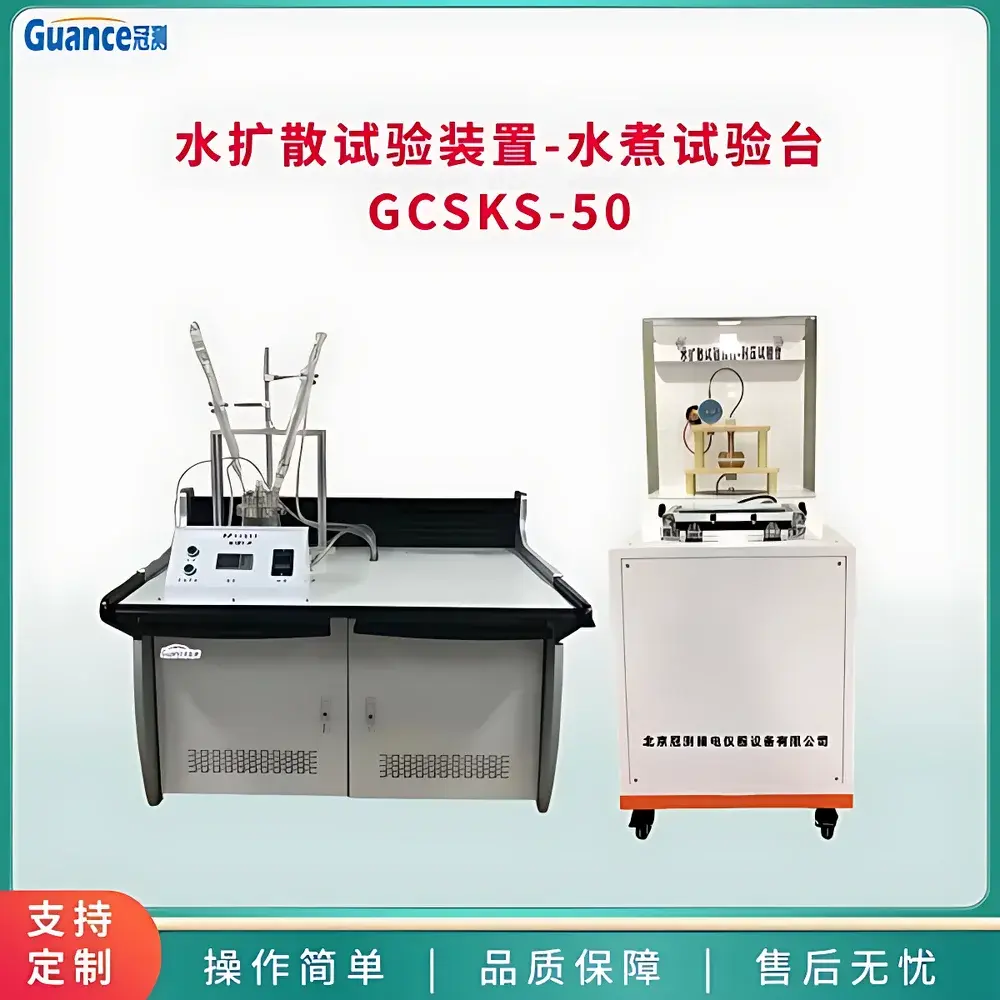
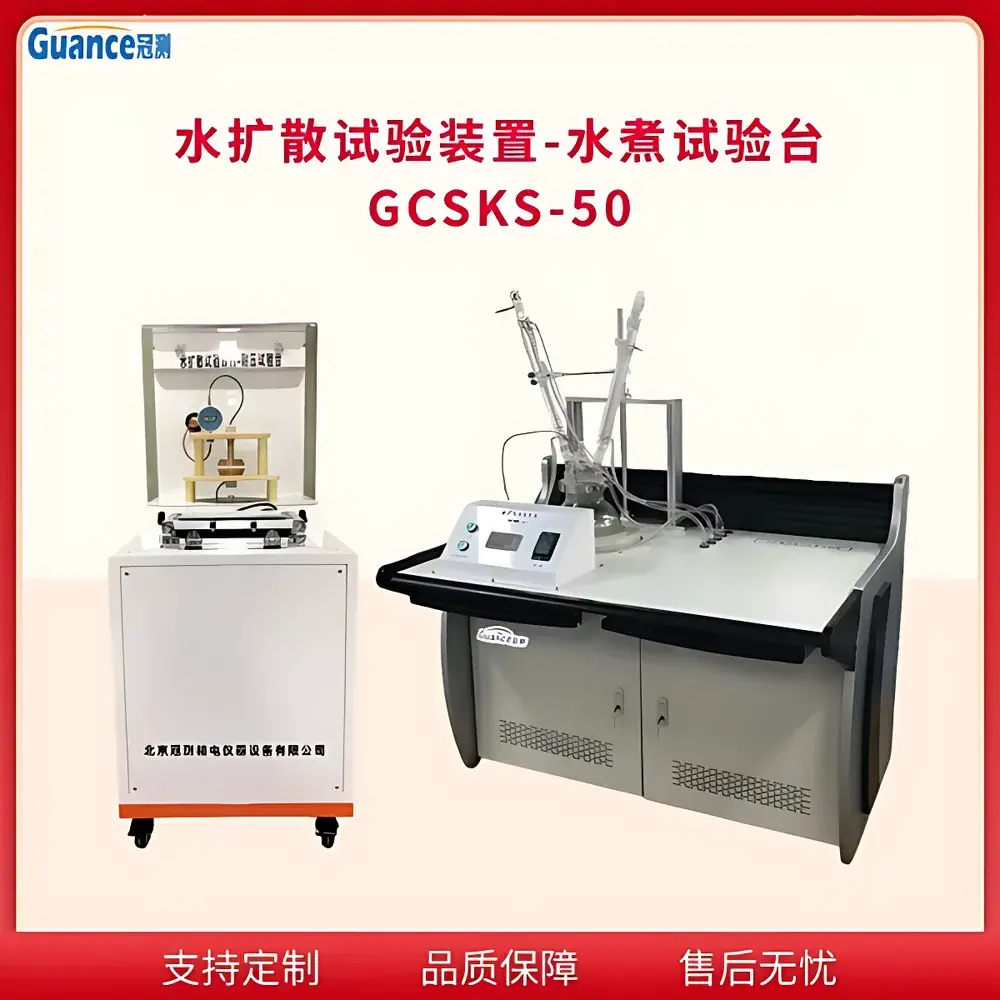
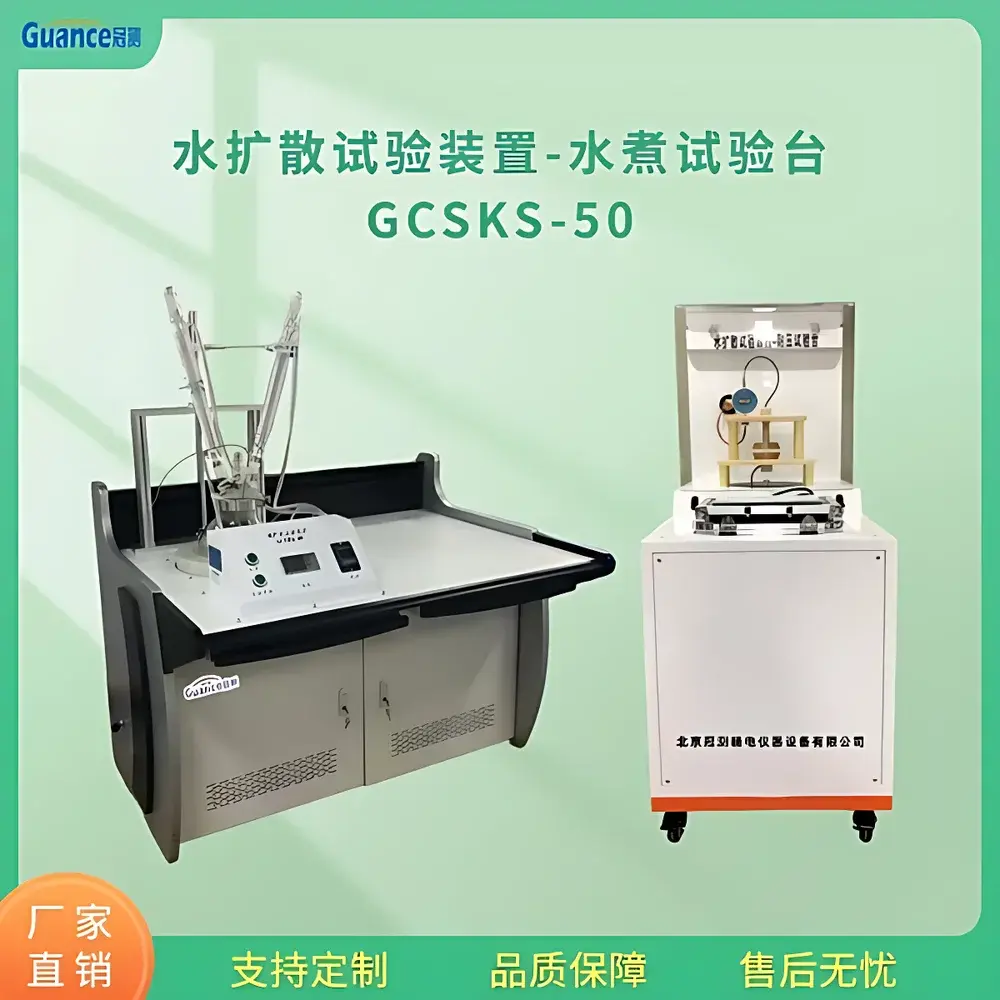
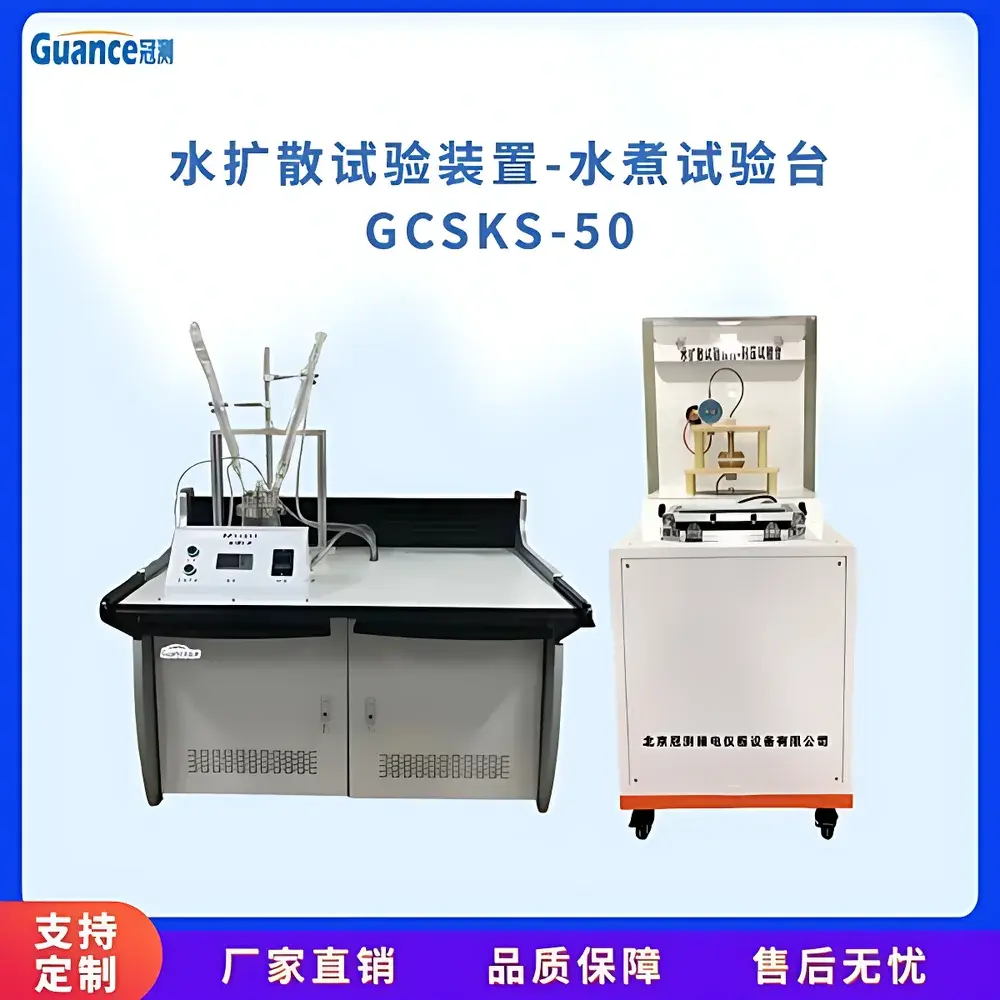
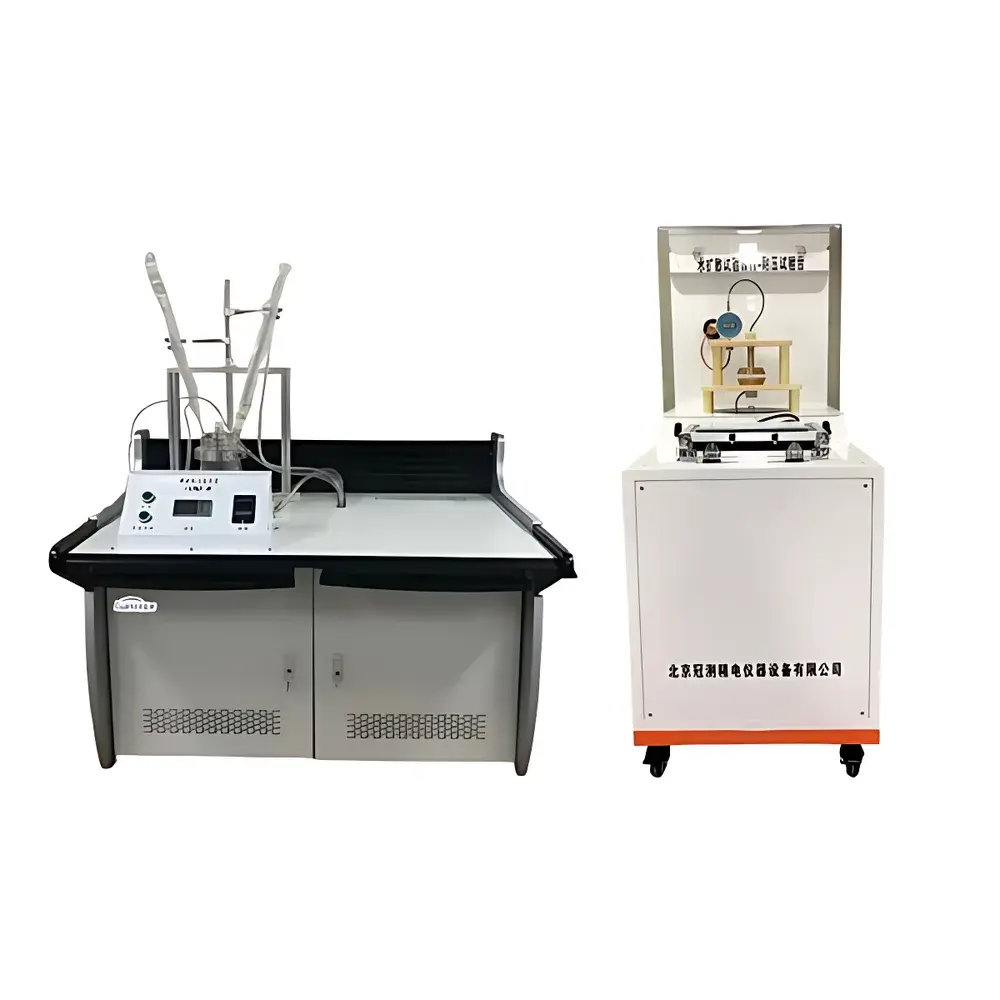
Guance GCSKS-50 Water Diffusion Test System for Composite Insulator Core Rods
| Brand | Guance |
|---|---|
| Model | GCSKS-50 |
| Origin | Beijing, China |
| Applicable Standards | GB/T 19519–2014, GB/T 22079–2008, GB/T 20142–2006 |
| Boiling Vessel Capacity | 5000 mL spherical reactor with 4-neck lid and 24/40 ground-glass joints |
| Condenser | 19# × 400 mm coiled reflux condenser |
| Cooling System | CW-3000 recirculating chiller |
| Temperature Control | Electric heating mantle with ±0.5 h accuracy over 100 h boiling duration |
| High-Voltage Source | 50 kV / 0.1 A AC transformer (50 Hz), integrated silicon stack for optional DC output |
| Leakage Current Measurement | 40–2000 µA range, Class 1 accuracy, digital microammeter (2 mA full scale) |
| Test Fixture | Movable electrode assembly with threaded brass electrodes, grounded measurement path via shunt resistor and isolated amplifier |
| Power Input | 220 V AC single-phase |
Overview
The Guance GCSKS-50 Water Diffusion Test System is a purpose-built laboratory apparatus engineered for evaluating the moisture resistance of fiberglass-reinforced polymer (FRP) core rods used in high-voltage composite insulators. It implements the standardized water diffusion test protocol defined in GB/T 19519–2014, GB/T 22079–2008, and GB/T 20142–2006—Chinese national standards aligned with IEC 61109 and IEC 62217 technical principles. The system executes a two-stage evaluation: first, prolonged boiling immersion of the core rod specimen under reflux conditions to accelerate water ingress along fiber-matrix interfaces; second, application of AC high voltage while monitoring surface leakage current to assess dielectric integrity after moisture saturation. This dual-phase methodology directly addresses the primary failure mechanism in polymeric insulators—electrochemical degradation initiated by interfacial water penetration under electrical stress.
Key Features
- Integrated reflux boiling station featuring a 5 L spherical glass reactor with four standard-taper ports (24/40), enabling simultaneous connection of condenser, thermometer, gas inlet (for nitrogen blanketing if required), and specimen suspension fixture.
- High-stability electric heating mantle with PID-controlled temperature regulation, calibrated to maintain sustained boiling at atmospheric pressure for precisely 100.0 ± 0.5 hours—meeting the strict timing tolerance mandated by GB/T 19519–2014 Clause 10.3.2.
- Dual-mode high-voltage source: 50 kV, 50 Hz AC transformer with built-in silicon rectifier stack; AC operation enabled by shorting the stack with provided copper rod, DC mode activated by removing the short—supporting both standard AC withstand and supplementary DC polarity tests per utility internal specifications.
- Leakage current measurement subsystem compliant with IEC 60270 partial discharge detection principles: low-noise shunt resistor + isolated signal conditioning + digital microammeter (0–2000 µA, Class 1 accuracy), with real-time display and manual hold function for peak reading during transient events.
- Modular mechanical frame with lockable casters, adjustable electrode height, and standardized brass electrodes (M12 threads) mounted on insulated ceramic supports—ensuring repeatable contact geometry and minimizing stray capacitance effects.
- Full-safety interlock architecture: door-mounted limit switch disables HV output when access panel is open; emergency stop button interrupts both heating and HV circuits; grounding stick included for safe discharge prior to specimen handling.
Sample Compatibility & Compliance
The GCSKS-50 accommodates cylindrical FRP core rods up to Ø35 mm × 400 mm in length, conforming to the dimensional limits specified in GB/T 19519–2014 Annex B. Specimens are suspended vertically within the boiling vessel using non-conductive PTFE hooks to prevent thermal short-circuiting or mechanical stress concentration. All wetted components—including reactor, condenser, and silicone tubing—are chemically inert to deionized water at 100 °C. The system satisfies functional requirements for Type Testing and Routine Quality Control per State Grid Corporation of China’s Grid Material Testing Guidelines (2017 Edition), Chapter 26 (Suspension Composite Insulator Core Rod Water Diffusion Test, Class B). While not certified to UL or CE directives, its operational parameters and safety design align with general principles of IEC 61010-1:2010 for electrical safety in laboratory equipment.
Software & Data Management
The GCSKS-50 operates as a manually supervised benchtop instrument without embedded firmware or PC connectivity. All operational parameters—including boiling duration, applied voltage level, and measured leakage current—are recorded manually in laboratory notebooks or LIMS-compatible spreadsheets. The analog front-end of the microammeter includes a 0–2 V DC output for optional external data logging via third-party DAQ systems (e.g., National Instruments USB-6009). For regulated environments operating under GLP or ISO/IEC 17025, users may implement audit-trail documentation protocols using timestamped operator logs and calibrated instrument calibration certificates (provided annually for the microammeter and timer modules).
Applications
- Qualification testing of FRP core rods supplied to transmission and distribution utilities in China and ASEAN markets requiring GB-compliant certification.
- R&D validation of new resin matrix formulations (e.g., vinyl ester vs. epoxy) for improved hydrolytic stability under thermal-electrical stress.
- Root cause analysis of field-failed insulators: comparative water diffusion performance between suspect and reference batches.
- Supplier qualification audits where evidence of process control over moisture barrier integrity is contractually mandated.
- Training platform for high-voltage laboratory technicians on standardized insulation material evaluation procedures per national grid specifications.
FAQ
What is the maximum specimen diameter supported by the boiling vessel?
The 5 L spherical reactor permits vertical suspension of core rods up to 35 mm in outer diameter, consistent with typical production dimensions for 110–500 kV class insulators.
Can the system perform DC voltage testing?
Yes—the integrated silicon rectifier stack allows conversion from AC to DC output; removal of the shorting rod enables full-wave rectified DC mode at rated 50 kV.
Is the microammeter calibrated traceable to national standards?
Each unit ships with a factory calibration certificate referencing CNAS-accredited metrology lab standards; annual recalibration is recommended per ISO/IEC 17025 clause 6.5.
Does the system include nitrogen purge capability?
While not pre-installed, the 4-neck reactor lid provides one dedicated port for inert gas inlet; users may integrate external N₂ supply with flow regulator and bubble counter.
What safety certifications does the equipment carry?
The GCSKS-50 complies with GB 4793.1–2007 (equivalent to IEC 61010-1:2010) for laboratory electrical safety; CE marking is not applied as it is designed exclusively for domestic Chinese grid compliance testing.



