
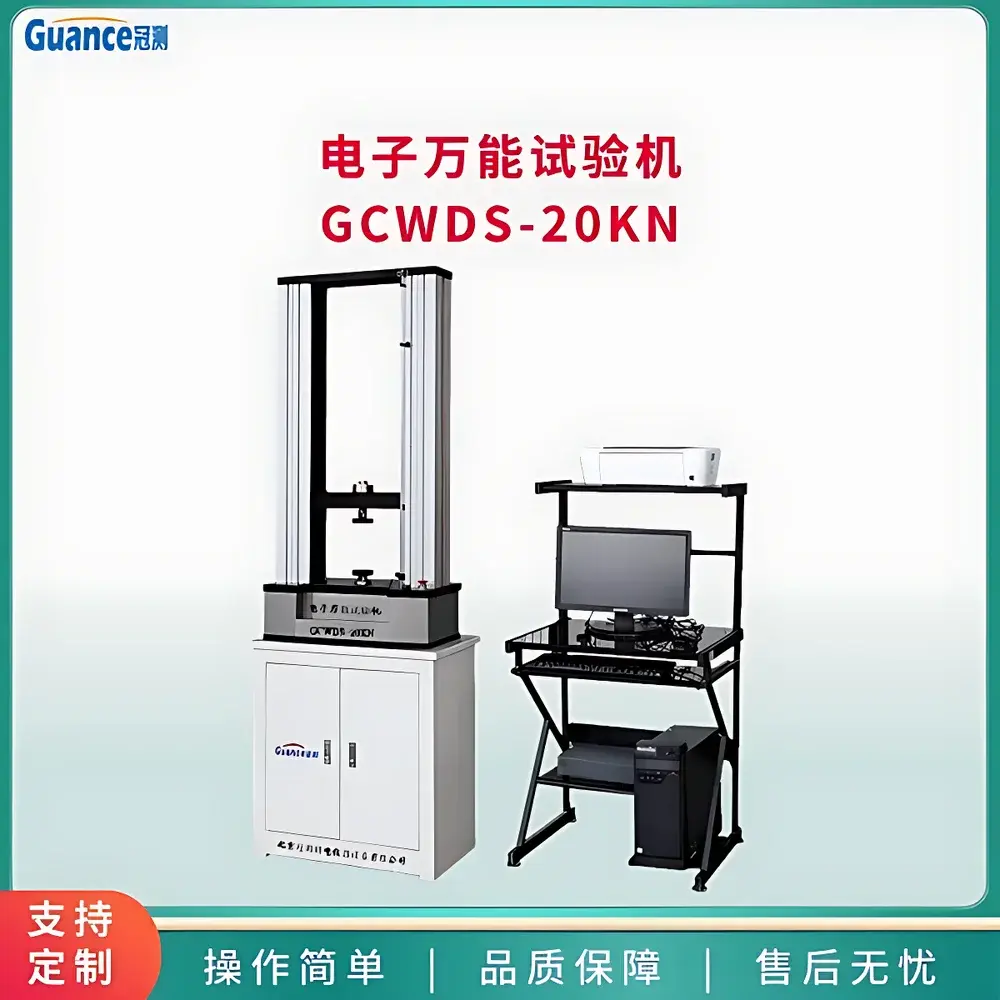
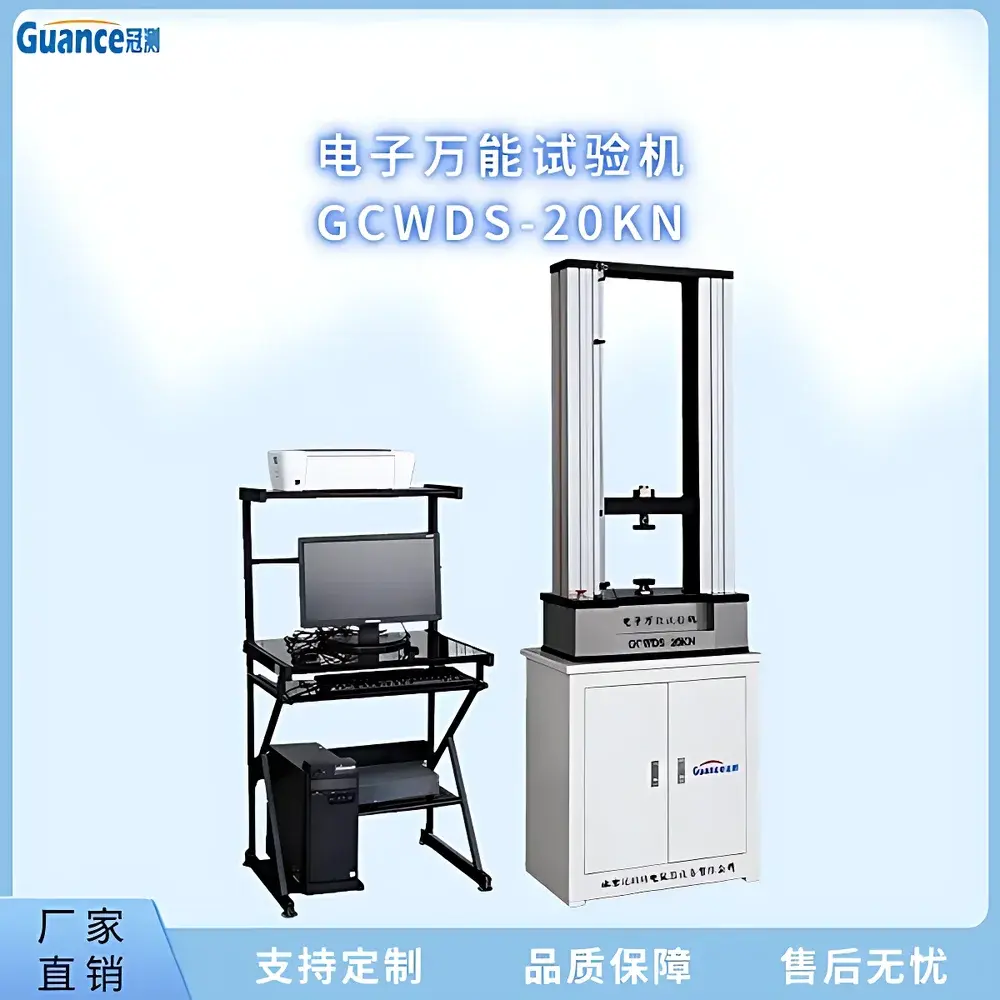
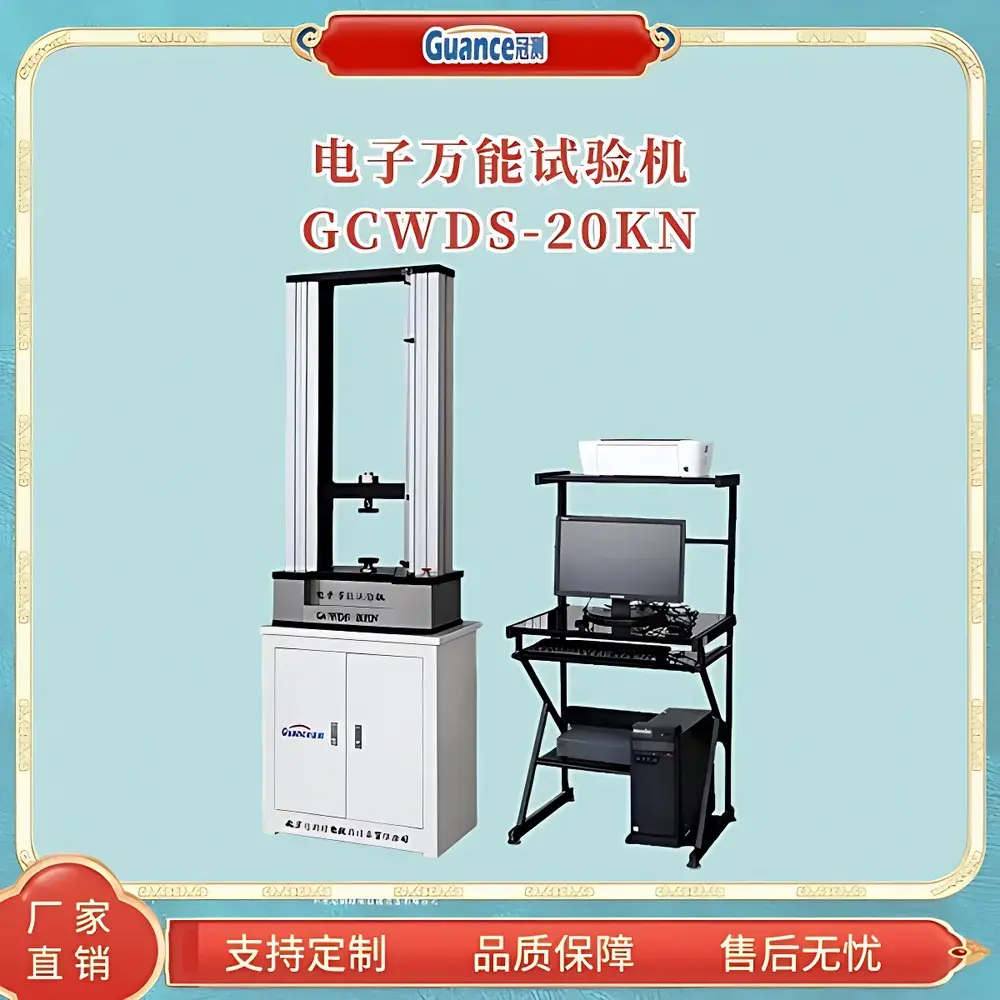
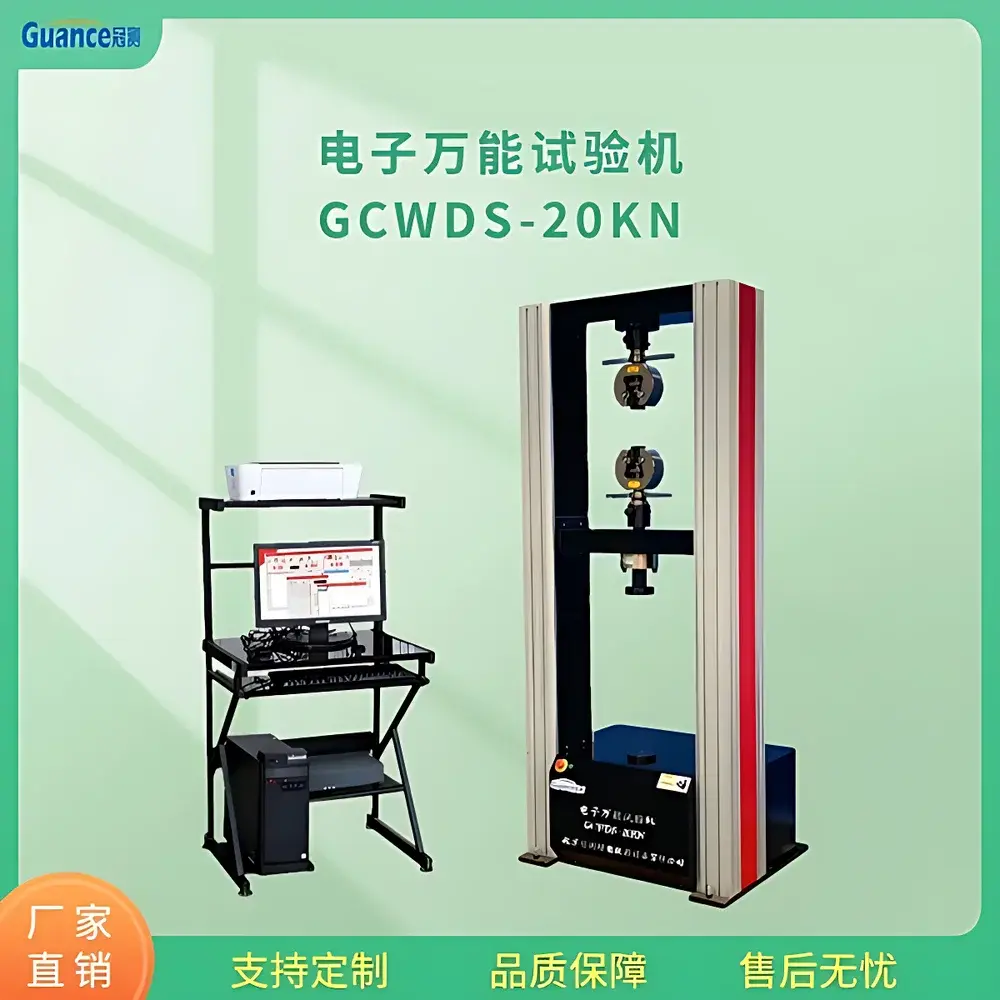
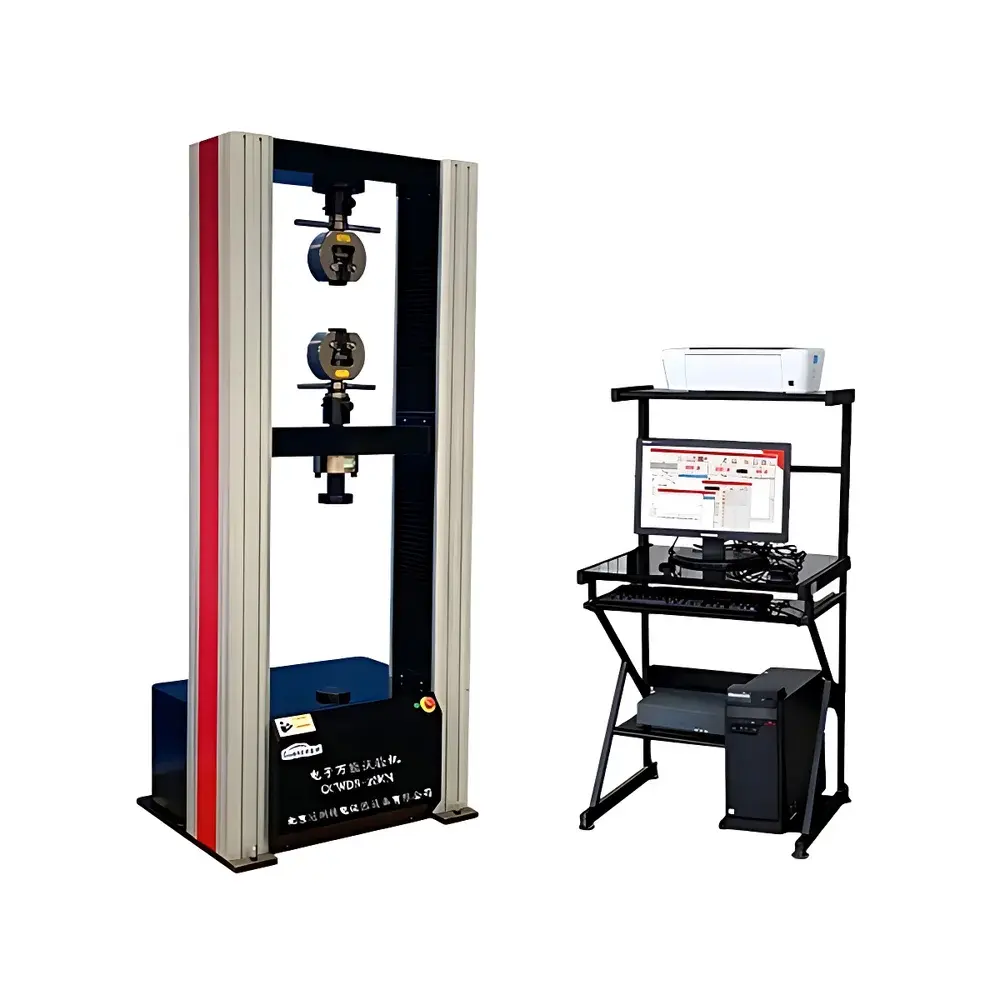
GuanCe GCWDS-20KN Microcomputer-Controlled Electromechanical Universal Testing Machine
| Brand | GuanCe Instruments |
|---|---|
| Origin | Beijing, China |
| Manufacturer Type | Authorized Distributor |
| Regional Classification | Domestic (PRC) |
| Model | GCWDS-20KN |
| Instrument Type | Electromechanical Universal Testing Machine |
| Max. Test Load | 20 kN |
| Accuracy Class | 0.5 |
| Force Measurement Range | 0.2–100% F.S. |
| Force Resolution | 1/300,000 full scale (fixed, unsegmented) |
| Crosshead Speed Range | 0.1–500 mm/min |
| Tensile/Compressive Stroke | 750 mm |
| Test Width | 400 mm |
| Power Supply | AC 220 V, 50 Hz |
| Rated Power | 0.75 kW |
| Operating Environment | 10–40 °C, 20–80% RH |
| Dimensions (W×D×H) | ~600 × 650 × 1800 mm |
| Weight | ~320 kg |
Overview
The GuanCe GCWDS-20KN is a microcomputer-controlled electromechanical universal testing machine engineered for high-fidelity mechanical property characterization of metallic and non-metallic materials under static tensile, compressive, bending, and shear loading conditions. It operates on the principle of closed-loop servo control: an AC servo motor—driven via a precision planetary gear reducer—actuates a preloaded, backlash-free ball screw assembly to move the crosshead with nanometer-level positional repeatability. Force is measured using a calibrated S-type load cell (manufactured by Transducer Techniques, USA), while axial displacement is captured via an optical encoder coupled to the screw shaft. The system complies with ISO 7500-1:2018 (static calibration of force-proving instruments) and meets the metrological requirements specified in ASTM E4, ISO 5893, and GB/T 16491–2008 for class 0.5 universal testing machines. Its dual-space frame architecture (upper space for tension, lower space for compression/bending) ensures optimal alignment, minimal parasitic moments, and high structural rigidity (>1.2 × 10⁶ N/mm vertical stiffness), critical for accurate modulus and yield point determination.
Key Features
- Class 0.5 accuracy per ISO 7500-1 and GB/T 16491–2008, validated across the full 0.2–100% F.S. force range
- Fixed-resolution force measurement at 1/300,000 full scale—no auto-ranging hardware switches, eliminating step-change errors during dynamic transitions
- Continuous crosshead speed control from 0.1 to 500 mm/min with ≤±0.5% speed deviation under load, enabled by digital servo tuning and real-time PID feedback
- Dual-channel digital signal conditioning board with hardware-based zero stabilization, automatic gain calibration, and anti-aliasing filtering (1 kHz cutoff)
- Integrated safety architecture: mechanical limit switches, overload cut-off (110% F.S.), and rupture-triggered emergency stop with <10 ms response latency
- Windows 10–compatible software platform supporting audit trail logging, electronic signatures, and 21 CFR Part 11–compliant user access controls (optional configuration)
- Modular I/O interface supporting extensometer inputs (LVDT or strain gauge), environmental chamber triggers, and video extensometry synchronization
Sample Compatibility & Compliance
The GCWDS-20KN accommodates specimens up to 750 mm in active length and 400 mm in test width—suitable for standard coupons per ASTM E8/E21 (metals), ISO 527 (plastics), ASTM D638/D790 (polymers), and GB/T 228.1–2021 (metal tensile). It supports flat, round, and sheet geometries—including thin foils (≥0.1 mm thickness) and high-strength alloys (e.g., Ti-6Al-4V, 7075-T6 aluminum, duplex stainless steels). All test sequences adhere to traceable calibration protocols aligned with ISO/IEC 17025 requirements. Software-generated reports include metadata stamps (operator ID, calibration certificate ID, environmental logs) and support GLP/GMP documentation workflows. Compliance extends to DIN EN 10002-1, JIS Z 2241, and ASTM A370 for ferrous product qualification.
Software & Data Management
The embedded TestMaster v3.2 software suite runs natively on Windows 10 (64-bit) and implements a relational database backend (SQLite with WAL journaling) for ACID-compliant data persistence. Each test session generates a self-contained .tmd file containing raw time-stamped channels (load, displacement, extensometer strain), processed parameters (Rm, ReH, ReL, A50, E, n-value), and metadata (standard ID, specimen ID, operator signature, calibration expiry). Batch analysis tools enable statistical comparison across up to 999 specimens; curve overlay supports stress–strain, load–displacement, and creep compliance plotting with customizable axis scaling and derivative calculation (dσ/dε for strain hardening exponent). Export options include CSV, XML (ASTM E1434-compliant), PDF/A-2u, and direct integration with LIMS via ODBC drivers. Audit trails record all parameter modifications, report exports, and user logins with immutable timestamps.
Applications
This system serves as a primary mechanical characterization tool in quality control laboratories for incoming raw material verification (e.g., coil steel tensile certification per ASTM A6/A6M), R&D departments evaluating novel composites (carbon fiber laminates, metal matrix composites), and failure analysis units performing root-cause assessment of brittle fracture or ductile overload. Typical use cases include: determination of yield offset (Rp0.2) in precipitation-hardened aluminum alloys; evaluation of plastic strain ratio (r-value) in deep-drawing steel sheets; cyclic loading tests (low-cycle fatigue pre-characterization); and validation of adhesive bond strength per ASTM D1002. Its low-noise operation (<55 dB(A)) and compact footprint make it suitable for shared lab environments requiring ISO 17025 accreditation.
FAQ
What international standards does the GCWDS-20KN support out-of-the-box?
It includes preconfigured test templates for ASTM E8, ISO 6892-1, GB/T 228.1, JIS Z 2241, and DIN 50145—with automatic parameter derivation (e.g., uniform elongation Ag, total elongation At) and pass/fail flagging against tolerance bands.
Can the system interface with external extensometers?
Yes—via analog ±10 V or digital RS-422 inputs; compatible with clip-on, video, and laser extensometers meeting ASTM E83 Class B2 specifications.
Is firmware update capability available remotely?
Firmware updates are delivered via signed USB media only; no remote network access to motion control firmware is permitted for functional safety compliance (IEC 61508 SIL2).
Does the software support multi-user role-based permissions?
Yes—administrator, technician, and reviewer roles with configurable privileges over method editing, test execution, result approval, and archive deletion.
What is the recalibration interval recommendation?
Annual force calibration per ISO 7500-1 is recommended; displacement system verification every six months using certified gauge blocks per ISO 9513.



