
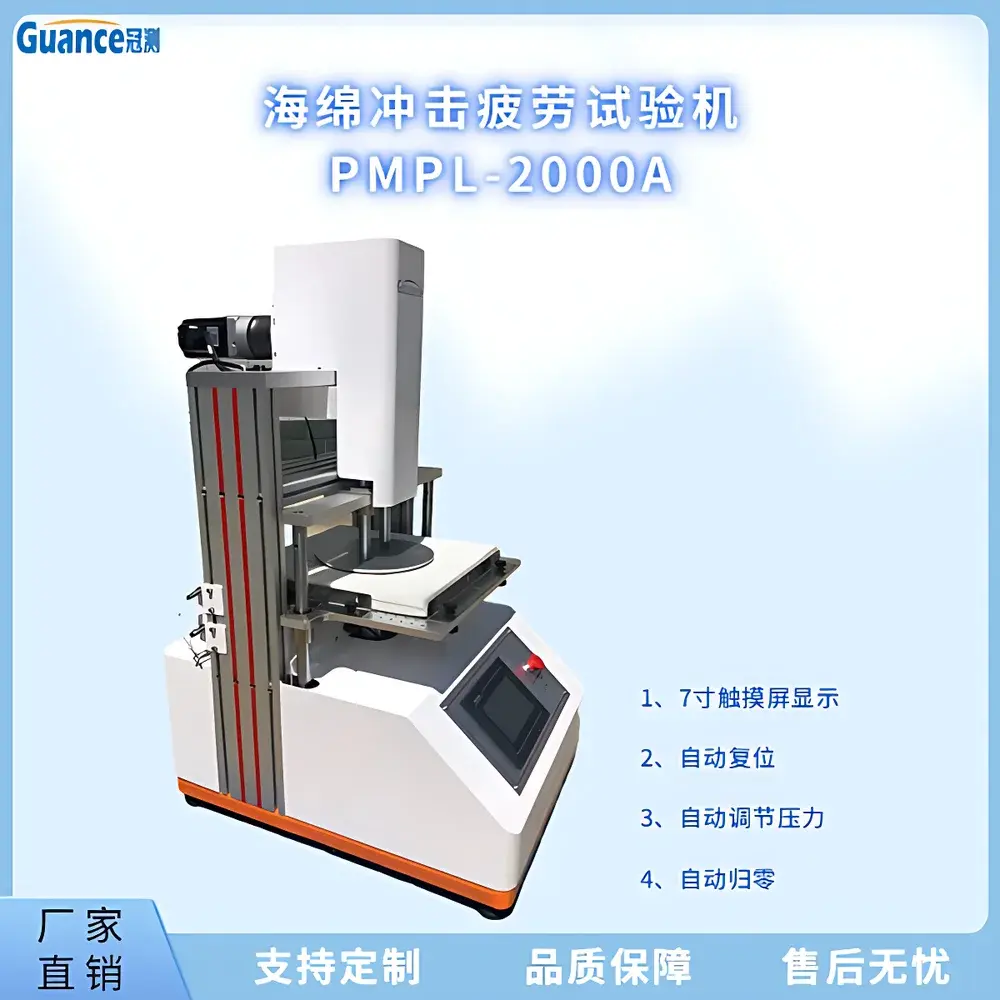
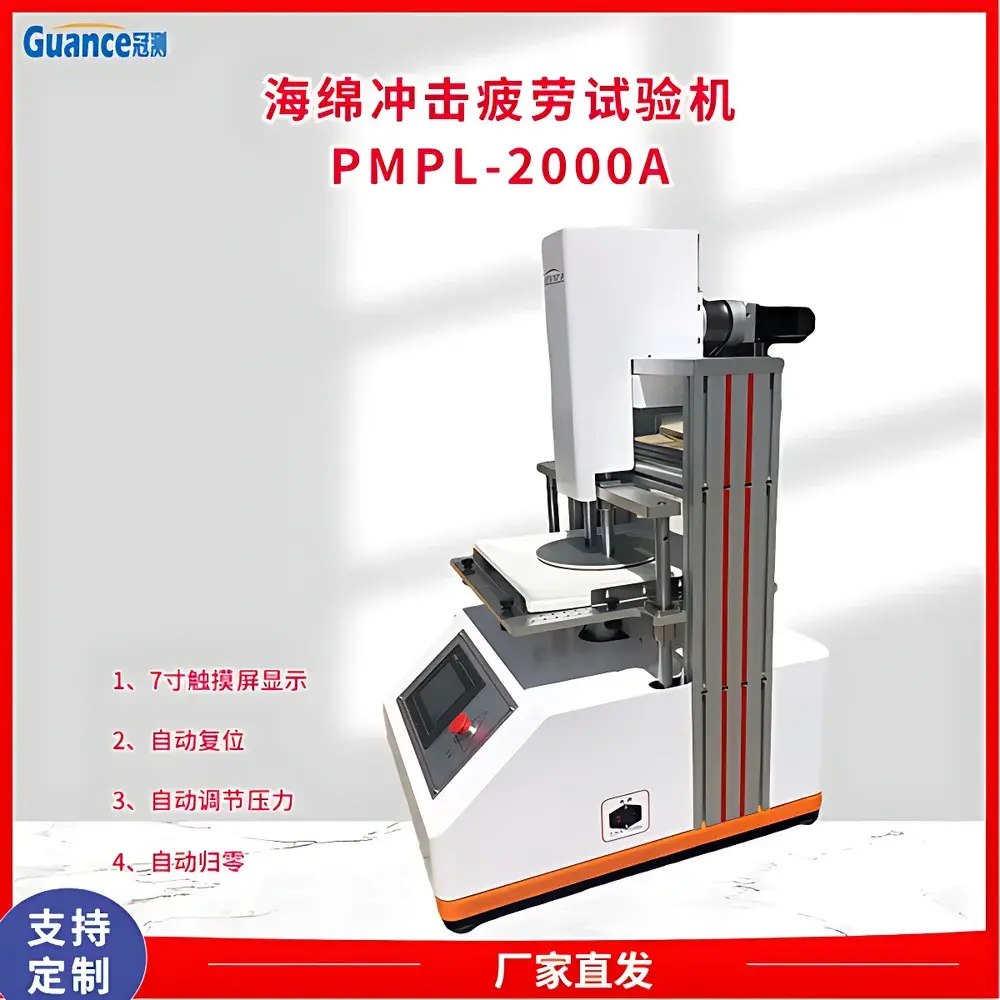
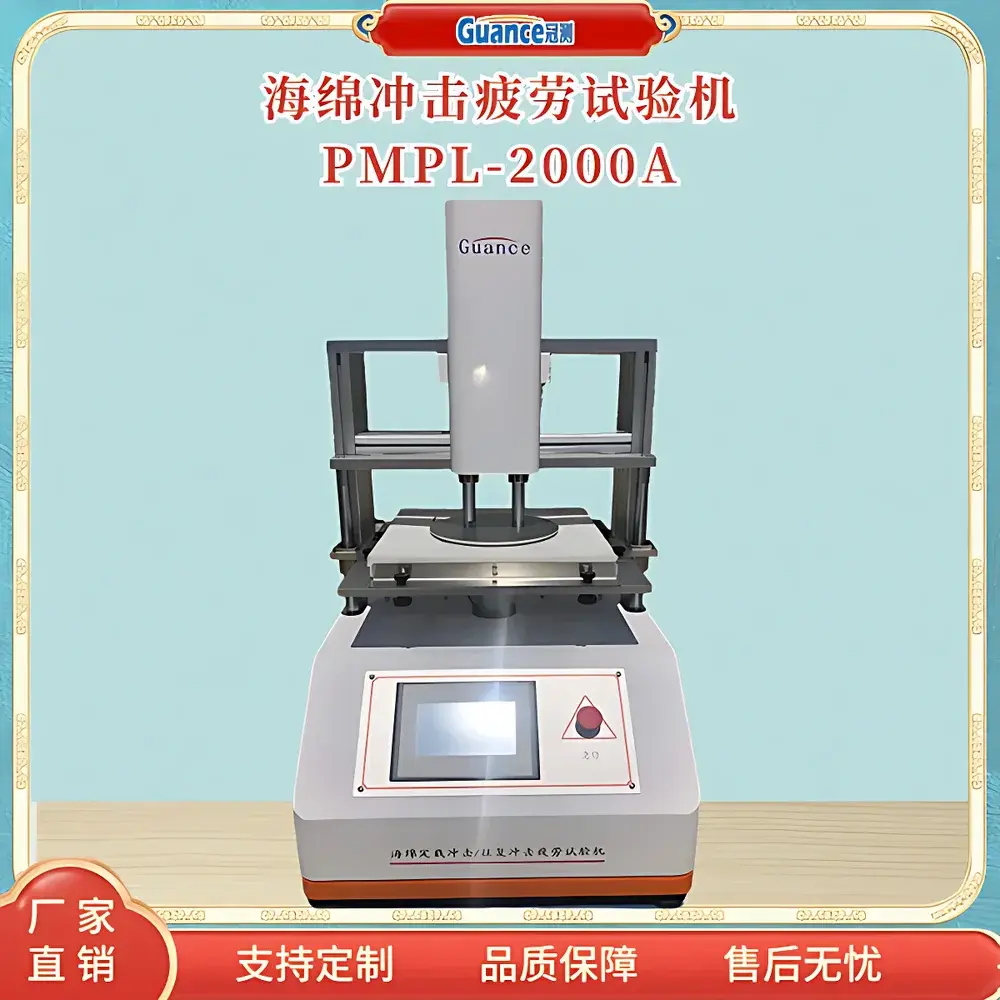
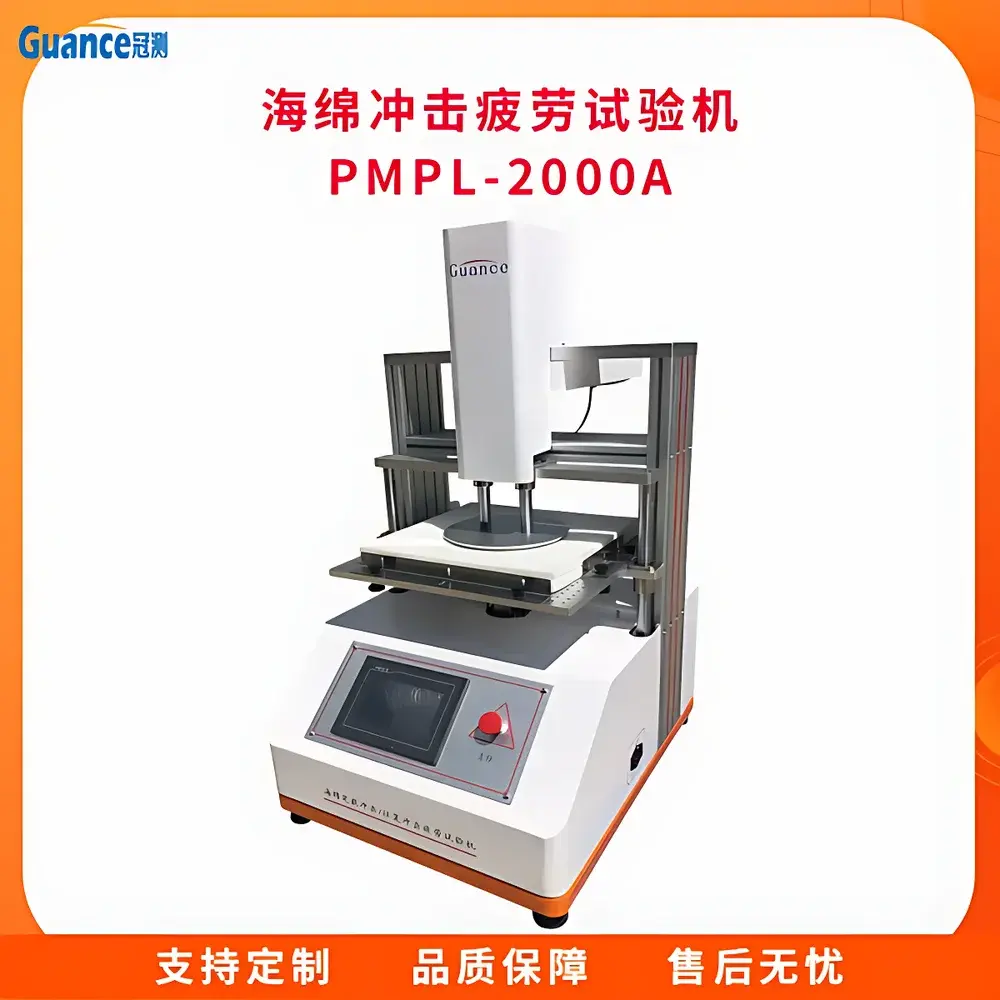
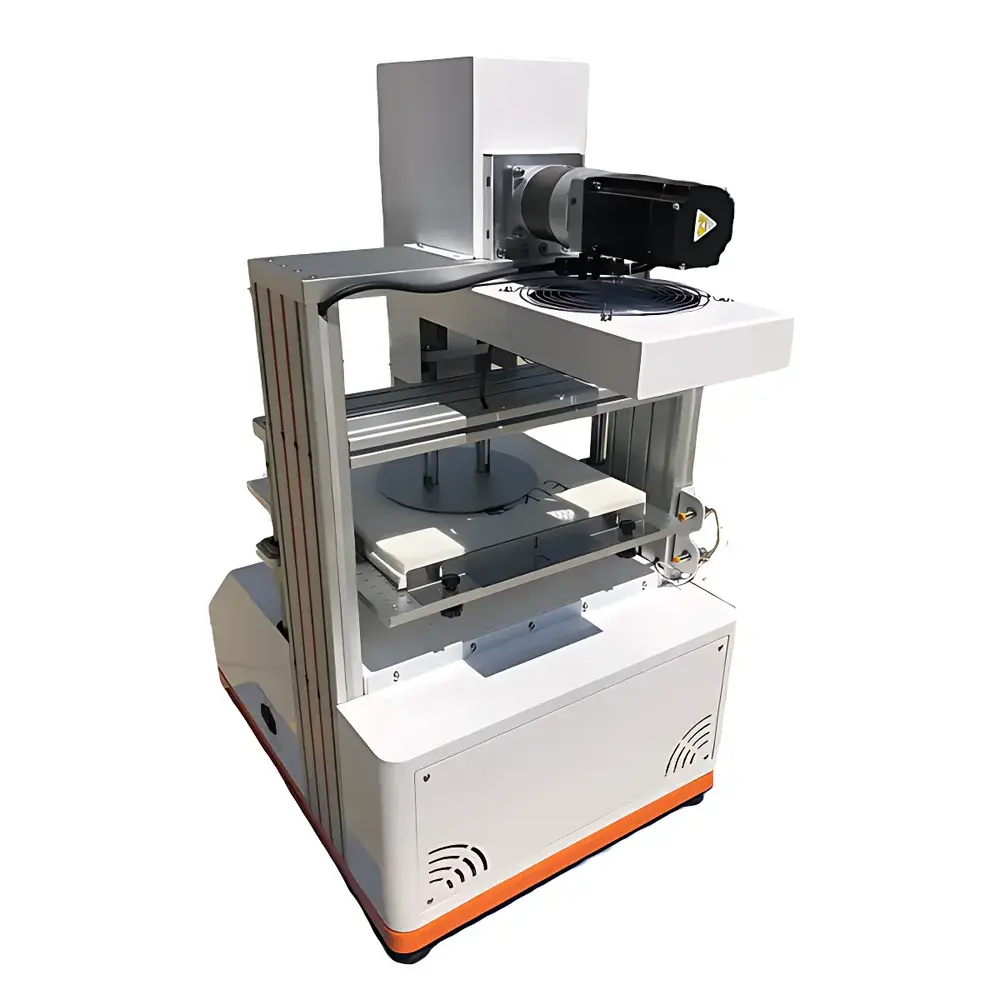
GuanCe PMPL-2000A Fully Automated Reciprocating Compression Fatigue Tester
| Key | Brand: GuanCe Instruments |
|---|---|
| Origin | Beijing, China |
| Model | PMPL-2000A |
| Max Test Force | 0–1000 N |
| Frequency Range | 10–100 cycles/min (Standard Compliance: 70 ± 5 cycles/min) |
| Stroke Control Accuracy | Closed-loop servo-regulated load maintenance |
| Platen Diameter | φ250 mm ± 1 mm (Edge Radius: R25 mm ± 1 mm) |
| Specimen Support Table | 500 mm × 500 mm × 10 mm (Perforated, 6.35 mm holes on 20 mm centers) |
| Specimen Dimensions | 500 mm × 500 mm × (50 ± 2) mm |
| Display | 7-inch color TFT touchscreen with real-time peak force logging |
| Drive System | Industrial servo motor with precision motion control |
| Test Modes | Constant-load mode or constant-thickness-compression-percentage mode |
| End-of-Test Action | Audible alarm + automatic platen return to home position |
| Power Supply | 220 V AC / 50 Hz |
| Dimensions (L×W×H) | 800 × 500 × 1200 mm |
| Weight | 100 kg |
Overview
The GuanCe PMPL-2000A Fully Automated Reciprocating Compression Fatigue Tester is an engineered solution for standardized dynamic fatigue evaluation of flexible polymeric foams—particularly polyurethane (PU), viscoelastic memory foam, and elastomeric cushioning materials used in automotive seating, furniture, bedding, and medical support surfaces. It operates on the principle of controlled, repetitive uniaxial compression under constant-force or constant-deformation conditions, simulating long-term mechanical stress exposure as defined in ISO 3385, GB/T 18941, QB/T 2819–2006, QC/T 56–93, and JASO B408–84. Unlike static compression set testers, the PMPL-2000A applies cyclic loading at precisely regulated frequencies and amplitudes, enabling quantification of time-dependent structural degradation—including residual thickness loss, hardness reduction (Shore C or IFD), and progressive hysteresis shift—critical for predicting service life and validating material formulation robustness.
Key Features
- Real-time closed-loop load regulation: Integrated Siemens PLC continuously monitors applied force via high-stability load cell and dynamically adjusts platen height using servo feedback—ensuring test force remains within ±2% of setpoint across >100,000 cycles, even as specimen creep or compression set evolves.
- Dual-mode test execution: Users select either constant-force mode (e.g., 500 N maintained throughout) or constant-thickness-compression-percentage mode (e.g., 40% thickness reduction held over repeated cycles), supporting both ISO 3385 and internal OEM durability protocols.
- Calibrated mechanical architecture: φ250 mm hardened steel platen with R25 mm edge radius ensures uniform stress distribution; perforated 500 mm × 500 mm support table (6.35 mm holes on 20 mm grid) enables consistent air venting during rapid compression/decompression—minimizing hydrodynamic resistance artifacts.
- Traceable operation interface: 7-inch industrial-grade touchscreen provides intuitive parameter entry (cycle count, frequency, target load, dwell time), real-time force waveform display, and automatic data timestamping compliant with GLP documentation requirements.
- Automated end-of-test sequence: Upon completion, audible alarm activates, platen returns to zero position, and system locks until manual reset—preventing unintended re-initiation and supporting audit-ready workflow integrity.
Sample Compatibility & Compliance
The PMPL-2000A accommodates standard test specimens measuring 500 mm × 500 mm × (50 ± 2) mm—aligned with ISO 3385 and QC/T 56–93 dimensional requirements. Its large-area support table and self-centering specimen retention design prevent lateral drift during extended testing (>10⁵ cycles), eliminating positional error-induced variance. The instrument is validated for use with open-cell and closed-cell flexible foams, including flame-retarded formulations and bio-based PU variants. All mechanical and control subsystems conform to IEC 61000-6-2 (EMC immunity) and IEC 61000-6-4 (EMC emission) standards. Test reports generated meet minimum traceability criteria for ISO/IEC 17025-accredited laboratories when paired with external calibration certificates for the integrated load cell (Class C, per ISO 376).
Software & Data Management
No proprietary PC software is required—the PMPL-2000A performs all control, acquisition, and basic reporting onboard. Force vs. cycle data is logged at ≥100 Hz sampling rate and stored internally (≥10,000 test records). Export options include USB-stick transfer of CSV files containing cycle number, peak force, minimum force, displacement amplitude, and elapsed time—structured for direct import into MATLAB, Python pandas, or LIMS platforms. Audit trail functionality includes operator ID input (optional), test start/stop timestamps, and firmware version stamping—supporting alignment with FDA 21 CFR Part 11 principles where electronic records are retained as primary data.
Applications
- Automotive interior validation: Fatigue resistance of seat cushioning foams per JASO B408–84 and QC/T 56–93; correlation of compression set with passenger comfort decay over simulated 10-year usage.
- Furniture industry R&D: Comparative assessment of filler material longevity across density grades, crosslinker types, and blowing agent systems.
- Medical device component qualification: Durability screening of pressure-relieving mattress overlays under ASTM F1980 accelerated aging protocols.
- Raw material supplier certification: Batch-to-batch consistency verification for foam manufacturers supplying Tier-1 OEMs requiring ISO 3385-compliant fatigue data packages.
- Academic polymer mechanics research: Quantifying viscoelastic recovery kinetics, Mullins effect progression, and strain-rate sensitivity in thermoplastic elastomers.
FAQ
What standards does the PMPL-2000A directly support?
ISO 3385, GB/T 18941, QB/T 2819–2006, QC/T 56–93, and JASO B408–84—all referenced in the instrument’s factory calibration certificate and user manual.
Is external computer connectivity required for operation?
No. All test setup, execution, and data storage occur locally via the built-in HMI. USB export is optional for post-test analysis.
Can the tester accommodate non-standard specimen sizes?
Yes—within mechanical limits. The 500 mm × 500 mm support table allows custom fixtures; however, full compliance with cited standards requires adherence to specified dimensions (500 mm × 500 mm × 50 mm).
How is force calibration maintained over time?
The system includes a certified load cell with annual recalibration interval guidance. Internal zero-point auto-compensation occurs at startup; full calibration requires traceable deadweight verification per ISO 376.
Does the instrument support GMP/GLP-compliant data archiving?
It provides timestamped, operator-identified CSV logs suitable for inclusion in regulated quality dossiers. For full 21 CFR Part 11 compliance, integration with validated third-party LIMS or ELN systems is recommended.



